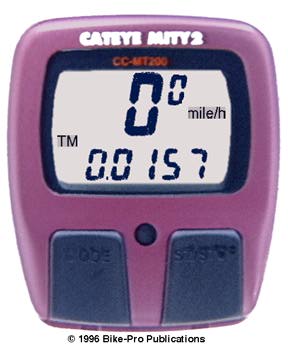
The Cateye Mity 2 has features similar to the Vectra, however the Mity 2 has an automatic start/stop function that the Vectra doesn't, all packed into a noticeably smaller and lighter case than the Vectra. The upper and lower case pieces are ultrasonicallywelded together making the case weather tight. The Mity 2 has a two line Liquid Crystal Display, the upper line, which displays only your current speed, has characters 9mm tall while the lower line, which displays time and distance functions, has characters are 4.5mm tall. The smaller characters on the display is just one of the ways Cateye was able shrink the size of this computer. All speed functions on the Mity 2 can be expressed in MPH or KPH, we will use MPH. The Mity 2 continuously displays current speed between 3 and 65 MPH, to the nearest 1/10 MPH. The current speed is only upper line display, and is displayed continuously.
The Mity 2 has an odometer as a lower line function, the total distance on the unit is accumulated and displayed to the 1/10th mile, up to 10,000 miles, when it resets automatically. There is a lower line display trip meter, that records up to 1000 miles, accurate to two decimal places, then resets, automatically. Also included is a stopwatch, on the lower line display, which shows the elapsed time between the starting point and the current point, up to 10 hours, displayed in whole seconds. You couldn't have a stop watch without a clock function, the Mity 2 has a 12 hour clock, a lower line function. The clock and tripmeter integrate to give the rider, Average speed over the course of the trip, and the Maximum speed achieved at any time during the trip meter operation. Both of these are displayed with 1/10th MPH accuracy.
The Mity 2 has an auto Start/Stop which permits the trip meter, average speed and stopwatch functions to start and stop automatically with any wheel movement. To increase the useful battery life the Mity 2 has a power saving function, which after 60 minutes of in-operation blanks the display to the 12 hour clock only. To release the unit from this power saving mode requires that one of it's two buttons be pressed. The Mity 2 uses a 27" long wire to a front-mounted, single magnet, wheel sensor, with two mounting brackets that fit up to a 1" diameter fork blade. The Mity 2's instruction manual is printed English, French, Italian, and Japanese. The Mity 2 uses one CR 1620 or a CR 1616, 3 volt Lithium battery with an average three year life. The Mity 2 can be quick programmed for up to 28" diameter wheels, and has a quick release handlebar mounting bracket, so the computer head may be taken with you to prevent theft. It comes complete with all mounting hardware, and has a weight on the bike of 43 grams.
The Mity 2 is available in a Black case only, from Japan. $ Price in Catalog
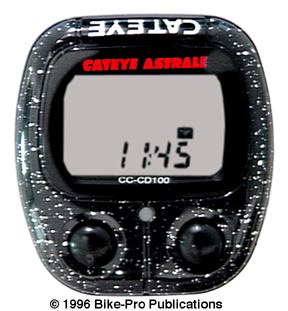
The Astrale small case, button placement and LCD display are based on the positions and types used on the Mity 2, and necessarily, the SpeedZone. The Astrale however has cadence. Like the two other mentioned models, the upper and lower case pieces are ultrasonically welded together making the case weather tight. The Astrale has the same two line Liquid Crystal Display. The upper line, with 9mm tall characters displays your current speed, when the cadence function is in use, the current speed can be shifted to the lower line of the display, while your cadence is displayed at the same time on the upper line, giving you two fairly valuable functions simultaneously. The lower line, displays all the remaining time and distance functions, and can display the cadence, in characters that are 4.5mm tall.
All speed functions on the Astrale can be expressed in MPH or KPH, we will describe its use in MPH. The Astrale continuously displays current speed between 0 and 65 MPH, to the nearest 1/10 MPH. The current speed is fundamentally an upper line display, but with the cadence in use, pressing the stop/start button reverses their positions between the upper and lower lines. The cadence, when displayed in the upper line, has a range of 0 to 200 RPM, in the lower display its range is 0 to 300 RPM (you might want to test the speed of some other device, since we know cyclists are incapable of 300 RPM).
The Astrale's odometer is a lower line function, the total distance on the unit is accumulated, and displayed, to the 1/10th mile, up to 100,000 miles, when it resets automatically. There is a lower line display trip meter, that records single trip distance up to 1000 miles, accurate to two decimal places, then resets, automatically. Trip distance is also reset at the beggining of each ride by pressing both buttons and then the stop/start button again.
The Astrale also has a automatic stop/start function, that starts the computer when there is wheel movement. A stopwatch, on the lower line display, shows the elapsed time between the start of the ride and the current moment, up to 10 hours, displayed in whole seconds.
The Astrale, as a part of its time keeping/stop watch functionality, has a 24 hour clock, as a lower line function, displaying the hour and minute in military time. The clock and tripmeter integrate to give the rider, Average speed over the course of the trip, and the Maximum speed achieved at any time during the trip meter operation. Both of these are displayed with 1/10th MPH accuracy. To increase the useful battery life, the Astrale, like the Mity 2, has a power saving function, which after 60 minutes of in-operation shuts the display down to just the 24 hour clock and a tiny clock emblem.
To release the unit from this power saving mode requires that one of it's two buttons be pressed, or with the auto stop/start function enabled wheel movement. The Astrale wire harness has two wire leads, to the rear wheel for time and distance functions, the other going to the cranks for cadence counting. It uses 45" and 53" long wires to the rear-mounted, single magnet, sensors. The wheel magnet bolts to the rear spokes, while the crank magnet is zip-tied in place.
There are three mounting brackets, (3/4", 1", 1 1/8") to fasten the rear wheel sensor to the chain stay that fit up to a 1 1/8" diameter stay. The computer head releases from the handlebar mount by pressing a lever and sliding the unit from the bracket and its three contact points. The Astrale instruction manual is printed English, French, German, Dutch, Italian, and Japanese. The Astrale uses one CR 2032 3 volt Lithium battery with an average three year life. It comes complete with all mounting hardware, and has an on the bike weight, with cadence installation of 62 grams. The Astrale has a marble-like finish in Black, or Lavender. Made in Japan. $ Price in Catalog
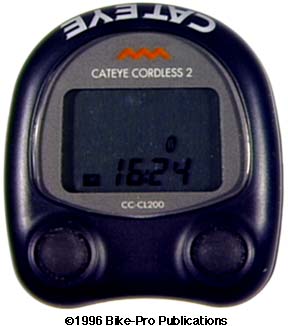
The cordless uses wheel movement to judge the bicycle rate of speed and transmits it without wires from the fork area transmitter to the handlebar mounted receiving computer. This computer is a cordless version of the 7 function Mity 2 and uses the same two line display found on the Mity and Astrale. It has an auto start/stop function and will shut the system down after an hour of no activity. The cordless has a dual tire size memory which allows it to be used with two different types of bikes easily, that have two different wheel diameters, if you have a second bike mounting kit. The Cateye cordless is the most reliable of its type. It has a total weight on the bike of 65 1/2 grams. Black only. $ Price in Catalog
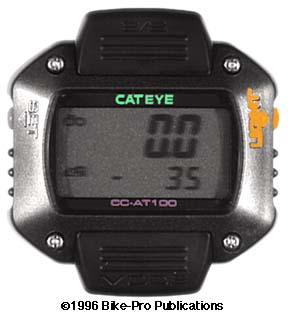
How many feet did you climb today? The AT100 will tell you from 1050 to 17,400 feet above sea level. The At-100 will tell you altitude gain or loss per session and total gain/loss since installation. It has a 2 line display. The upper line is 8.5mm tall, the lower is 5mm tall. The upper line is used to tell Current Speed, Altitude gain or loss, or its Current temperature. The lower line displays Current Altitude, Average Speed, Stopwatch (ride time per session), Trip Distance, Total Distance (odometer), Maximum Speed that session, or a 12 hour Clock. The altimeter is reset each session to calibrate for the current barometric pressure. It has auto start/stop and a sleep mode that shuts down the system after an hour of disuse. The screen is back-lit so you can light the display in dark surroundings. The complete on bike weight of the system is 70 grams. Made in Japan, Black $ Price in Catalog
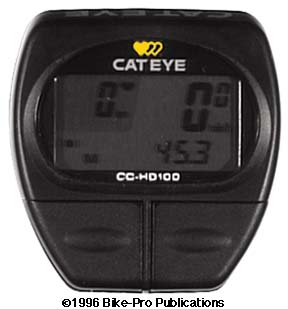
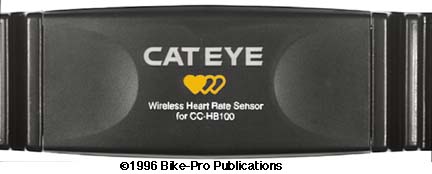
The HB-100 is a programmable heart-rate monitor and cyclometer all built into a single system. It uses a two line display, with the primary line 8.5mm high and the lower line 4mm high. A secondary window in the upper left of the display presents your current or average (selectable) heart rate in beats per minute 6mm high. Current speed, up-dated each second is on the upper line. Maximum speed, Average speed, Total Distance, Trip distance, Stopwatch, and 12 hour clock are on the lower line. It also calorie consumption, as a function of heart rate monitor x time x average speed calculation displayed on the lower line. It has auto start/stop for the bike functions and a sleep mode which shuts the system down after 1 hour of disuse. The on the bike weight of the computer, bracket and wire harness is 62 grams. The Heart Monitor uses a wireless transmitter worn on the chest. The transmitter and strap weigh 82 1/2 grams. Made in Japan. Black only $ Price in Catalog
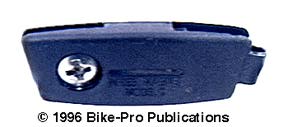
Cateye wheel sensor are installed, and held in place with a small Phillips head machine bolt that threads into a rear mounted brass nut. Occasionally, over time the bolt may back off and you may not realize and tighten it, in time before it drops off and is lost, making the computer useless. For those circumstances, we sell the Cateye original replacement wheel magnet. This is the magnet used for the magnet used Vectra, Mity 2, Micro and ATC computers. The 166-5120 wheel magnet weighs 4 grams. $ Price in Catalog