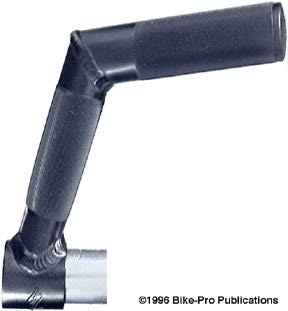
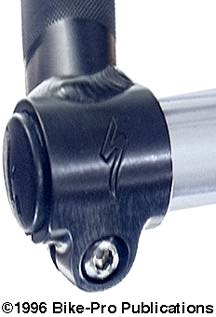
Specialized makes a cinch type aluminum alloy L-bend bar extension. Much of the original design work was done in conjunction with Control Tech, which explains their resemblance to the Control Team Issue set. They are made in the United States of heat treated 6061 aircraft aluminum. The cinch assembly is made from extruded aluminum, elliptically shaped using the wide area of the ellipse to fit around the handlebar. The extrusion is turned on a lathe to trim and round the area of the cinch bolt reducing weight and adding aesthetic appearance. The lathe cuts the piece to 1 3/32 long which will become width on the handlebar. The cinch assembly is bored front and back for the cinch bolt, recessing its head. A stainless steel nutsert is pressed into the rear of the cinch assembly to receive the bolt. This prevents the steel bolt from seating into merely aluminum threads, so it's less likely to strip out with too much pressure. The grip tube section is made of two 3 5/16" long pieces of 6061 aircraft aluminum with a 1.8mm wall thickness. The primary grip tube is miter cut to contour the shape of the cinch piece, giving a large surface joining area. It's crimped slightly at the point where it's TIG welded to the cinch assembly making it taller than it is wide. This crimping feature is known as a "low profile" design, please read the overview for a greater understanding. The primary grip tube is welded to the cinch assembly at about a 12 degree from handlebar perpendicular angle inward toward the front tire. The primary grip tube has 1 13/16" of knurling on it's surface starting 5/8" from the cinch assembly. The primary and secondary grip tubes are miter cut at an angle so they join smoothly together. The secondary grip section has a knurled surface for the last 2 1/4 inches. It's TIG welded to the primary section so that it tips upward at a 14 degree angle as it bends inward toward the front tire by about 60 added degrees from the original primary to cinch weld. The cinch bolt is made of steel, threaded to 6mm by 1mm pitch, 14mm long, with a 4mm hex head fitting. The bolt has a "mushroom" head, meaning it's round rather than the cylindrical "cap screw" type used by most other makers. The bolt weighs 3.5 grams. Dirt Rodz come four Black plastic press-in end cars for grip tube and handlebar end openings, the grip tube plugs are installed. Dirt Rodz are available in anodized Black, Lavender, or Silver. A pair with steel cinch bolts and 4 end plugs weigh 152 grams. Price in Catalog
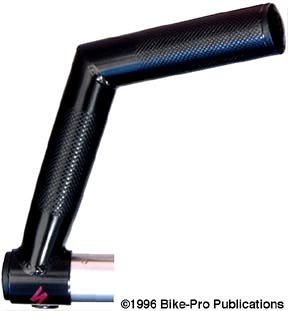
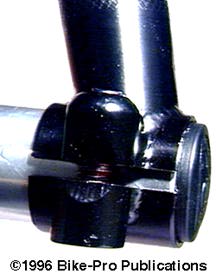
Specialized has the Dirt Rodz II made for them, in Taiwan. They are a set of Cro-moly bar ends that strongly resembles the original, US made alloy Dirt Rodz. The cinch assembly is made of 1mm wall thickness Cro-moly tubing cut to 1 1/16" length which will become width when on the handlebar. The grip sections are made using two pieces of 1mm wall thickness. The primary grip section has its width reduced from 22mm in outer width to just 19.5mm on the end which is welded to the cinch tube, making this a "low profile" bar extension set. The reduced end is miter cut to contour the cinch tube, while the opposing end is given an angled, square miter cut so the primary and secondary tubes when joined will create between the necessary angle for the secondary grip section. The pieces are TIG welded together forming the 3 1/2" long primary grip section. The primary grip section is welded to introduce 15 degrees of angle inward toward the front wheel. The tube for the secondary grip section is angle cut to form a corner between the grip sections and straight cut at the end plug side. With the secondary tube welded in place a 3 3/8" long secondary grip section is made. The secondary grip section is welded to introduce an added 65 degrees of inward angle toward the front wheel, while it also rises upward at a 20 degree angle. The cinch fitting is machined from Cro-moly steel rod, the length of the piece of rod used however seems to vary. The set we received had one that was 27mm long, while the other was 24mm long. The rod is drilled through to make the recess for the cinch bolt head, and the passageway to be tapped for the bolt threads. Once the threads are tapped the cinch fitting is TIG welded in place on the lower side of the cinch assembly, and the fitting and tube are cut through to create the cinch clamp mechanism. The cinch bolt is made of steel, threaded to 6mm by 1mm pitch, 20mm long, with a 6mm hex head fitting. Each bolt weighs 6 grams. The Dirt Rodz II are "wet" painted in Black. Four Black plastic, press-in end plugs are included, two are installed in the grip tubing ends, the others are for the open handlebar ends. These plugs are the same type used by Ritchey and Onza with logo on its face in this case made as the "S" logo. The weight of a pair of Dirt Rodz II, with the steel bolts and the four plugs is 252 grams. Price in Catalog
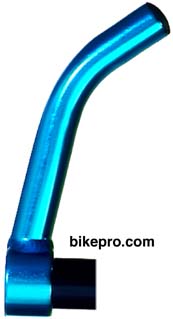
This is a short length ski-bend model that uses an elliptical shaped aluminum grip tube welded to an aluminum clamp section. Made in Taiwan, these are sold under a few brand names. They come with end plugs for the bar ends and the handlebars. The cinch bolt is steel. These are anodized in Blue, Black, Red or Silver. Price in Catalog