

|
Product Overviews |
Archive Reviews |
Comparison Tables |
Tables |
Metals Guide |
Frank's Picks |
News & Gossip
| |
| Additional Knowledgable Resources | |
|
Reach BikePro on a 24 hour basis at 803-280-1537 Terry Dunbar is on duty as the technical expert, who also speaks Spanish as well as English and has quantities on hand information. Call her now for any questions about Bike Pro you may have. |
![]() |
|
Bottom Brackets Brake Systems
Computers Cranks and Chainrings Forks Frames & Framesets Freewheels and Cassettes Front Derailleurs Grips Handlebars Handlebar Extensions Headsets Helmets Hubs and Skewers Lubricants Metal Guide - Bicycle Metallurgy Mirrors Pedals and Toe Clips Pumps and Inflation Systems Racks Rear Derailleurs Rims & Rimstrips Saddles Seatposts and Binder Bolts SRP Replacement Titanium & Aluminum parts - Master Index Stems Tires Tubes Shoes Spokes (Tables Only) Tools - Bicycle Repair Tools Yakima Fit List -to fit all cars Notes Home |
Scott Bar Ends
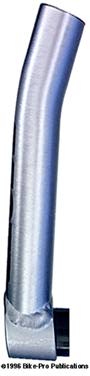
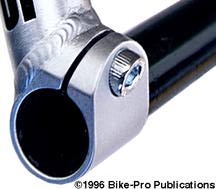
SCOTT ATNZ-LF SHORT BAR ENDSScott USA, well known for handlebars also makes handlebar end sets. The ATNZ-LF uses an aluminum extrusion as the basis of its cinch assembly. The extrusion is cut to 29/32 of an inch in length, which becomes "width" on the handlebar. This is just slightly wider than the 7/8 inch outer diameter aluminum grip tubing section. The tubing section is miter cut to contour the clamp extrusion, so there is continuous contact at the joining surfaces. The Tubing is TIG welded to the clamp piece so it tucks at a 9 degree angle, from handlebar perpendicular, toward the front tire. The tube itself is 5 1/4 inches long, with an inward bend occurring 3 3/4 inches from the clamp. This bend adds 15 more degrees of inward angle for the last 1 1/2 inches of grip tube. After welding, the lower side of the clamp is drilled through, producing a slight recess for the cinch bolt head, and the bolt hole is tapped with threads for the cinch bolt. The cinch assembly iscut sawn through, to create the clamping mechanism. The cinch bolt is made of nickel plated steel, with 6mm x 1mm thread pitch that is 16mm long and weighs 5.5 grams. ATNZ ends also come with 4 Rodon press-in Black plastic end plugs for the tubing and handlebar ends. The Scott ATNZ Short ends come in anodized Black or Lavender, the weight of the pair with steel bolts, and the 4 end plugs is 129.5 grams. Made in USA. Price in Catalog
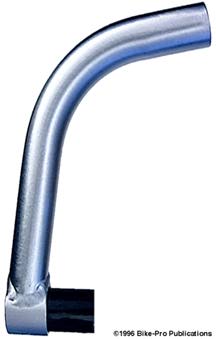
SCOTT ATNZ-LF LONG BAR ENDSScott also makes an L-bend version of their ATNZ-LF bar ends. The grip tubing is longer and bent a little differently, but the cinch assembly and the four end plugs are identical. The grip tubing section is 8 inches long, and welded to the cinch assembly at the same 9 degree angle. The inward bend to the secondary grip section begins 3 1/2" from the clamp. The bend adds 70 1/2 degrees to the inward angle for the remaining 4 1/2 inches, and gives a slight, just 5 degree upward bend to the secondary grip tube. The ATNZ Long is made in an anodized Black or Lavender color, with steel bolts and end plugs the set weighs 139.5 grams. Made in USA. Price in Catalog SCOTT ATNZ SHORT BAR ENDScott makes a less expensive version of the LF Short model that has the same bends and tubing diameters but has the grip tube and clamp section bonded together rather than welded. Made in a brushed Silver finish. Price in Catalog SCOTT ATNZ LONG BAR ENDSThe ATNZ Long is the bonded version of the Long ATNZ-LF. It Uses the same tubing and bends but has a separate clamp and grip tube which are bonded together lowering production costs. The ATNZ has a brushed Silver color. Price in Catalog |

|
In-depth Information About Metals Aluminum Aluminum is extracted electrolytically from bauxite ore. It is made by the electrolysis of aluminum oxide which is found in larger concentrations within bauxite ore. Bauxite is a mixture of the hydroxides of aluminum, together with other impurities such as oxides of iron, titanium, and silicon. Bauxite is produced by the weathering and change of aluminum silicate rocks usually found in tropical and semitropical regions where climate has produced an accelerated weathering process. Bauxite is not a rare ore and is widely available in the US, the Caribbean, and Europe. Approximately 4 pounds of read the full article... Beryllium Beryllium is a specialty metal that is steel-grey metal in color, with an extremely low density, making it very light weight. At 1.85 grams to the cubic centimeter, its density compares to that of magnesium. It is also a high strength metal, making it possible to design light weight, thin membered parts with ahigh stiffness. A column made of beryllium to support a load placed directly downward on top of it, will have a greater load carrying capacity, and be lower in weight than any other metal of equal size. Until the 1950's beryllium was used read the full article... Titanium The element titanium was discovered in 1763 by an English cleric, William Gregor who was an amateur chemist with an inquiring mind. It was in the black sands of Cornwall that he discovered the new element that had up to that time, attracted little scientific interest. A few years later, an Austrian, Klaproth, extracted the same element from an ore widely known as "rutile", which is a mineral consisting of titanium dioxide (one titanium atom, two oxygen atoms), that is a reddish-brown substance with a slight metallic luster. While rutile is the highest grade read the full article... Metallurgic Hardness Testing There are three types of tests used with accuracy by the metals industry,they are the Brinell hardness test, the Rockwell hardness test, and the Vickers hardness test. Hardness is the property of a metal which gives it the ability to resist being permanently deformed (bent, broken, or have its shape changed), when a load is applied. The greater the hardness of the metal, the greater resistance it has to deformation. Since the definitions of metallurgic ultimate strength and hardness are rather similar, it can generally be assumed read the full article... |
