Answer Bar Ends
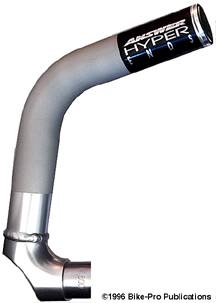
ANSWER HYPERENDS XC
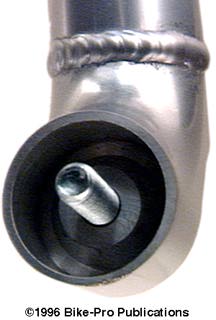
The Answer bar ends are easily among the best conceived and executed of the bar ends we've written about. If you've already read any part of this book you know how sparingly praise is awarded. Answer is now the only bar end maker using an internal wedge system to hold the bar end to the handlebar. Part of the reason why is the Answer wedge aluminum system weighs so much less than the previous steel systems. Another reason is that Answer cleverly designed their system to expand and grip the interior of the handlebar within an outer shell that surrounds the outside of the handlebar to enclose what ever expansion it undergoes. In this way even the thinnest of handlebar tubing walls are supported both internally and externally from the expansive nut of the bar end. The bar end has two major structural pieces, the wedge to grip assembly and the grip tubing.
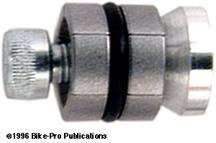
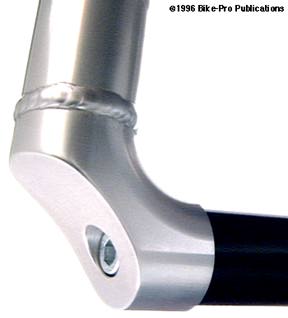
The wedge to grip assembly is machined from 6061-T6 aluminum alloy. It's function is to house the internally expanding wedge at one end and enlarge the diameter to accommodate, and set the angle for the grip tubing to be TIG welded to it. The interior of the handlebar end has a machine tapered aluminum cone that presses into the handlebar to center and hold it, while six inclined wedges are expanded by the tightening of a bolt that draws up a machined aluminum wedge. The six inclined wedges each equally cover all 360 degrees of the interior of the handlebar. While the handlebar side of the wedge to grip assembly accommodates the 22.2mm outer diameter of the handlebars, the grip tubing side has a 25.4mm or 1" diameter matching that of the grip tubing. Answer alone is the only maker using a larger 1" diameter grip tubing, which is closer to the dimension most hands require, its draw back is that grips fit a bit tightly if at all on these bar ends. The grip tubing is made of 6061-T6 alloy with a 1mm wall thickness. The XC model of the Hyperends has a grip tube with an overall length of 8 inches. The primary grip section is 4 inches long, and the secondary section is also 4 inches long. Five inches of the grip tubing starting and inch from the wedge to grip assembly, is lightly sand blasted to texture the surface. The wedge to grip assembly introduces 10 degrees of angle inward toward the front wheel to the grip tube, when the two pieces are TIG welded together. The bend making the secondary grip section adds another 62 degrees of additional inward angle, while rising at a 7 degree angle. An artfully machined from aluminum rod end cap plugs the end of the grip tube. It's machined so that it tightly fits when just pressed-in. The bolt which draws up the wedge is made of steel, 6mm by 1mm thread pitch, 20mm in length, with a 5mm hex head and 6 gram weight. A Titanium replacement for this steel bolt is available at the end of this section. The Answer XC Hyperends are available with a Blue, Black, or Silver (clear) with the alloy end plugs left in the Silver aluminum color. The weight of a set of XC Hyperends, with steel bolts, is 162.5 grams. Price in Catalog
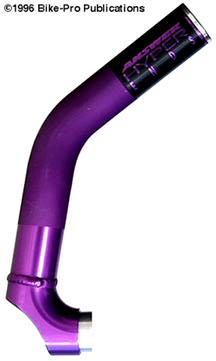
ANSWER HYPERENDS HILL BEND
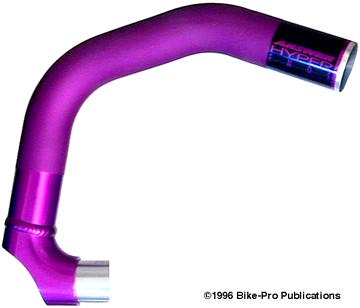
The Hyperend Hill Bends are the same as the XC with changes in the grip tubings length and angles. The grip tube has a 7 inch overall length, with 4 inches given a lightly sand blasted finish beginning an inch from the wedge to grip assembly. The wedge to grip assembly introduces 10 degrees of angle inward toward the front wheel to the grip tube, when the two pieces are TIG welded together. The bend making the secondary grip section adds another 45 degrees of additional inward angle, while rising at a 5 degree angle. The same wedge assembly and end plugs are used on the Hill Bend set. The Answer Hill Bend Hyperends are available with a Blue, Black, Silver (clear) or Purple anodized finish, with the alloy end plugs left in the Silver aluminum color. The weight of a set of Hill Bend Hyperends, with steel bolts, is 155.5 grams. Price in Catalog
ANSWER HYPERENDS GUARDIAN
The Hyperends Guardian is the final variation of the Answer bar ends. The Guardians use the same mounting system as the previous models but have a longer "Tri" bend styling with a short tertialry grip section. Using 1 inch diameter tubing that is TIG welded to the mount, the grip tube has an overall length of 9 5/8". The wedge assembly introduces a 10 degree bend inward toward the front wheel. The primary grip section is 3 1/4 inches long. The secondary bend adds an additional 64 inward degrees and 7 degrees of upward bend to the 3 1/4" secondary grip section. The final tertiary grip section is 3 1/8" long, bent at an added 34 degrees while still sloping upward at 7 degrees. The grip tubing is given a light sand blasting to provide extra adhesion for grips or hands on the middle 7 1/4 inches beginning 1 inch from the joining of the wedge assembly. The same wedge assembly and end plugs used are the same found on the Hill Bend and XC set. The Answer Guardian Hyperends are available with a Blue, Black, Silver (clear) or Lavender anodized finish, with the alloy end plugs left in the Silver aluminum color. The weight of a set of Tri- Bend Guardians, with steel bolts, is 175.5 grams. These have been discontinued for 1997.