Self Sealing Tubes
SELF HEALING BICYCLE INNER TUBES
Self healing tubes have become the latest weapon in the battle against inner tube punctures and flat tires. The self healing tube borrows a principle that has been used in the automotive market for several years. It involves the use of a liquid sealant with rubber adhesive that has a fiber material suspended in it . When the liquid sealant is in the tube and the tube is correctly inflated, the wheel rolls over an object that punctures the tube and the sealant washes over the interior hole where, under pressure, the fiber material begins to make a matrix, clogging the hole and covers the inside of it. As the hole fills, the sealant's rubber adhesive, now exposed to external air begins to set, hardening the "patch" that is being built inside the tube. The wheel's revolutions continue add more sealant, building the patch until air leakage stops. In practice, self healing tubes have a difficult time sealing a hole larger than 1/8" (6.4mm) in diameter, or multiple punctures occurring at the same time, largely because the internal air pressure drops too quickly for the sealant under rotation to be forced into the holes quickly enough before total loss of pressure. Self healing tubes aren't directly designed to seal a sidewall puncture because the rotational velocity of the wheel forces the sealant into the rear of the tread area. Slow leak sidewall punctures can be sealed if the wheel is removed from the bike and "rocked" horizontally, forcing the sealant to wash over the sidewall puncture and seal it. Because the sealant runs to the bottom of a wheel at rest even self healing tubes will lose their air pressure over periods of disuse, because again rubber is porous to air, and all the internal surface area of the tube not covered by the liquid sealant will slowly permit air molecules to pass through it. The solution isn't replacing the tube, merely inflate it and the wheel with sealant is ready for use again. Self healing tubes, depending on their diameter, don't correct just one puncture, there is enough interior sealant in self healing tubes to fill and patch several to many holes as they develop.
ACCESS MARKETING - the company
In all, rather little is known about Access Marketing, which is based in Shell Beach, California. There is no known street address listed in trade directories and they use a postal box for mailed communication. Steve is said to handle matters related to both sales and service. What we find most interesting, is that with just three well known brands of self-healing tubes in the US market, Access Marketing distributes 2 of them, leaving the Specialized Airlockª as the third. The Self Sealing Tube was the first of their two tube products. Access Marketing then introduced "Slime", a liquid sealant ,that can be installed in a standard replacement tube after or before the tube has been installed. Slime, as an aftermarket product, was successful enough that the Slime Tube brand of self healing tube was introduced. Both the Self Sealing Tube and Slime Tubes use similar butyl tubes made in the orient. The tubes have an amount of sealant installed. The sealant put in the Self Sealing Tube brand has a Black color, while the sealant put in the Slime Tube brand of tubes has the characteristic Green Slime color. It's not known if there is any formula difference in the sealant, other than the pigment used to make it Black or Green.
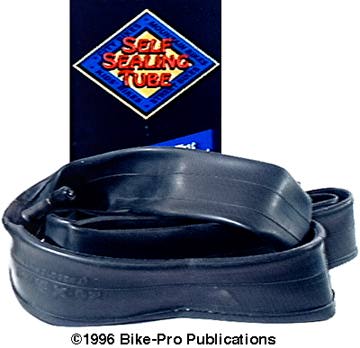
SELF SEALING BICYCLE INNER TUBE
This is the first of Access Marketing's "self healing" tubes. The Self Sealing Tube, using butyl rubber tubes from Asian factories, has a Black colored sealant inside which seeps out to fill and patch holes as the wheel revolves under pressure. We sell the Self Sealing Tube in the six sizes listed below with their weights including valve cap.
24 x 1.5 - 1.9" - Schraeder $ Price in Catalog
27 x 1 1/8 - 1 1/4" - Schra 270 g. $ Price in Catalog
27 x 1 1/8 - 1 1/4" - Presta $ Price in Catalog
26 x 1.50 - 1.75" - Schraeder 310 g. $ Price in Catalog
26 x 1.50 - 1.75" - Presta $ Price in Catalog
26 x 1.90 - 2.125" - Schra 346.5 g. $ Price in Catalog
26 x 1.90 - 2.125" - Presta 332.5 g. $ Price in Catalog
Slime Bicycle Inner Tube