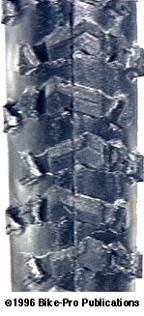
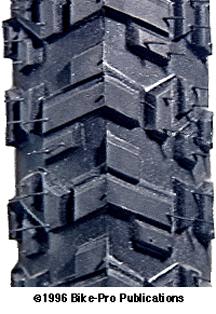
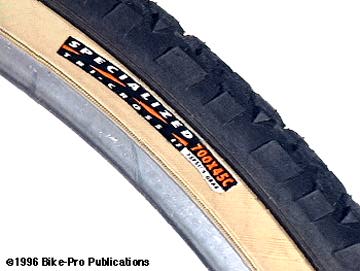
The Tri-Cross was discontinued in the 1994 model year. This review gives you a basis to evaluate the Transition and the Tri-Sport. There were four models of Tri-Cross II tires, one made in Taiwan, three in Japan. From the sizes it's made in, you'll see this tire is intended for Cyclo- Cross or Hybrid bike use. The Taiwan model, sized 700 x 45c is believed to be made by Cheng Shin because of mold markings on the chafing strip. The Japanese models are sized 700 x 28c, 700 x 35c and 700 x 41c. All four models have Skin sidewalls and steel wire beads. The Tri-Cross uses two tread patterns depending on tire width, the 28 and 35c widths have one, the 41 and 45c widths the other. Both Tread patterns were designed by Wilderness Trails Bikes. The narrow tread pattern is less complex, it uses two rows of four tread blocks for each pattern repetition. At the center is a V-shaped block which looks like a "Ã" mark. There are two triangular blocks on the hooked side of the "check" or "tick" mark block, and a single triangle block on the non-hooked side. The second row is a mirror of the first, reversing the block shape and position. The Larger Tri-Cross II tires use a highly complex design based again around the center block which is shaped like a "check" or "tick" mark (Ã). None of the Tri-Cross tires are thick enough for the tread rubber to be accurately measured for hardness. The 28c Tri-Cross II had a total thickness at the tread center, including three layers of casing fabric of 5mm, while the 35c is 5.4mm thick, the 41c is 5.2mm thick, and the 45c has a 5.8mm thickness.
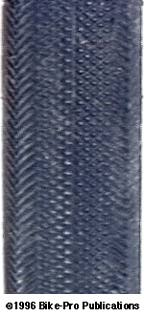
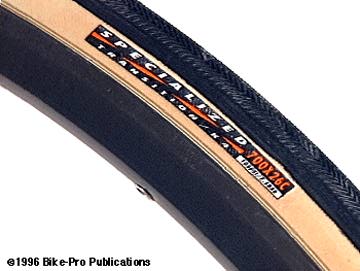
The Transition family of tires spans both the 700c and 27" diameters using a steel bead with a Skin sidewall. Made in 9 models, the Transition tire line has 4 models without and 5 models with a Kevlar fabric belt imbedded below the tread stock. The lower Kevlar belt assists in prevention of tube puncture and casing fabric cuts through the tread portion of the tire. The sidewall casing in all models is not Kevlar protected. The Transition uses finely raised rubber "knurls" in the center portion of the tread with a raised herringbone pattern on the outlying sides. The herringbone pattern comes in ground contact while cornering. The Transition tire tread stocks aren't thick to measure their rubber hardness. Remember, the total tread thickness at center may give you an idea of tread depth, but it includes three layers of rubberized casing fabric. In the 1994 model year, Specialized introduced the Armadilloª tires which use a DuPont made fabric as the casing material. This fabric is, from a manufacturing point of view, an improvement over the traditional Kevlar belt because the Kevlar belt as a derivative of a Teflonª PTFE (poly tetra-flouro-ethylene) was hard for rubber to grip when molded and vulcanized. The Armadilloª fabric is said to have most of Kevlar's resistance, (particularly in bike applications) and because it's used as the casing fabric, there is three layers without adding undue thickness to the tread area of the tire producing a more lively feel over the previous Kevlar belted "K4" type Transition tires. Now the bad news, we haven't received, in inventory, a full complement of the Armadilloª tires so we have left the tables bare of weights. The next edition of this Buyers Guide will be more complete on this. Please consult the 27" and 700c tire tables for more information.
Transition 700 x 20c $ Price in Catalog
Transition 700 x 23c $ Price in Catalog
Transition 700 x 20c - Armadillo $ Price in Catalog
Transition 700 x 23c - Armadillo $ Price in Catalog
Transition 700 x 26c - Armadillo $ Price in Catalog
Transition 27 x 1 1/8" $ Price in Catalog
Transition 27 x 1 1/4" $ Price in Catalog
Transition 27 x 1 1/8" - Armadillo $ Price in Catalog
Transition 27 x 1 1/4" - Armadillo $ Price in Catalog
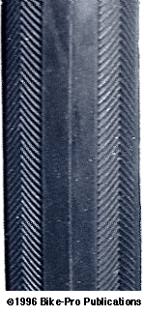
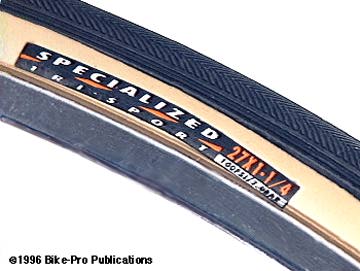
The Tri-Sport presents a low cost alternative in tire replacement. It's made in just three sizes which fit many of the recreational bikes built in the last two decades. Made in Taiwan the three sizes are 27 x 1 1/8", 27 x 1 1/4" or 26 x 1 3/8". All three models have a steel bead and a "gum" colored Skin sidewall. The tread pattern on the Tri-Sport is simple enough, it has a smooth raised center ridge which is 9mm wide on the 27 x 1/8" model and 10.5mm on the 27 x 1/14" and the 26 x 1 3/8" models. On both sides of the raised center ridge is a raised herringbone tread which is 9mm wide on the 27 x 1 1/8" and 10.5mm on the 27 x 1/14" and the 26 x 1 3/8" models. The tread rubber is too thin to measure its hardness. Please use the table for all the specifics, and in the case of the 26" model, we made the table entry for convenience in our 27" tire table.
Tri-Sport 27 x 1/8" $ Price in Catalog
Tri-Sport 27 x 1/4" $ Price in Catalog
Tri-Sport 26 x 1 3/8" $ Price in Catalog