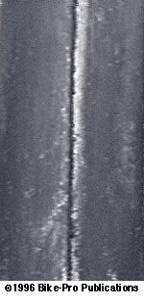
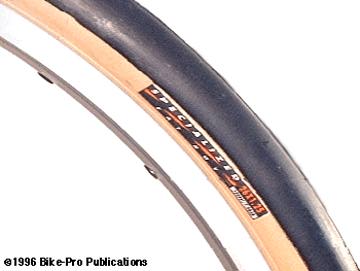
The Fatboy is the easiest of the Specialized ATB tires to write about because it has a smooth tread surface and no tread blocks. The Fatboy, at the center of the tread, has a total thickness of 3.5mm, which includes the three layers of bias ply casing fabric. The Fatboy tire tread is not thick enough to accurately measure the tread rubber hardness. This is made in a Skin side casing only.
Fatboy 26 x 1.25" $ Price in Catalog
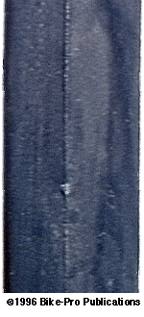
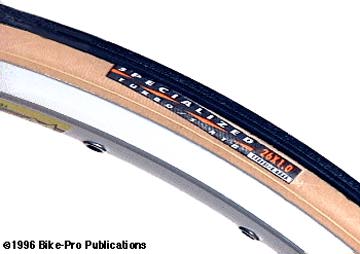
The Turbo/S ATB is a folding Kevlar beaded 26 x 1.0" tire for pavement riding purposes. Made in Japan, the tread is not quite smooth. The center 8mm tread width has a slightly raised knurl pattern, while 5mm of the tread on each side has a slightly raised chevron pattern. The Turbo/S ATB has a Skin sidewall with a total tread thickness at the center of just 3mm which includes three layers of casing fabric. The Turbo/S ATB tread isn't thick enough to accurately measure its tread rubber hardness.
Turbo/S ATB 26 x 1.0" $ Price in Catalog
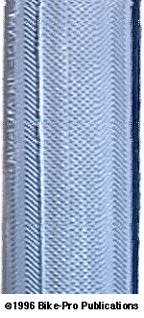
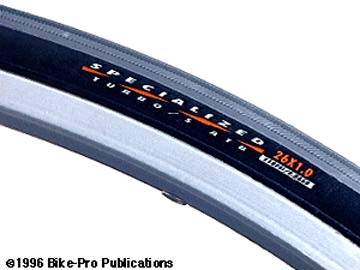
The Turbo/S Wheelchair is a folding Kevlar beaded 26 x 1.0" tire that can be used on 26" wheelchair or 26" mountain bike rim. To further qualify the wheelchair user, this tire is made for the 559mm bead seat diameter rims though in the bike industry it's referred to as a 26" rim. It's made in Japan, and has a Black sidewall with Grey tread. The Grey tread, is not advertised as the softer Umma Gumma type, it's Grey so that it will be non-marking, meaning it won't leave Black marks when it's used as a high performance court tire. The Grey tread is applied and vulcanized to the tread stock so it extends farther down the sidewall on one side of the tire, though the area with the tread pattern is centered on the tire. The "hot patch" (the colored Specialized logo on the side of the tire) side of the tire has 9mm of exposed Black sidewall casing, while the side without the "hot patch" has just 6mm of exposed Black casing. The 8mm of tread at the tire center has a slightly raised knurl pattern, while 5mm of the tread on each side has a slightly raised chevron pattern. The tire is made using Black rubberized casing fabric so its Black sidewall is actually exposed Black casing fabric. The Turbo/S Black/Grey Wheelchair has a Black sidewall with a total tread thickness a the center of just 2.6mm, which includes three layers of casing fabric. The Turbo/S Black/Grey tread isn't thick enough to accurately measure its rubber hardness.
Turbo/S 26 x 1.0" - Kev/Black/Grey $ Price in Catalog
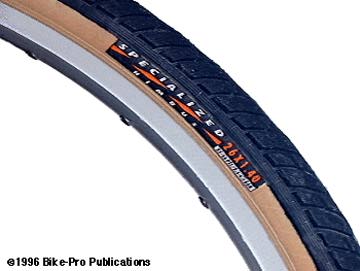
There are four Nimbus models, one each in 26" and 700c diameters. The 26 x 1.5" size is made in Japan. The 700c x 41c model is made in Taiwan and has s yellower sidewall because the rubber used for the casing fabric is more of the sort used on "gum" sidewall tires. The wider, 26" Japanese Nimbus has a Skin sidewall. The Nimbus tread pattern is directional, based on a forward pointing arrow-shaped, chevron design. The center of the tread is smooth with a sipe through the middle. On pavement it will have a more silent ride because there are no large tread blocks to "clomp" down the street, while the center sipe provides a channel for water to migrate through. At the sides of the tread are two unjoined parallelogram shaped blocks with a knurl finished surface. The total thickness of the narrow 26" Nimbus, at the tread center, is just less than 4mm thick which includes three layers of casing fabric, and isn't thick enough to accurately measure its tread rubber hardness. The 700 x 41c has a total thickness of 5mm. The wider 26" Nimbus measured to a 66/A hardness.
Nimbus 26 x 1.5" $ Price in Catalog
Nimbus 700 x 41c $ Price in Catalog
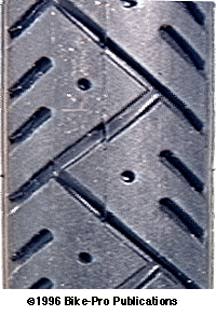
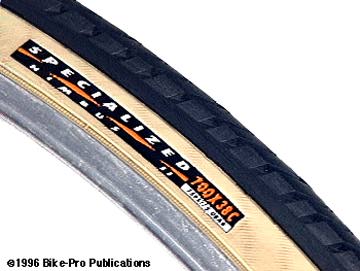
The 700 x 38c Nimbus III is made in Taiwan, by what is likely Cheng Shin from the mold markings near the chafing strip. It has a steel wire bead and a gum colored, Skin sidewall. The tread has a broad smooth area for pavement contact, based on interlocking rectangles which move off the tire at an angle. The rectangle is 20mm wide with long side being 27mm long. There are two 12mm long grooves from the tire edge inward which are 2.5mm wide, as well as 2mm wide grooves separating all the rectangles "blocks". The Nimbus II isn't thick enough to measure the tread rubber hardness accurately. Its total thickness at the centerline, including three layers of casing fabric is just 3.5mm.
Nimbus III 700 x 38c $ Price in Catalog