SPECIALIZED "/C" FAMILY SERIES ROAD TIRES
The "/C" family of tires all have in common a tread pattern designed by Wilderness Trail Bikes and that they are all made in Japan with a Kevlar folding bead for weight reduction. The "/C" tires are largely a "slick" tire, meaning they have largely a smooth rubber tread which on a perfect surface, would provide perfect contact. This largely smooth tread does however have some fine lines in the tread to act as sipes to deal with surface porosity and irregularities. This lined tread pattern is simple enough to describe. It's made of five rows with use just four standard "characters" found on computer keyboards. The four characters used are the "/" or "forward slash" as its known, (ascii 47, hex 2F), another is the "Ã" or "check mark" as its known in America, the "tick" mark as it's known in Europe. The remaining two characters are the "<" (ascii 60, hex 3C) and ">" (ascii 62, hex 3E) known as the "less than" and "greater than" character used in mathematical expressions. Now we will describe how these characters are used. Remember, the center of each of these tires is smooth with these characters centered left and right of the centerline. Line 1 has a "Ã", check mark on the left side and a "/", forward slash on the right side. Line 2, up from line one, has a "/", forward slash on the left side, and an upside down and backwards "Ã" check mark on the right side. Line 3 is made of a"<" and an ">" on both sides of the centerline. Line 4 has a reversed forward slash "\" also known as a "backward slash" on the left side, and a "Ã" check mark on the right side. The 5th line again moving up from the 4th line has a an upside down "Ã" check mark on the left side and a "\" backward slash on the right of the centerline. Notice that if the 5th line tread pattern were reversed it would be identical, which is why these are not directional tires. These "sipes" are, again, to produce tire adhesion on irregular surfaces, and channels for water to migrate out from under the tire. It's surprising from a design point of view that the needed shapes already existed as a seeming common part of a computer character set, or as one of our European customers remarked after this observation, "Wow, tread design from a word processing keyboard, is that rocket science or what?" Now we will tell you the specifics of each of the tires that use this tread pattern.
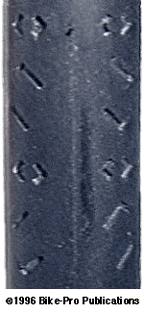
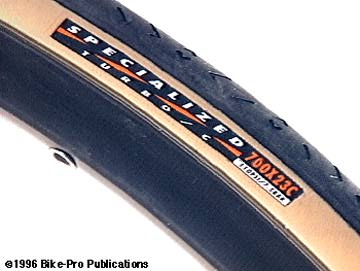
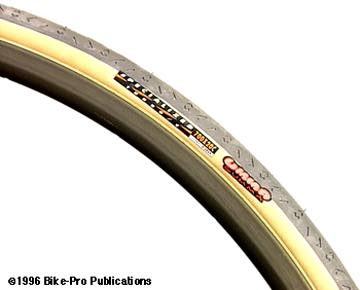
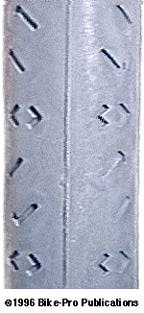
There are five models of the Turbo/C, all are 700c diameter tires in three sizes, 700 x 18c, 700 x 20c and 700 x 23c. As mentioned above, they are made in Japan and have Kevlar beads. The Turbo/C models all have Skin sidewalls, three use the standard hardness Black rubber tread, two of the sizes are also made using the softer Umma Gumma Grey rubber tread. All of them use the "/C" family tread pattern. The tread rubber hardness can't be measured because the tread is too thin for accurate measurement. However, you may use the 26" mountain tire tables to get an indication of the approximate variation between the Black and Grey tread rubber hardness. Please use the 700c table for specifics, notice it provides the total thickness of the tire at the centerline. Remember, that measurement includes three layers of casing fabric.
Turbo/C 700 x 18c - Skin/Black $ Price in Catalog
Turbo/C 700 x 20c - Skin/Black $ Price in Catalog
Turbo/C 700 x 23c - Skin/Black $ Price in Catalog
Turbo/C 700 x 20c - Skin/Grey $ Price in Catalog
Turbo/C 700 x 23c - Skin/Grey $ Price in Catalog
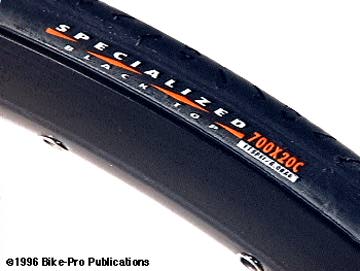
The Blacktop is a variation on the 700 x 20c Turbo/C. It appears to be the same tire with a different tread stock used before Vulcanization. The Blacktop's tread stock is wider to include a real Black sidewall for this tire. The casing fabric is made with tan colored rubberized casing fabric, the Black tread stock covers the casing bead to bead making a genuine Black sidewall. Sidewalls as explained in the overview, add rigidity to the tires structure, and add resistance to "snake bite", or tube pinch punctures from potholed roads or bad driveway approaches, as well as added protection against casing cuts. Any urban environment with a poorly maintained road system is a candidate for this tire. It uses the "/C" family tread pattern and is too thin to accurately measure its hardness. Please use the 700c tire table for specifics.
Turbo/C 700 x 20c - Black/Black $ Price in Catalog
The Turbo Infinity/C K4 is a variation on the Turbo/C 700 x 23c tire. It has a Kevlar bead and a Skin sidewall with an added upper layer of casing fabric which covers the standard three layers. This added layer also acts as a chafing strip. It adds support in the sidewall area, and increases the sidewall and casing's resistance to cuts. The "K4" in the name refers to an added Kevlar fabric belt placed below the tread. This Kevlar belt improves the tires resistance to punctures and cuts through its standard Black rubber tread. Again, this tire uses the "/C" tread pattern, please use the 700c tire table for more specifics.
Turbo Infinity/C K4 - 700 x 23c - Skin/Blk $ Price in Catalog
The Turbo/CR is the last of the "/C" type tires. The 700 x 20c tire uses a lightly rubberized cotton casing fabric to reduce its weight substantially, bringing its total weight down to just 207 grams. The cost for this weight reduction however, is likely to be a tire casing which wears rapidly. The Turbo/CR has a Kevlar bead. It is said to use a "low durometer" rubber for its tread compound, though it is Black in color not the Grey soft compound that Specialized has made famous. We found the tread too thin to accurately measure its hardness. Please use the 700c tire table for specifics.
Turbo/CR 700 x 20c - Skin/Black $ Price in Catalog