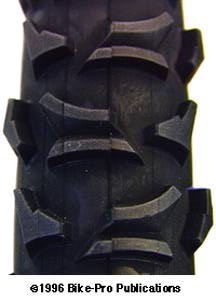
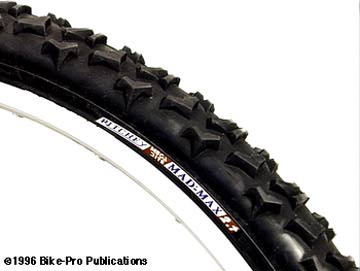
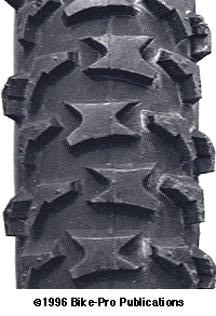
The Mad-Max is a directional tire with arrows on the sidewall indicating the proper forward direction. Made in Taiwan, by Cheng Shin Tire for Ritchey, the Mad-Max has wide areas left open with no tread blocks, referred to as an "Open tread" design. The Mad- Max has a tread pattern that repeats at 47mm intervals, based on just three blocks, placed in two rows, one row mirroring the other. The center block has a near flat top with a 21mm width. This block has a 12mm side at one end and 18mm side at the other. The bottom of the block is arched to smooth the transition from the heights of each side. Horizontally across the top of the block a deep sipe is cut, that is reminiscent of the Z-Max tread block. At each side of this center block is a small triangular with a flat surface. The side block is smaller on the 18mm side of the center block and has sidewall supports. The placement of the three blocks shifts them on the tire in the direction of the 18mm side of the center block. The next row in both directions reverses the order and mirrors the image with the block set shifting off center the other direction again following the 18mm side of the center block. The Mad-Max is made in wire bead only, having a Black tread with a Black tinted sidewall casing. The tread rubber tested to a 62/A hardness.
Mad-Max 26 x 2.1"- Steel/Black/Black $ Price in Catalog
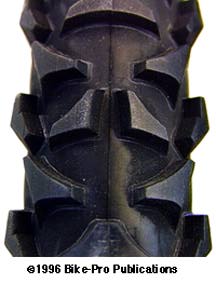
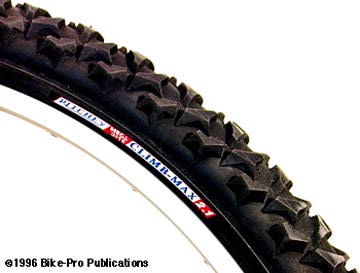
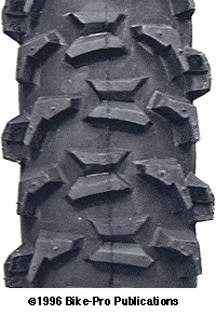
The Climb-Max is made in Taiwan for Ritchey by Cheng Shin Tire is a 26 x 2.10" wire bead tire. It is a directional tire with arrows on the sidewall indicating the proper rotation direction. The Climb-Max tread pattern repeats at 65mm intervals. The Climb- Max, like the Omega uses a large triangle with the base at the top side for its center tread block. This center block is 24.5mm wide by 12mm tall. At a 20mm distance is another of these same center triangles but it is cut down the middle with each half separated by about 5mm. Between each type of the center blocks is a pair of smaller triangular pointing diagonally outward. Separated by 10.5mm these provide ground traction between during the 20mm gaps in the canter. At the very outside, flanking the large center blocks is somewhat smaller triangular blocks, that have vertical support rising up from the sidewall. The Climb- Max has Black tread and a Black tinted sidewall casing. We found the tread had a durometer hardness of 64/A.
Climb-Max 26 x 2.1" - Steel/Black/Black $ Price in Catalog
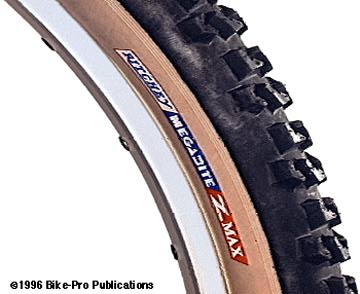
Ritchey has concentrated greatly on their Z-Max tire, in both resources and reputation. It's the most recent of their mountain tire introductions. The Z-Max has 13 models in the 26" diameter, (so far it hasn't been released as a 700c Hybrid tire). It's made in 4 widths, 26 x 1.7" , 26 x 1.9", 26 x 2.1" and 26 x 2.35". Each of these widths comes in either three or five models. The 26 x 1.7" size comes only with the Ritchey "WCS" soft rubber compound and only with a Kevlar bead. There are three models each of the 1.7" and the 1.9" tire, all are made in Japan. They are made having a Skin sidewall with Black WCS tread, a Black sidewall with Black WCS tread, and a Skin sidewall with Red WCS tread. The 2.1" and the 2.35" tire are each made in five models, some in Japan, some in Taiwan. They are made with a steel wire bead having a Skin sidewall and the standard, harder Black tread, also a steel bead with a Black sidewall and the standard Black tread. The wider widths are also made in three models with a Kevlar bead and use the softer WCS tread compound. They are made having a Skin sidewall with Black WCS tread, a Black sidewall with Black WCS tread, and a Skin sidewall with Red WCS tread. All models with a Black sidewall are made with Black pigmented rubberized casing fabric, so their Black sidewall is really exposed Black tire casing. The Z-Max tire is directional with arrows pointing the correct rotation molded into the casing. Its tread pattern is made of two rows of tread blocks, the second being a mirror reversal of the first. There are four blocks to the row. At the center is a block shaped like a butterfly with open wings as though it's flying left or right, off the tire. We'll describe the row as though it's flying to the right. This block is set off center so that just the butterfly tail rests on one side of the centerline while the majority of the block is on the other. To its right, where the bulk of the center tread block rests, is a triangular, B-2 bomber shaped block which doesn't quite reach the casing edge. To the left of the center butterfly block are two other multi-sided triangular blocks, each boomerang shaped. All four of the blocks have a wider base than top to penetrate and release loose ground. The second row, again, is a mirror of the first, so their relative position and direction has been reversed. The top of the center butterfly block on the 1.7", 1.9", and 2.1" tires has a horizontal, V-cut sipe on the top, the 2.35" size has a smooth top on the center tread block. The specifics of the 13 models would be confusing to relate here, please use the ATB tire table for all the specifics.
Z-Max 26 x 1.7" - Kev/Skin/Blk $ Price in Catalog
Z-Max 26 x 1.7" - Kev/Blk/Blk $ Price in Catalog
Z-Max 26 x 1.7" - Kev/Blk/Red $ Price in Catalog
Z-Max 26 x 1.9" - Kev/Skin/Blk $ Price in Catalog
Z-Max 26 x 1.9" - Kev/Blk/Blk $ Price in Catalog
Z-Max 26 x 1.9" - Kev/Blk/Red $ Price in Catalog
Z-Max 26 x 2.1" - steel/Skin/Blk $ Price in Catalog
Z-Max 26 x 2.1" - steel/Blk/Blk$ Price in Catalog
Z-Max 26 x 2.1" - Kev/Skin/Blk $ Price in Catalog
Z-Max 26 x 2.1" - Kev/Blk/Blk $ Price in Catalog
Z-Max 26 x 2.1" - Kev/Blk/Red $ Price in Catalog
Z-Max 26 x 2.35" - steel/Skin/Blk $ Price in Catalog
Z-Max 26 x 2.35" - steel/Blk/Blk $ Price in Catalog
Z-Max 26 x 2.35" - Kev/Skin/Blk $ Price in Catalog
Z-Max 26 x 2.35" - Kev/Blk/Blk $ Price in Catalog
Z-Max 26 x 2.35" - Kev/Blk/Red $ Price in Catalog