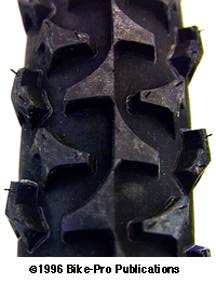
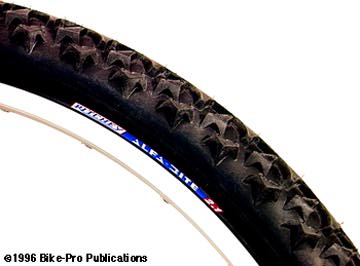
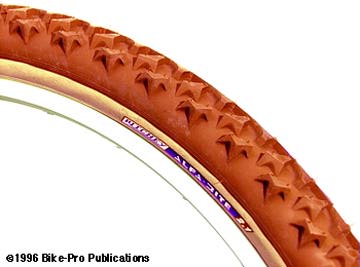
The Alfa-Bite is made in Japan for Ritchey by IRC. It is made in a Kevlar bead having either a Black or Red WCS tread. It is intended for use as a front tire, with directional tread and has an arrow on the sidewall indicating the proper direction of rotation. The 26 x 2.10" tire has a tread pattern that repeats every 31mm. The blocks down the center are made of triangles with the right angle facing forward, and an arched lower side. Each of these center blocks is linked by a ridge. A triangular shaped tread block floats 5mm from flat side of each center triangle. There is a multi sided triangular block at the outer side extreme, with sidewall support at the narrow side of each center triangle. The Red WCS tread version of the Alfa-Bite has a Skin sidewall. The Black tread model is available in a Skin sidewall or a Black tinted casing sidewall. The Black WCS tread was measured to have an 59/A hardness.
Alfa-Bite 26 x 2.1" - Kevlar/Skin/Red $ Price in Catalog
Alfa-Bite 26 x 2.1" - Kevlar/Black/Black $ Price in Catalog
Alfa-Bite 26 x 2.1" - Steel wire/Skin/Red $ Price in Catalog
Alfa-Bite 26 x 2.1" - Steel wire/Black/Black $ Price in Catalog
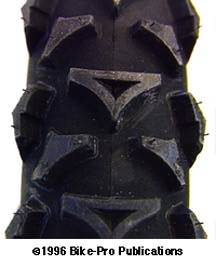
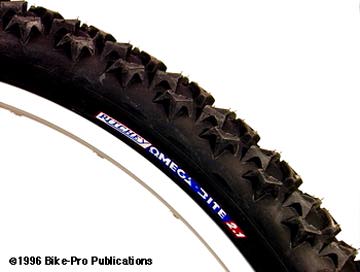
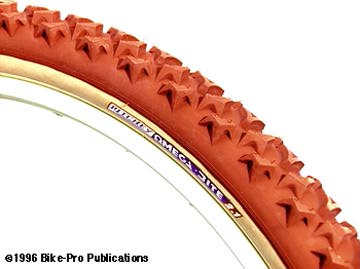
The Omega-Bite, also made in Japan by IRC is the rear mate to the front Alpha above. Like the Alfa it is made with a Kevlar bead only using a Black or Red WCS tread compound. The 26 x 2.10" tire has tread pattern that repeats at 31mm intervals. This directional tire has an arrow on the sidewall indication the proper direction of rotation. At the center is an inverted triangle with a 22.5mm base on top coming to a point 15mm away. Its short sides are curved slightly. At the top of the base, on each side are triangular blocks with their curved base facing back toward the base of the large central tread block. Smaller triangular tread blocks are placed at the extreme sides on the lower half of the large center triangle. Each of these side blocks has supports rising up from the sidewall. The Red WCS model of the Omega has a Skin sidewall, the Black tread, like the Alfa, is also available in a Skin sidewall or a Black tinted casing sidewall. The Black WCS tread rubber on the Omega-Bite had a hardness of 59/A.
Omega-Bite 26 x 2.1" - Kevlar/Skin/Red $ Price in Catalog
Omega-Bite 26 x 2.1" - Kevlar/Black/Black $ Price in Catalog
Omega-Bite 26 x 2.1" - Steel wire/Skin/Red $ Price in Catalog
Omega-Bite 26 x 2.1" - Steel wire/Black/Black $ Price in Catalog
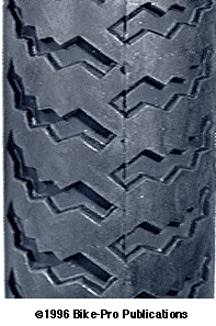
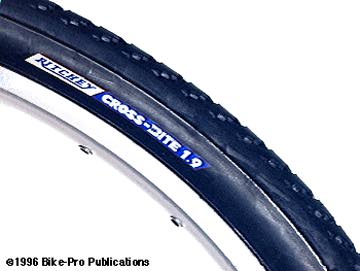
The Cross-Bite tire family was introduced in 1992 for Hybrid and Mountain bikes ridden on and off road. The Cross-Bite is made in 8 models. There are two sizes 26 x 1.1" and 26 x 1.9" that come in a Skin or Black sidewall with either a steel wire or Kevlar bead. All 8 models are made in Japan. Those models that have Black sidewalls are made using Black rubberized casing fabric giving the tire casing a Black color, so rather than having an external sidewall made as a part of the tread stock, these tires rely on exposed tire casing to for their Black sidewall. The Cross-Bite tires are directional with arrows pointing the proper rotation molded into the sidewall. Rather than raised tread blocks, the tread is made by molding depressions into the tread. The tread depressions leave the majority of the tread raised with one large, smooth, common joined surface, rather like Avocet's "Inversedª" tread. The molded depressions are in the form of a Zig-Zag line which is larger at the tire center and narrows at its outer side. It has a very slight curve to it as it moves to the outer side of the tire. With the tire facing properly, the left depression we find extends past the centerline into the right half of the tire, while the right depression begins 1.5mm to the right side of the centerline. All Cross-Bite tires have the same tread pattern, on the wider size the pattern has merely been "enlarged" to fill the width of the tire. The tread rubber on the Cross-Bite tire isn't thick enough to get an accurate durometer measurement of the rubber's hardness. We found the total tire thickness for the 1.9" wide model to be on average about 4.5mm at the tread center which included three layers of casing fabric, while on the 1.1" wide model, it averaged a 3.5mm thickness.
Cross-Bite 26 x 1.1" - steel/Skin $ Price in Catalog
Cross-Bite 26 x 1.1" - steel/Black $ Price in Catalog
Cross-Bite 26 x 1.1" - Kevlar/Skin$ Price in Catalog
Cross-Bite 26 x 1.1" - Kevlar/Blk $ Price in Catalog
Cross-Bite 26 x 1.9" - steel/Skin $ Price in Catalog
Cross-Bite 26 x 1.9" - steel/Black $ Price in Catalog
Cross-Bite 26 x 1.9" - Kevlar/Skin $ Price in Catalog
Cross-Bite 26 x 1.9" - Kevlar/Blk $ Price in Catalog
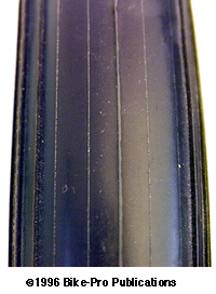
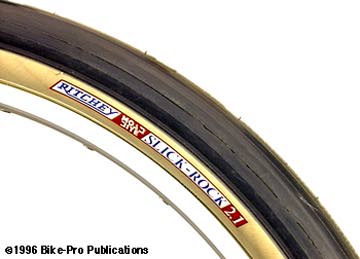
The Slick Rock is made in Taiwan for Ritchey by Cheng Shin Tire. The relatively smooth surface is intended to give good adhesion to extremely hard surfaces while its Grey color is said not to leave Black marks from a skidding tire. The 26 x 2.10" wire bead tire has a skin side wall that has more of a Yellow color than the standard skin side wall. The centermost 36mm is smooth, each ridge occurs at each side with an additional 6mm smooth section, followed by another ridge, then another 6mm wide smooth section. Although the MoabBite - Slick Rock is said to be more "sticky", hence softer than the standard compound, it has more "plastic" less yielding feel. The 4mm thick tread stock area isn't thick enough to technically get an accurate hardness reading from, but our admittedly flawed readings show it to have a hardness in the 64/A region. This tire explains on its sidewall that it employs "vector analysis tread design". Oh, really? And the tread is smooth? Doesn't that take a little of the credibility out of the Ritchey tire "Science"? And doesn't it really take a little away from all tire "scientists"?
Moab Bite 26 x 2.1 - Skin/Grey $ Price in Catalog