The Japanese National Tire Co. markets tires under the brand name of "Panaracer". In 1991, they introduced the "Smoke" tire family with great success, and have used the Smoke name on more recent though different models to capitalize on this initial success. The original Smoke tire we are told was designed at a meeting between Mr. Ken Masada of Interjet, (who represents National/Panaracer for sale to the United States), David Ajiki and Danny Otello, the founders of OnZa. Smoke tires come in 3 nominal widths. The Smoke Lite which is 26 x 1.9", the Smoke which 26 x 2.1", and the Smoke Magnum which is 26 x 2.2". All three models come Skin and Black sidewall and also come in a steel wire and Kevlar bead. The quality and workmanship on these tires is very high with no detail in the manufacture being over looked. Smoke tires rely on the same tread block design throughout the three tire widths. The design is merely "enlarged" proportionally with each tread block occupying the same percentage of tread stock surface as the tire models become wider. The Smoke uses two block patterns that are repeated around the tire. The first has a rectangular shaped tread block mounted horizontally across the tire with small indents at each end of the rectangle. At the sides of the rectangular tread blocks are large "boomerang" shaped blocks with the long leg facing in the forward rolling direction if you follow Panaracer's directional advice for this tire. Between each of the rectangular block patterns, in the tire center, are two smaller "boomerang" blocks. At the side of the smaller boomerangs are small triangle shaped blocks. The outer edge of the boomerangs and triangle rises at an angle, these Panaracer refers to as a raised "shoulder" and until they're worn off Panaracer suggests they assist in holding the tire's footing while turning. The side tread blocks on all Smoke models protrude from the sidewall, making the crown width wider than a measurement taken outer sidewall to outer sidewall. This is why the crown width and the section width numbers on the table are the same. Panaracer suggests the Smoke be used as a rear tire and their Dart tire be used for the front. The thread count on all these models is unknown, as is the casing fabric.
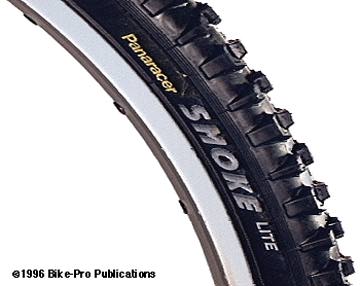
The Skin sidewall model uses the tire casing as its exposed sidewall. The tread on the Skin model tested to an 69/A hardness. The Black sidewall model is built using pigmented Black rubber on the casing fabric, which permits the exposed tire casing on the sidewall to appear that the tread stock encloses the tire with a real sidewall. The sidewall part of the tire is really exposed Black casing. The tread on the Black sidewall model tested to a 71/A hardness.
Smoke Lite 26 x 1.9" - steel/Skin $ Price in Catalog
Smoke Lite 26 x 1.9" - steel/Black $ Price in Catalog
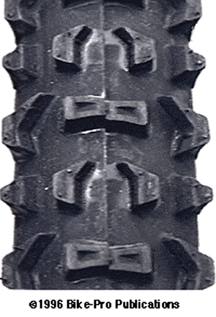
The Compe indicates these are the Kevlar bead version of the Smoke tires. These tires have an extra high thread count in their casing fabric. The Skin Smoke Lite Comp uses the tire casing for its sidewall and tested to a 70/A hardness. The Black sidewall model is made using Black rubberized casing fabric, the Black sidewall isn't a sidewall, but exposed Black tire casing. The Black model tested to a 72/A hardness.
Smoke Lite 26 x 1.9" - Kevlar/Skin $ Price in Catalog
Smoke Lite 26 x 1.9" - Kevlar/Blk $ Price in Catalog
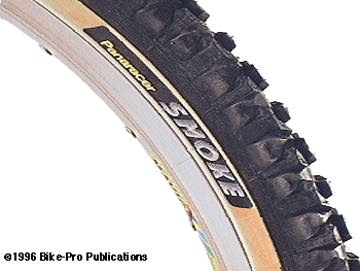
The Smoke Skin model uses the casing for its sidewall. It has a durometer hardness of 70/A. The Black sidewall model is made using Black rubberized casing fabric, what you see as Black sidewall is exposed Black tire casing. The Black sidewall model tested to an 71/A hardness. Notice in the tire table that the Smoke wire models weigh more than the Smoke Magnum wire models. This might be explained by the Smoke having a 4mm tall tread where the Smoke Magnum has just 3mm.
Smoke 26 x 2.1" - steel/Skin $ Price in Catalog
Smoke 26 x 2.1" - steel/Black $ Price in Catalog
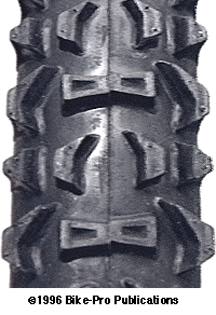
The Kevlar beaded competition versions of the Smoke tire are extremely well made with an extra high casing fabric thread count. The Skin sidewall model uses the tire casing for its sidewall and was hardness tested at 68/A. The Black sidewall model, like many Panaracer Black wall tires is made using Black pigmented rubberized casing fabric. The Black sidewall is really the exposed Black tire casing, and tested to a 67/A hardness.
Smoke 26 x 2.1" - Kevlar/Skin $ Price in Catalog
Smoke 26 x 2.1" - Kevlar/Black $ Price in Catalog
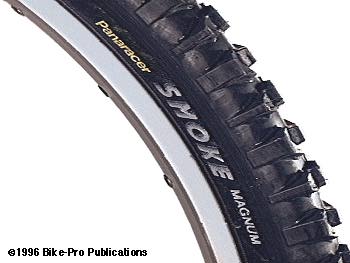
The Skin model uses the tire casing for its sidewall. The tread on the Skin model tested to a 71/A hardness. The Black sidewall model is made using Black tinted rubberized casing fabric. Rather than having an actual Black sidewall this tire has exposed Black casing to allude to a Black sidewall. The tread on the Black sidewall model tested to a 66/A hardness. These are no longer available. We sold them for $19.99
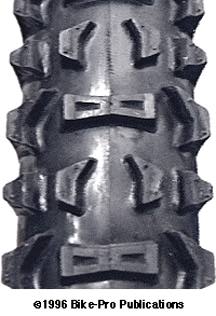
These tires show above average quality with a high thread count for the casing fabric. The Skin sidewall model has exposed tire casing for its sidewall with a durometer tested hardness of 69/A. The Black sidewall model uses exposed Black tire casing for its sidewall, rather than an added sidewall and has a tested hardness of 66/A.The Magnum series has fallen out of favor. We sold these for $24.99
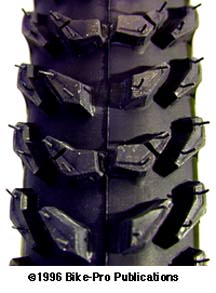
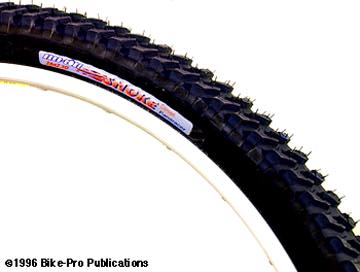
Many of the mountain bike riders working here remember the Cycle Pro "Snake Belly" as a tire from when we rode BMX bikes. That tire was made by National Tire for West Coast Cycle to market as the Snake Belly. The Smoke Hardcore looks nothing like any of the other tires in the Smoke family of tires, but it does, in a way, resemble the Snake Belly. The Smoke Hardcore is a directional tire with arrows on the sidewall to indicate the proper forward direction. Its tread pattern replicates at 35mm intervals using two rows of artfully abstracted tread blocks from a flying bat design. The center block of the first row is a "bat" shaped block with a 28mm wingspan and a 3.6mm vertical sipe through the middle. Each of the "wings" has a small sipe running diagonally up and outward cutting the wing tip away. The second row uses the same shape for the center block but has the middle 6.5mm cut completely away leaving half of each wing hanging alone. At each edge of each of the center blocks is a hockey stick shaped edge block. The short side of the stick forms the outer edge, the longer length of the stick curves to cover part of the open wing. Supports rise from the sidewall to make an outside footing for the edge blocks. The Smoke Hardcore has the same upper Blue-Grey surface. Again, we don't know what the purpose for this outer skin is, only that it's thinly on the top of a standard Black tread stock. The Smoke Hardcore is available in a Skin sidewall or a Black tinted casing fabric to look like a sidewall. We found the tread rubber of the Smoke Hardcore Compe, the Kevlar bead model, had a durometer hardness of 64/A.
Smoke Hardcore 26 x 2.1" Steel/Skin/Black $ Price in Catalog
Smoke Hardcore 26 x 2.1" Steel/Black/Black $ Price in Catalog
Smoke Hardcore 26 x 2.1" Kevlar/Skin/Black $ Price in Catalog
Smoke Hardcore 26 x 2.1" Kevlar/Black/Black $ Price in Catalog