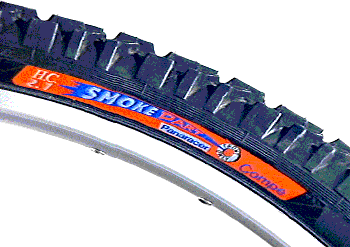
In 1992 Panaracer introduced the Dart series of tires. Using the same manufacturing techniques as the Smoke series, these tires are well constructed and Panaracer recommends they be used as front tires. Darts come in two types with each having four models. The Dart H.C. is nominally sized at 26 x 2.10". The H.C. stands for "Hard Conditions" intended for pavement or hard packed dirt, the tire is said to made of softer rubber that provides added stickiness or traction, now being called "Sticktion". Remember softer rubber compound is generally achieved by including less carbon black in the rubber prior to vulcanization. The second type, the Dart S.C. is nominally sized at 26 x 2.20". Naturally the S.C. stands for "Soft Conditions". The tire is said to be made of a stiffer less abrasive rubber so it "gives" less as the riders weight is pushed into soft material (mud or sand). The Dart S.C.'s greater width gives a larger tire patch to load the weight across. Both the Dart types are made in Skin or Black sidewall with steel or Kevlar beads. The Dart H.C. tire relies on a tread block pattern that repeats approximately every two inches around the circumference of the tire that is based on elongated triangles pointing forward on these directional tires. The triangles come in two sizes 15mm long with a 5mm wide base and 20mm long with a 5mm wide base. At the top of the tread pattern there are two of the small triangle blocks spaced approximately 5mm off the center line of the tire. Behind them by 15mm are two more spaced 12.5mm off the tire centerline. Between the rear two on the centerline is one of the larger triangles, which closes up the open space between the triangular tread blocks. Small angular "hockey stick" shaped blocks are used for the side tread blocks. There are two on each side beginning half way down the small, front triangle blocks, extending a third of the distance into the rear set. To link the pattern, a thin rectangular side tread block is placed between each pattern set. The Dart S.C. uses the same triangle shapes in a slightly different pattern. The small triangles are spaced the same distance from the centerline, but the two rows are separated by 35mm with one large triangle centered between them. Smaller triangular blocks placed at a forward angle make up the side tread blocks, with two of them on each side between each rectangle block. The side tread blocks give a near vertical surface to the tread on the side. The measurement for section width and crown are the same because the crown extends slightly past the sidewall. The thread count and casing fabric for these tires is unknown.
The Skin sidewall model uses the tire casing for its sidewall. The tread on the Skin model tested to a 62/A hardness. The Black sidewall model is built using Black rubberized casing fabric, so what appears to be a Black sidewall is really exposed Black casing. The tread tested to a 66/A hardness.
Dart H.C. 26 x 2.1" - Steel/Skin $ Price in Catalog
Dart H.C. 26 x 2.1" - Steel/Black $ Price in Catalog
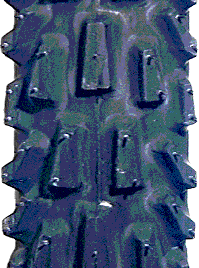
The Dart H.C. Compe is the Kevlar model of the H.C. The Skin sidewall uses the exposed brown tire casing for its sidewall and tested to a 64/A hardness. The Black sidewall model is made using Black rubberized casing fabric which is exposed as the sidewall of the tire. The Black sidewall model tested to a hardness of 67/A.
Dart H.C. 26 x 2.1" - Kevlar/Skin $ Price in Catalog
Dart H.C. 26 x 2.1" - Kevlar/Blk $ Price in Catalog
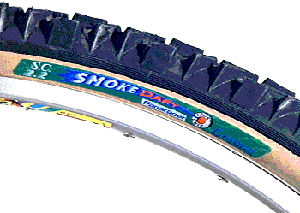
The Skin sidewall model uses exposed tire casing its sidewall and tested to a 67/A hardness. The Black sidewall model is made using Black rubberized casing fabric which is exposed as the Black sidewall. Our hardness testing of the rubber yielded a 66/A hardness, which is, oddly the same hardness of rubber we found in Dart H.C. Black which should a softer compound.
Dart S.C. 26 x 2.2" - Steel/Skin $ Price in Catalog
Dart S.C. 26 x 2.2" - Steel/Black $ Price in Catalog
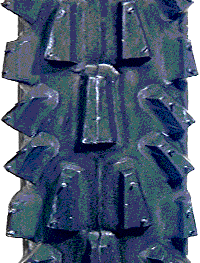
Again the S.C. Compe models have a Kevlar bead. The Skin sidewall model uses its brown tire casing for the sidewall and had a tested hardness of 62/A. The Black sidewall model was again made of Black rubberized tire casing fabric giving the impression of a sidewall, it tested to a 64/A hardness.
Dart S.C. 26 x 2.2" - Kevlar/Skin $ Price in Catalog
Dart S.C. 26 x 2.2" - Kevlar/Black $ Price in Catalog
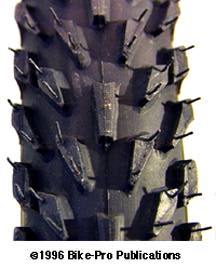
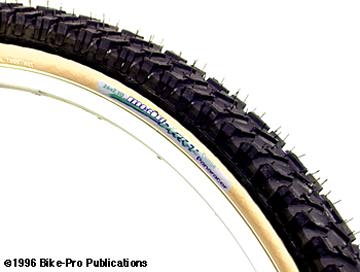
The Dart Hardcore is a directional tire with arrows in the sidewall pointing proper direction for use. Intended for front wheel use, the Dart Hardcore is made in two sizes 26 x 2.0" and 26 x 2.1" It is made in both a steel and a Kevlar bead, all models are made in Japan. The tread pattern repeats at 35mm intervals. The tread is based largely on the Smoke Dart pattern using narrow triangles between 15mm and 18mm in length with the point facing forward. A single Dart triangle in the middle has one at each edge, followed by the next row with two darts in the middle tread area, with one at each edge again. The final row has two darts near the center line with one at each edge. The Dart Hardcore has an upper rubber surface that is Blue-Grey. This colorant is not consistent through the tread stock, just below the top surface is common Black rubber, so after a short period of wear you will have Black appearing in all the worn surfaces. The Blue top tread is said to be a "high grip" rubber compound, while the lower Black compound is said to of "hard consistency". The Dart Hardcore is available in a Skin sidewall or a Black tinted casing fabric to look like a sidewall. We found the tread of the Dart Hardcore Compe, which is the Kevlar bead model, had a durometer hardness of 67/A.
Dart Hardcore LX 26 x 2.0" Steel/Skin/Black $ Price in Catalog
Dart Hardcore LX 26 x 2.0" Steel/Black/Black $ Price in Catalog
Dart Hardcore 26 x 2.0" Kevlar/Skin/Black $ Price in Catalog
Dart Hardcore 26 x 2.0" Kevlar/Black/Black $ Price in Catalog
Dart Hardcore 26 x 2.1" Steel/Skin/Black $ Price in Catalog
Dart Hardcore 26 x 2.1" Steel/Black/Black $ Price in Catalog
Dart Hardcore 26 x 2.1" Kevlar/Skin/Black $ Price in Catalog
Dart Hardcore 26 x 2.1" Kevlar/Black/Black $ Price in Catalog