Real success in the bike industry occurs only if you pass through land of Taiwan. Think of the most popular brands of bicycles sold in the United States, Trek, Specialized, Giant and GT. These brands generally each year have more complete bikes with their brand on them made in Taiwan. Because cost is the reason for the Taiwan manufacture, keeping costs low in any possible way is the name of the game. But, you want your bike made by one of the few well known factories, (that even make models for your competitors), to have some form of uniqueness. This uniqueness is often expressed in "brand name" parts being put on the bikes, but these "brand name" parts must be easily available in Taiwan and inexpensive. Many of the well designed and better produced after market replacement parts have less expensive, and poorer quality copies made in Taiwan to be sold to bike factories. The manufacturers have one or more of these reasons for doing this. 1) "We want to aggrandize our brand name by having it more prominently on complete bikes in stores" 2) "We need and want the small royalty per piece that Taiwan factory is supposed to pay us for each piece they make with our name on it.", (there are reportedly some factories that don't pay all the royalties they are obligated to). 3) "We can get our goods made more cheaply, on a contract basis, for delivery to Taiwan factories and then have the same factory ship to us, in the United States, the same goods (made less expensively), so can make much larger profits selling them as after market replacement parts." 4) "Everyone else we compete with is doing this, we can't afford not to have the goods we sell not be made in Taiwan to keep our costs down, even though we don't sell to Taiwan complete bike factories" And finally reason number 5) "We don't have the capital to make a factory of our own from scratch, lets merely subcontract the work to where it is capable of being competently done." OnZa, Ritchey and Specialized have tires, with their brand name on the side, made for them by Cheng Shin Tire. "CST" is how they labels their own tires, rather than leaving it to the consumer to guess how to pronounce the "Cheng Shin" name. CST has manufactured tires under many leading brand names for many years. Though CST has sold their tires under the CST brand in bike and department stores for several years as inexpensive replacements, they are now making a foray into the specialty, replacement, tire market. The brand name they are using for this segment of their tire sales, and develop a new identity around is "Maxxis". According to advertising we read from Chen Shin and their American distribution agent for these tires Tip Plus Distributing, CST has been selling motorcycle and automobile tires under the Maxxis brand name already. We have no knowledge or experience with this. However CST has a great deal of experience in making bicycle tires, and has the benefit of making tires for their market competitors, so probable market success seems certain.
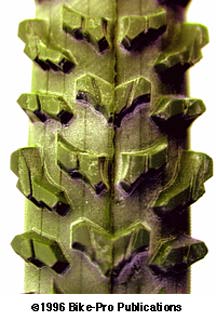
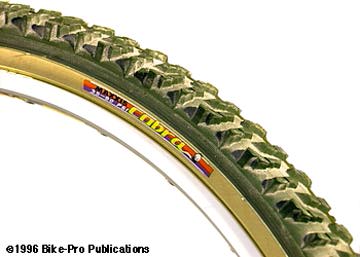
The Cobra tire is designed with the intent that it be used as a rear tire only. It is also a direction tire that has arrows on the side wall indicating the proper rolling direction. Its tread pattern repeats in two rows of tread blocks at 38mm intervals. A single 18mm wide by 12mm high block is used at the center of row one. This block has the shape of a downward look onto the B2 bomber, meaning a caricature of a bat in flight. To each side is a multisided block with a rough rectangular shape measuring 14.5mm by 6.5mm. This edge blocks have a serrated front and are placed at a slight diagonal so the inner edge is ahead of the rear or outer edge. The second row has appears to have rearward swept bat wings separated by a 4mm gap. There is a vertical sipe at the middle of each of these separated wing blocks. At the end of this second row of wing blocks is an edge block that has a hockey stick appearance. This shape has been used with many variations on quite a few tires. This hockey stick shape arches over the split wing shapes with its left end between the two rows. The 26 x 1.95" Maxxis Cobra comes at this time, only in wire bead. The tread stock comes in two colors, Black and Green. Colored tread has become popular to indicate a difference in hardness. The Black tread measured with a durometer to an 64/A hardness. The Green tread proved to be a negligible softer 61/A hardness. The Black tread has a Black tinted casing fabric leading you to believe it has a Black sidewall. The Green tread has a Skin sidewall.
Maxxis Cobra 26 x 1.95 - Steel/Black/Black $ Price in Catalog
Maxxis Cobra 26 x 1.95 - Steel/Skin/Green $ Price in Catalog
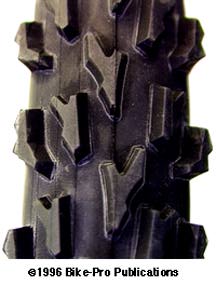
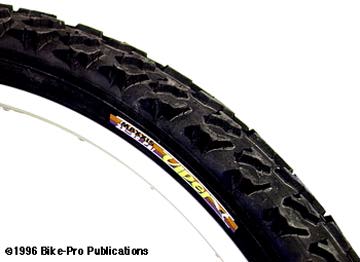
The Viper is front mate for the Cobra rear. The 26 x 2.10" tire is directional with arrows on the sidewall indicating the proper rotational direction. The Viper tread pattern is based on "harpoon barb", (dart?) shaped blocks, with a variation on the hockey stick shape for edge blocks. The four row pattern repeats at 72.5mm intervals. The center block of the first row has a point and lies on the centerline with an extended leg on one side. The second row has four blocks, an 18.5mm open area around the centerline is flanked by two of the harpoon barb blocks. Outside of the harpoon barb blocks is a modified hockey stick edge block that has a notch removed at the side. The third row has a repeat of the center placed Barb block from row one, but is mirrored so the barb leg appears on the opposite side. The fourth row is a mirrored repeat of row three. Like the Cobra, the Viper tread comes only in a wire bead and in two colors, Black or Green. The Black tread tire comes with a Black tinted casing fabric, the Green tread has a Skin colored casing fabric. The Black tread had a durometer hardness in the 63/A region, and the Green tread was in the 62/A region.
Maxxis Viper 26 x 2.1" - Steel/Black/Black $ Price in Catalog
Maxxis Viper 26 x 2.1" - Steel/Skin/Green $ Price in Catalog