Continental is a German maker of both automobile and bicycle tires, having been a maker of bike tires since 1892. In the past few years many road racing riders have adopted Continental tires for sport riding, training and racing. Though they make some popular tubular tires we confine ourselves to selling just two families of their road racing clincher tires. They are the Super Sport Ultra, and the Grand Prix series tires. Both families of Continental tires have a Skin sidewall which has a slightly darker rubber color than is used by the Japanese tire makers. Both series of tires also have Kevlar beaded versions. The ads for Continental tires state that the tires use a polyamide fabric for the tire casing fabric. Unless you shop in Europe, you wouldn't be familiar with the term "polyamide", which is the term or name given to nylon based materials. To remove the ambiguity, remember that "polyamide" is a nylon based plastic fabric. Continental tires are said to use a tread that is "composed of a natural rubber compound". The same Continental ad material in a discussion of their Butyl tubes says that they are, "Made with pure, natural, virgin butyl rubber". In our overview's discussion of butyl rubber we make clear that it's synthesized of chemical derivatives from petroleum which don't occur in nature, so their definition of the "natural" remains uncertain. The use of latex rubber in conjunction with a synthetic rubber is well known but the exact composition of this tread compound remains unknown.
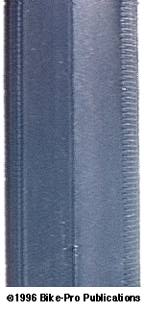
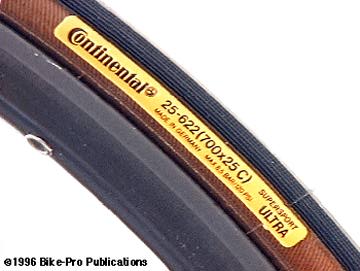
The Super Sport Ultra is a tire used by many for training rides. It comes in a steel wire or Kevlar bead and is sold through us in 5 models. The Super Sport Ultra uses standard three bias ply tire casing construction. The central portion of the tire tread is smooth. This smooth area varies in width from 13.5mm to 15.5mm depending on the tire width. On the outer sides of the smooth area are is a recessed cross- hatched pattern which comes into ground traction while cornering. The three steel wire bead models come in 700 x 20c, 700 x 23c or 700 x 25c. The Kevlar bead models we sell are sized 700 x 20c and 700 x 23c. The tread rubber is too thin to measure its hardness, for more specifics, including total tire thickness, please use the 700c tire table.
SS Ultra 700 x 18c - Steel bead $ Price in Catalog
SS Ultra 700 x 20c - Steel bead $ Price in Catalog
SS Ultra 700 x 23c - Steel bead $ Price in Catalog
SS Ultra 700 x 25c - Steel bead $ Price in Catalog
SS Ultra 700 x 20c - Kevlar bead $ Price in Catalog
SS Ultra 700 x 23c - Kevlar bead $ Price in Catalog
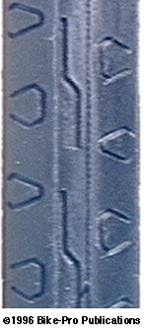
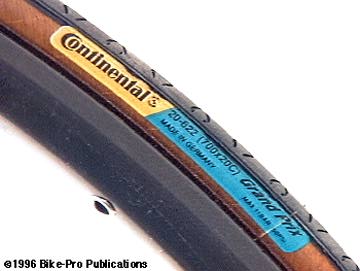
The Grand Prix is Continental's lighter high performance line of clincher tires. Grand Prix tires have two added upper fabric belts between the standard three bias ply casing and the thread, making a stronger casing with added tube protection. With the added belts, the tires are still lighter than the Super Sport Ultra tire, this is likely because the Grand Prix tires use a thinner tread stock to reduce its weight. The depth of the center sipe on the tire is just .5mm, which serves as an indication of the tread depth. The Grand Prix has a largely smooth tread with small sipes down the center, and small open sided triangular sipes at the tread edges. The Grand Prix comes in a steel wire or Kevlar folding bead and is sold through us in 5 models. The three steel wire bead models come in 700 x 20c, 700 x 23c or 700 x 25c. The Kevlar bead models we sell are sized 700 x 20c and 700 x 23c. The tread rubber is too thin to measure its hardness, for more specifics, including total tire thickness, please use the 700c tire table.
Grand Prix 700 x 20c - Steel bead $ Price in Catalog
Grand Prix 700 x 23c - Steel bead $ Price in Catalog
Grand Prix 700 x 23c - Steel bead $ Price in Catalog
Grand Prix 700 x 20c - Kevlar bead $ Price in Catalog
Grand Prix 700 x 23c - Kevlar bead $ Price in Catalog