Shimano Road and Mountain Bicycle Seatposts
1995 SHIMANO DURA-ACE SEATPOST
In the 1995 model year Shimano will release a new version of their Dura-Ace seatpost. Although pre-release versions of the seatpost have been seen by some, we haven't and can't describe what it looks like or the techniques used to make it. It is expected to be lighter in weight, and available for after market replacement part sales in early 1995.
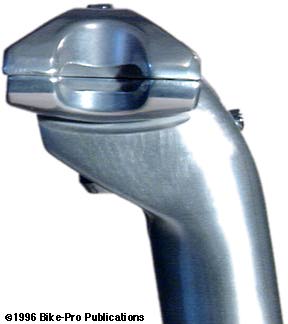
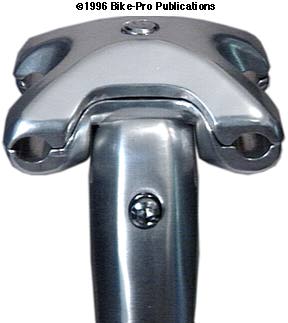
SHIMANO SP-7400-B DURA-ACE SEATPOST
The 7400-B is Shimano's "aerodynamic", semi-oval, shaped Dura-Ace post. It's design and shape is a variation on the Deore AX seatpost released as a touring grouppo in the early 1980's. There are 5 major parts to the 7400-B post, the mast assembly, two clamp pieces, the fastening bolt and a steel spacer. The mast assembly is a true work of art. Machined of a single piece of billet aluminum, there is a great deal of intricate workmanship involved in its oval-aero shape. The interior of the mast is bored out to reduce the weight, leaving a 2.7mm wall thickness and sturdy top section to support the clamp pieces. The clamp pieces rest in a machined cradle that permits the clamp angle to rock and be cinched at different angles. A slot milled through this clamp support allows the fastening bolt to pass up through the bottom of the cradle into the upper clamp piece. The fastening bolt rises through a chrome steel spacer (the spacer has a 9 gram weight) located beneath the bottom of the clamp saddle. This spacer fits in a half-rounded hollow and has flat ends. At the front, near the top, there is a 3mm steel hex bolt which pushes or holds the spacer and the fastening bolt in a fixed position. This small bolt can permit tiny adjustments in this micro-adjusting seatpost. The fastening bolt is chromed steel with a 6mm hex head. It's 8mm by 1mm thread pitch with a 34mm length and a 17.5 gram weight. The clamp pieces are both cast of aluminum alloy. The upper clamp piece resembles the Ritchey and Campy upper pieces, having threads for the fastening bolt to grip and four points of saddle rail contact. Each side of both clamp pieces offer 1 5/8" of rail contact. The lower clamp piece is cast with a hole for the threaded bolt anchor from the upper piece to pass into, as a "key" locking the pieces in place. There are knurles on the lower side which grip against the top of the clamp saddle on the mast when tightened. The entire post has a satin polished finish, with the name, in Black, etched on edge in the front. With the clamp perpendicular to the mast section, the center of rail to end of tube length is 200mm. The weight of a 27.2mm 7400-B post is 261 grams. The Shimano SP-7400-B Dura-Ace post is made in Japan, and is available in, 26.2mm, 26.4mm, 26.6mm, 26.8mm, 27.0mm, and 27.2mm sizes.
Size-62-64-66-68-70-72$ Price in Catalog
New Dura-Ace/Easton Seatpost 27.2mm $ Price in Catalog
1995 SHIMANO XTR SEATPOST
In the 1995 model year Shimano will release a new version of their XTR seatpost. Although pre-release versions of the seatpost have been seen by some, we haven't and can't describe what it looks like or the techniques used to make it. It is expected to be lighter in weight, and available for after market replacement part sales in early 1995.
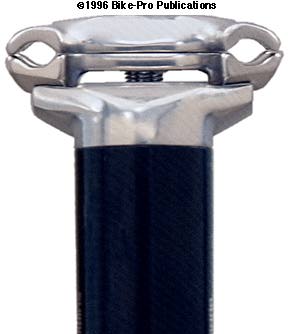
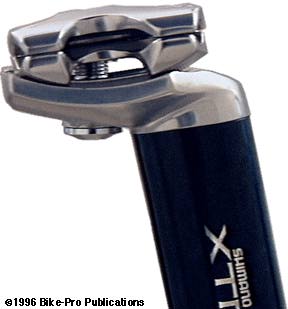
SHIMANO M-900 XTR SEATPOST
The XTR post is styled like the XT post, but has the aluminum clamp pieces far more finely polished than XT model. The XTR head and clamp pieces are similar to those used in the XT post. The head piece is cast aluminum with a knurled upper surface where the lower clamp piece contacts it. In the middle there is a slot milled out, to permit the fastening bolt to move forward and backward, as needed, in adjusting the angle of the saddle. The head piece is tightly press fit to a depth of 1" into the Black painted, Cro-moly heat treated steel tubing section. The lower clamp piece is finely cast aluminum with four knurled points of contact to the head piece. The middle of the lower clamp piece has an oval shaped hole down from the upper clamp piece for a mated protrusion, to lock the two in the correct position prior to tightening. The upper clamp piece is made of cast aluminum, also finely polished, a hole through the middle of the protruding oval is threaded for the steel fastening bolt. The fastening bolt that passes up through the head piece and both clamp pieces is Chrome plated steel with a 5mm hex head fitting for tightening, it's threaded with a 8mm by 1mm thread pitch and is 30mm long. The steel fastening bolt is replaceable with a Titanium model found at the end of the article. The head and clamp pieces are left in their natural Silver color rather than painted Black, and appear to be barrel polished with final hand polishing. With the clamp perpendicular to the tubing section, the center of rail to end of tube length is 329mm. The weight of a 26.8mm XTR post is 261 grams. The Shimano XTR post is available in, 26.6mm, 26.8mm, 27.0mm, and 27.2mm sizes.
Size-66-68-70-72 $ Price in Catalog