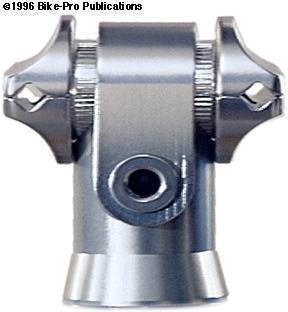
There is another version of the RinglŽ Moby post. For the Manitou frameset Answer needed a a high quality US made seatpost. The RinglŽ post was chosen but not made in the 31.8mm diameter that Answer needed. They arranged to have a special version of the Mody head machined for them to affix to the top of Easton tubing producing the needed 31.8mm diameter post. The Answer/Manitou post has a Silver anodized top and a pewter Grey anodized mast tube. Look at the Ringle post for a complete description. $ Price in Catalog
This post is the basis of the future Answer BodyShock post so we
have included the review of its predecessor here.
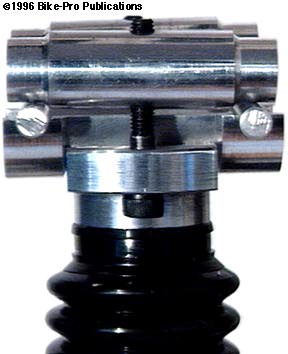
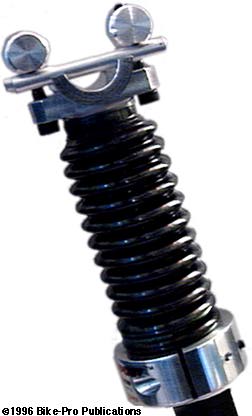
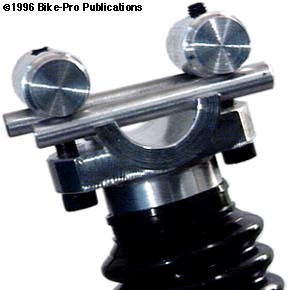
The Bodyshock is an elastomer bushing cushioned suspension seatpost that relies on four internal elastomer plastic "springs" to dampen road shock. We are going to describe the head and clamp assembly first. The head piece supporting the clamp pieces, is machined from a billet aluminum. It is fastened to the 3/4" diameter 6062-T6 aluminum piston that compresses the elastomer "springs" by a driven-through steel pin. The top of the head piece has a half round hollow at the center that the lower clamp piece seats and revolves in. The head piece has two extensions that are drilled through for the bolts that hold the upper clamp pieces. The lower clamp piece is turned from aluminum tubing, each end is drilled through for the saddle rail, then cut in half length-wise making two lower pieces. This lower clamp piece revolves in the head pieces central half round recess making this an infinitely adjustable seatpost. The upper clamp pieces are turned down on a lathe from aluminum rod stock. They are drilled though the middle and tapped for the fastening bolt. With the saddle at the desired angle tightening each of the fastening bolts secures the saddle rigidly in place. The steel bolts are 5mm by .8mm thread pitch. They have a 4mm hex head, and each weighs 6.5 grams. The aluminum shaft the head piece is fastened to, acts like a piston in compressing the elastomer "springs". This aluminum piston is machined flat on one side and a tight fitting steel plate is inlaid into the mill work. An aluminum collar around the compression tube holds a roller bearing in place against the flat, steel clad, side of the piston shaft. The roller bearing eases the vertical movement and assures that the piston with the mounted head piece will not rotate horizontally. The area above the roller bearing and below the head piece is shrouded beneath a Black rubber boot. The compression tube, which houses the elastomer bushings or "springs" is made of Black anodized aluminum tubing. Between the bottom of the 3/4" aluminum piston and a thread-in end plug at the bottom of the compression tube, there are four cylinders of the elastomer "spring" material which compress against one another, cushioning road shock. The end plug at the bottom of the compression tube is made of machined aluminum, and has a knurled for grip knob that pre-compresses the "springs" when turned in the clockwise direction by shortening the interior length of the tube. The outer diameter of the compression tube is 25.4mm. To achieve sizes from 26.0mm to 31.6mm by 2/10ths millimeter, a 4" long, machined from aluminum tubing, then split-cut down the side shim is used. Each of the four "springs" is cylindrical, 1 1/2" long and 2/3" in diameter. They are made in four colors, each representing a different hardness. The Blue spring, which is the softest measures to an A/60 hardness on an A scale durometer. The Black medium hardness is an A/72, the Clear color measures to an A/75, while the Orange measures to an A/82 durometric hardness. Any combination of these springs may be used at the same time in concert with each other. If the post had four Blue urethane polymer springs, proper full compression of the springs would occur under a rider of 125 to 150 pounds. Four Black springs will fully compress under a rider of 150 to 175 pounds; Clear will support a rider whose weight is 175 to 200 pounds, and four Orange springs will support a rider's weight of 250 to 275 pounds. The post comes from the factory with two Clear and two Black springs for a rider of 140 to 175 pounds. To custom configure the post, you can average the capability of the four springs and mix the colors accordingly. The Bodyshock post is available only with the clamp in Silver on a Silver head piece mounted on Black compression tube. With the clamp perpendicular to the tubing section and the suspension post un-loaded, the center of rail to end of tube length is 416mm. This will reduce under load by up to 45mm. The Bodyshock in the 26.6mm diameter size weighs 636.5 grams. The Bodyshock is available in 25.4mm, 26.0mm, 26.2mm, 26.4mm, 26.6mm, 26.8mm, 27.0mm, 27.2mm, 28.6mm, 29.4mm, and 31.6mm. Extra elastomer springs are available in pairs, both the same color. The Answer Body Shock version is available 26.8mm, 27.0mm, 27.2mm or 31.6mm in Silver or Black only.
Size-68-70-72-16 $ Price in Catalog