American Classic Seatposts
AMERICAN CLASSIC MOUNTAIN SEATPOST
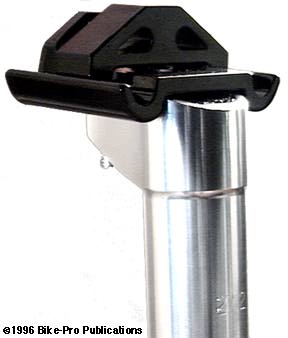
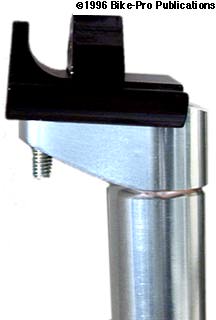
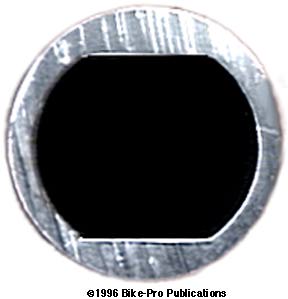
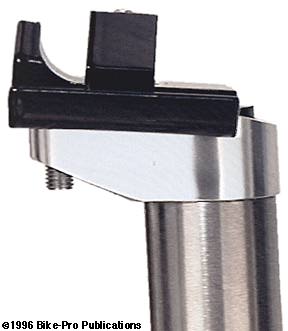
The American Classic follows a form and design originated by a Mr. Shook several years ago. Though the clamp system on this post is patented, you will see it on other posts, and it's use by others is under litigation. To our way of seeing it, this appears to be the original version of this style of post. The clamping system is made of three parts; the Silver head piece (machined as a part of the seat mast), a cradle plate, and an upper clamp piece. The cradle plate and upper clamp piece are anodized in Silver or electrostatically painted in a high gloss Black. The head piece is extruded in its teardrop shape as a part of the aluminum seat mast stock. The cross sectional view of the interior of the extruded mast stock shows the tubing thicker at the front and rear. The wall thickness at the sides is 2.6mm thick while the front and rear have a 4.8mm wall thickness. This extra thickness, fore and aft, makes the post far less susceptible to bends or failure. There are three holes through the head piece with the largest situated over the tubing section. The two other holes are for bolts used in adjusting the angle and tilt of the saddle. The saddle cradle piece is made of a 1 3/4" length of a special extruded aluminum. The top surface is milled down to the height of the saddle rail center, leaving a raised back. A 12mm hole is drilled through the center of the cradle plate, this for the clamping bolt to pass through on it's way up to the threaded clamp piece. A 1 3/4" trough that supports the saddle rails is at both sides of the cradle piece. The clamp piece is made of extruded aluminum, shaped like a truss with two holes to reduce weight. The upper clamp piece is cut with a 1/2" length giving it's concave clamping ends 1/2" of full downward support to the saddle rails. At the center of the clamp a hole is drilled and tapped for the 30mm long, steel 6mm by 1mm thread pitch clamp bolt. The clamp bolt has a 5mm allen head, (weighs 8 grams), which rests against a self-lubricating, brass bushing on the interior underside of the head piece. On the underside of the cradle plate, behind the hole for the clamp bolt is a circular depression. This recess is for the micro-adjusting bolt. The micro-adjusting bolt threads from the bottom, up through the top of the head piece and pushes on the bottom, at the rear of the cradle plate, giving it the saddle tilt adjustment. Once the tilt is correctly adjusted, then the clamping bolt is tightened, cinching the saddle solidly to the post. With the clamp perpendicular to the tubing section, the center of rail to end of tube length is 353mm. The weight of a 27.2mm American Classic Mountain post is 309.5 grams. The American Classic post, made in USA, has a powder painted Black clamp section, mounted on a head piece and mast section anodized in a Silver or Black color. It's available in 26.4mm, 26.6mm, 26.8mm, 27.0mm, 27.2mm and 27.4mm sizes. This post is also made in a Road bike length of 235mm in 25.0mm, 26.8mm, 27.2mm.
252mm length (Size-64-66-68-70-72-74 Color-BK-S) $ Price in Catalog
235mm length (Size-64-66-68-70-72-74 Color-BK-S) $ Price in Catalog
AMERICAN CLASSIC TITANIUM ATB SEATPOST
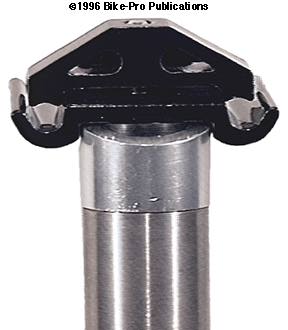
This is the same seat post in design and manufacture as above, except the aluminum tubing section has been replaced with a 355mm length of Titanium 3Al-2.5V tubing to reduce weight and increase strength. The American Classic Titanium post is available only with the clamp painted Black on a Silver head piece, mounted on the Titanium tube. With the clamp perpendicular to the tubing section, the center of rail to end of tube length is 383mm. At this time, the American Classic Titanium post is only made in the 26.8mm, 27.0mm or 27.2mm diameters. The 27.2mm size weighs 233 grams.
Size-68-70-72 $ Price in Catalog