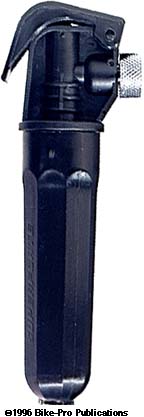
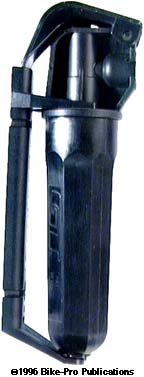
This product was widely introduced to the world as the GT Instaflate, though it had been made by Innovations In Cycling of Arizona. Innovations has introduced the product with their own name, the Superflate. The Superflate is different from the adapter type of CO2 inflator because the 12 gram cartridge is enclosed, and the Superflate uses a valved release of air into the tube permitting you to burst small blasts of air while your tire seats. This valve for air release at the top of the Superflate also permits you to "store" or "save" that part of the cartridge you didn't immediately use, provided you don't unscrew the Superflate enclosure. The Superflate has two parts a lower hollow chamber for the air cartridge, and the top section which has the cartridge seal puncture needle, valve and delivery system. The chamber is made of Black molded plastic and has threads around its upper inner lip. The top section threads into the lower section where a downward needle punctures the cartridge seal. A brass seat and rubber seal prevent air loss during this puncture process. With the top seated on the chamber section, a hinged handle on the top of the Superflate is pressed downward. When the handle is released, air delivery to the tube is stopped. The un-spent air can be saved for future use. The Superflate has a machined aluminum fitting, threaded for a Schraeder valve, with an internal rubber seal, which spins independently onto the valve stem for a tight seal. If you have Presta tubes, the Superflate comes with a machined aluminum Presta to Schraeder adapter. The Superflate doesn't use threaded neck cartridges, it uses standard 12 gram cartridges in the small neck size which are available through us or generally any sporting goods store for use in air rifles. New sealed cartridges are stored inverted in the Superflate so their seal can't be accidentally punctured. The Superflate comes with no on bike mounting device, but the 5 1/4" long unit can be easily stored in your jersey or bike pack. Two alternate mountings are available below. The Superflate comes with the upper and lower sections which weigh 54.5 grams, a valve adapter weighing 1.5 grams and one CO2 cartridge weighing 43 grams. $ Price in Catalog
SUPERFLATE MOUNTING CLIP
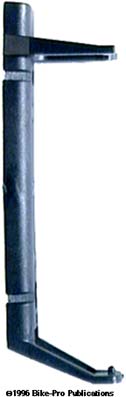
An optional mounting clip for the Superflate, allows you to mount it in place of a water bottle cage using frame braze-on cage fittings. The mounting clip is made of Black molded plastic and grips the Superflate though a recess in the bottom of the lower section and has two locking arms which grip the top section around two custom recesses for the clip, holding it securely. The clip has contoured back to fit the radius of the frame tube. Using the clip this way, prohibits using the braze-on set for cage mounting purposes, but two zip ties are included so you can strap the clip to any location on the down, top, or seat tube. The clip weighs 10 grams, while the 8 inch long un-cut zip ties weigh just 1 gram. $ Price in Catalog
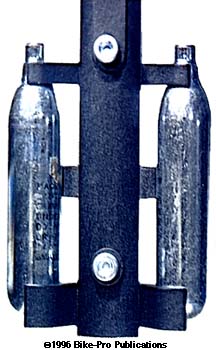
SUPERFLATE SPARE AIR CLIP
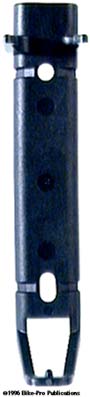
The Spare Air clip is an optional holder that mounts using frame braze-ons for a bottle cage, below the mounted cage or below the Superflate mounting clip if you are using it. Made of molded Black nylon plastic, the Spare Air clip holds two 12 gram CO2 cartridges with a three contact, custom arm set that holds the bottom, middle and neck of the cartridges. The back is contoured to fit the radius of the frame tube and it comes with a pair of 14mm long steel bolts to replace the shorter ones that come with most frames. Zip tie fastening for this clip isn't an option because this clip and the bottle cage can both use the same braze-ons. You may also choose to use the Superflate mounting clip instead of a cage giving you two cartridges in the Spare Air clip and one un-used in the Superflate. $ Price in Catalog
As we've said, the Superflate uses standard 12 gram, small neck CO2 cartridges that have an un-threaded that are found at most sporting goods stores. If your life is like ours, shopping may not be convenient, so we sell 12 gram small neck replacement cartridges in a package of three.
Three - 12 gram small neck CO2 $ Price in Catalog