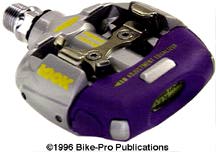
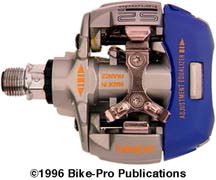
At the middle of 1993 LOOK released their S2 pedal sets. The S2 pedals are LOOK's response to the success of Shimano's SPD system and their desire to recess a small cleat into the sole of the rider's shoe. To make use of the Shimano style, LOOK adopted the hole drilling pattern that Shimano uses for the SPD system. Any shoe that is directly capable of having an SPD cleat mounted and recessed within the sole is also capable of doing the same with a LOOK S2 cleat. Having the same hole drilling pattern is referred to as "Shimano compatible", which is the shortened form the full term of "Shimano compatible drilling". Shimano cleats will not work with this pedal!! The S2S Nevada is the Sport model with springs that can adjust the cleat release tension to let go at between "5 and 14 Newtons per meter", (the term Newton per meter appears to describe .1375 Kilograms-meters or .9945 foot pounds). The S2S Nevada pedals use the same spindle and bearings that are used in all the LOOK road pedal models, with two insignificant changes. The spindle and its bearing are covered in the LOOK overview, the difference is that the spindle is bright chrome plated, and the plastic locknut has been replaced with another plastic one (threaded the same) that requires a LOOK specific tool (LOOK # 144724). The new tool is an improvement over the 18mm open wrench end used previously, which sometime slipped and stripped the plastic locknuts gripping sides away. The tool however isn't included with the pedals. The S2 pedal is made primarily of three cast aluminum parts, the body and then two interchangeable pieces that form the heel or toe cleat retention clamp.
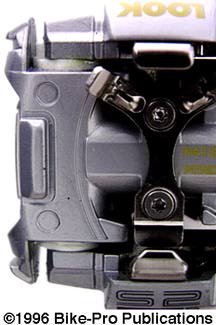
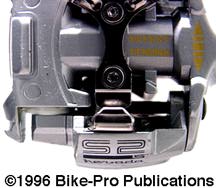
The two cleat retention clamps are held to the body by a steel bolt that not only threads into the body holding the clamp, but becomes an axis/axle for it to rotate on. The clamp piece is capable of a small rocking movement forward or rearward. The distance of this movement and its ease, is the adjustable feature for the cleat release. At the outer side of the pedal body is a chamber that holds a spring ,enclosed between two White pistons that the springs force apart. The pistons are in direct contact with the cleat retention clamp. When there is strong force against the pistons, (the spring has increased tension) the piston gives very little inwardly and the cleat clamp won't easily release the cleat. When the spring tension is decreased by turning a 5mm hex head adjusting screw counter-clockwise (anti-clockwise), the pistons move back into the body of the pedal more freely and permit the retention clamps to rock more freely allowing an easier cleat release. In case it's not clear, the cleat is held at both the front and rear by spring loaded cleat retention clamps. The tension of both the front and rear clamps is dependent upon the tension of a single spring that divides its tension by pushing at both ends of the pistons that permit the cleat retention. Using clamps front and rear permits both lateral and vertical (with forward movement) release. At the outer side of the pedal is a clear, plastic covered, graduated indicator (5-8-14) to give the user a sense of the present tension. Bolted to the top of the body is a stamped steel plate "saddle". The saddle has two rising claws that guide the front of the cleat into its clamp. The saddle is held to the body by two steel T-10 Torx head bolts. (There have been known cases where the guide saddle has bent in use, LOOK has corrected the problem and has made replacements available at no charge. Though the problem is presently corrected, if you have an older, original pair of S2 pedals we can arrange spares for you.) The actual hook that holds the cleat is made of steel plate and has hooks at both ends so it can become the front or rear of the top and bottom. The S2S Nevada is painted in a Silver color with a molded rubber outer side protector in Lavender. The pair of pedals weighs 519 grams. The Black steel cleats and mounting hardware weigh an added 75 1/2 grams. Made in France. $ Price in Catalog
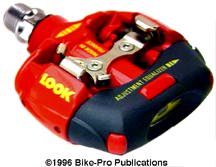
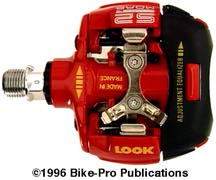
The S2R (S2 Racing) Moab is the same pedal set as the S2S, only the spring that creates the common tension between the two pistons changed, and the pedal sare given different cosmetics. The 2SR Moab has cleat tension that adjusts from 8 to 17 Newton per meter. We can tell that since 8 is the loosest setting, that at its minimum, the S2R will require more effort than the S2S Nevada to release the cleat. The 17 Newton upper end also means the Moab can be set to an even tighter tension, release than the Nevada. The Moab is painted in glossy Red, with the rubber side protector in Black. The pair of Moab pedals weigh 521 grams. The Black steel cleats and mounting hardware weigh an added 75 1/2 grams. Made in France. $ Price in Catalog