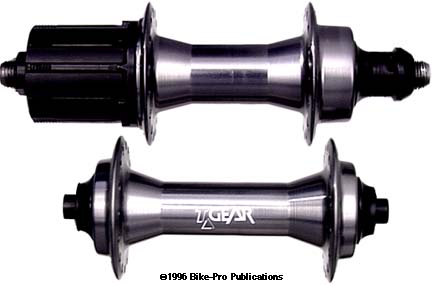
The Eclipse hubs are a machined aluminum, sealed bearing, Shimano cassette compatible hubset. Six fairly simple pieces make up the front hub. The single piece front hub shell is machined from 6061-T6 aluminum alloy rod stock. After turning at a lathe station, the piece is drilled through to hollow and reduce its weight. Each end is bored, leaving a bearing cavity with a shoulder at the backside for the precision sealed bearing cartridge to butt against. The empty shell weighs just 47 grams. A hollow machined aluminum axle with the interior of each end tapped with threads separates the bearings. Once one of the bearings has been pressed into the hub, the axle is inserted, then the second bearing is installed over the axle. The axle is held in place by raised shoulders that the bearing inner race presses against. To finish the hub two machined aluminum axle caps are used. This cap threads into the axle covering most of the bearing. The cap has a 17mm diameter contact surface with the fork blade. The face of this cap is knurled to grip the fork. The rear hub has a machined shell, that's again drilled and bored for the non drive side sealed bearing. The drive side of the hub remains without a cartridge sealed bearing. Instead, T Gear uses the Shimano freehub, with the Shimano fastening system to hold it to the hub shell. The Shimano system and the basis of the Shimano patent on the freehub they sell is to use a 13.8mm diameter steel tube threaded on the outside with 1mm pitched threads. The tube has a 10mm hex sided interior, for a 10mm hex wrench as the installation tool. The tube has a shoulder at its outer end to press against and hold the freehub body. The steel fastening passes through the freehub and threads into the hub shell holding the steel freehub. For the drive side bearing, the Shimano outer cup and nine steel ball bearings are used. The hollow steel axle uses a steel cone race and lock nut with a rubber contact seal on the drive side. The non-drive side uses a machined from aluminum thread on end cap which covers the majority of the sealed bearing. Aluminum spacers and a lock nut finish the non-drive side. The Eclipse rear hub come in three axle arrangements, a 130mm length using an 8 speed Ultegra freehub body, a 135mm length using an XT 7 speed freehub body, or a 135mm length using an XTR 8 speed freehub body. The 135mm, 8 speed will accept CS- M737, HG-90, or HG70 8 speed cassettes. For 7 speed, the HG-50, HG-60 or HG-90 will work. The front hub has a 50mm hub flange diameter, with 70mm spaced between flanges. The front spoke holes have a 43mm center circle diameter. The rear hub has a 50mm hub flange diameter, with flanges spaced 54mm apart. The rear spoke holes have a 43mm center circle diameter. The Eclipse front weighs 115 grams, the rear with 135mm spacing for 7 speed use, without cogs, weighs 324.5 grams. The front hub requires two 7/32" hex wrenches to remove the axle end caps. For the rear hub, you will need two 14mm cone wrenches to hold the cone race, loosen the locknut. The Eclipse hubs have an anodized finish in six colors, Blue, Black, Grey, Lavender, Red or Silver. The hubs are available in 32 or 36 hole drilling, matched the way you want, with a 130mm 8 speed axle, a 135mm 7 speed axle or a 135mm 8 speed axle. Please specify hole pattern.
Eclipse front only $ Price in Catalog
Eclipse cassette rear only $ Price in Catalog
Eclipse hubset (pair) $ Price in Catalog