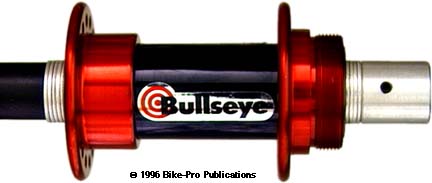
Bullseye hubs, are made in Burbank, Southern California, are affordably price, while being flexible in the bikes they will fit. Bullseye was one of the first two hub makers to make hubs using precision sealed cartridge bearings. Nearly the entire hubset is made of aluminum. The hub is made of three pieces of aluminum, The flanges are machined as separate pieces and pressed onto an aluminum tube that is the core tube. The three pieces once pressed together make a single rigid hub shell. The front hub uses two Chinese (Mainland China) made sealed bearing cartridges. With one bearing pressed in place, a 16mm O.D. aluminum tube is placed into the hub core tube, then the other bearing is pressed in place. This inner aluminum has a 12mm inner diameter. The 11.96mm outer diameter hollow aluminum axle slides through both bearings and the inner aluminum which reinforces the axle.
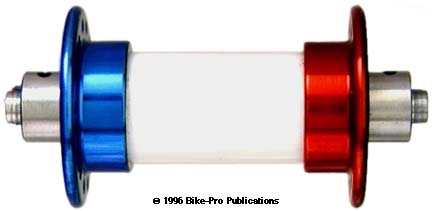
The axle is machined from rod, its ends are reduced to the needed 9mm outer diameter for the fork ends. Two locking collars are used to hold the axle in place. These aluminum rings use a single set screw with a 2mm hex fitting to lock the collar onto the axle. The rear hub is similarly constructed using a longer axle, with additional spacers so the hub will accomodate any English threaded freewheel. The ends of both axles have inner threads tapped into them. These threads permit four included bolts to be used to fasten the hubs/wheels to the bike without using wheel skewers. The included bolts with their washers weigh somewhat less than quick release skewers.
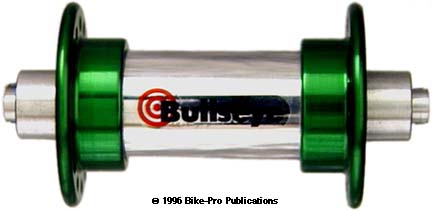
We inventory Bullseye hubs in all Black and all Silver, but many other combinations are other available. The hubsets can be custom built. You can specify when ordering any number of color combinations. The flanges are always an anodized color, and can be; Blue, Black, Red, Gold, Lavender, Green, or Silver. The core tube joining the flanges can be any of those anodized colors plus a number of painted colors, including Avocado Green, Yellow, White, Neon Yellow, Pink or pastel Lavender. It takes about two weeks for the hubs to be delivered, so patience is required. Rear axle length can be custom ordered to be 126mm (Road 6 speed use), 130mm (Road 7 or 8 speed use), 135mm (Mountain 7 or 8 speed use), or 140mm (tandem rear wheel use) depending on your use. The available drillings for hole patterns on the hubs are 24, 28, 32, 36, 40, or 48 hole flanges. The hole drillings can be split differently front and rear. The front hub has a 54mm hub flange diameter, with 72mm spaced flanges. The front spoke holes have a 43mm center circle diameter. The rear hub has a 54mm hub flange diameter, with 59mm spaced flanges. The rear spoke holes have a 43mm center circle diameter.
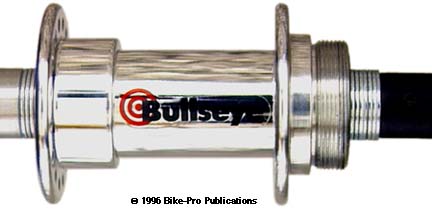
With mounting bolts & washers, the front weighs 198.5 grams, (the bolt set is 27.5 grams), the rear hub in a 135mm length axle, with bolt set, and without freewheel, weighs 249 grams, (the bolt set weighs 27.5 grams). Bullseye includes the needed 3/16" hex wrench to use their bolt set for wheel fastening. Also included is a 2mm hex wrench to adjust the locking collars. Please specify hole pattern. Please be ready with rear axle length, hole pattern, and color scheme when ordering.
Rront hub only (Color-BK-S) $ Price in Catalog
Rear hub only (Color-BK-S) $ Price in Catalog
Pair (Color-BK-S) $ Price in Catalog
Bullseye custom front hub only $ Price in Catalog
Bullseye custom rear hub only $ Price in Catalog
Bullseye custom hubset (pair) $ Price in Catalog