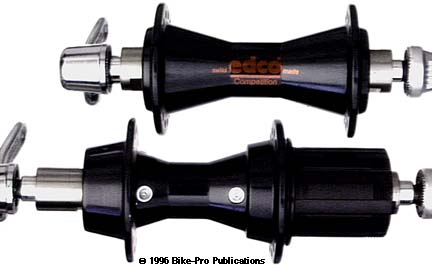
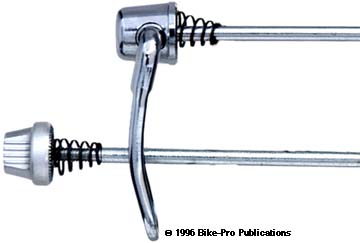
Edco is a Swiss manufacturing concern that was among the first to stand up and try to intrude on Shimano's cassette market and courageous enough to make the cassette body spline compatible with the Shimano Uni-Hyper-Glide/Drive cassettes. The second distinction these hubs have is being the first Shimano cassette compatible hubset with "Zerk" styled lubrication injection ports on the inner hub flange to force grease through the bearings. The hub shells are a one piece design, machined from aluminum alloy rod. The front hub is turned on a lathe to derive its hour glass shape. The piece is drilled through for the axle passageway. Each end of the hub is bored to make a cavity to recess the bearing cartridge. At the inside of each flange a hole is drilled and a grease injection fitting is pressed into the conical shape of the hub. This angle allows the lubrication to be injected into the back of the bearing. Which brings us to the bearings, Edco uses precision sealed cartridge bearings that have the seal on one side removed, (this is the exactly the concept also used by WTB in their "GreaseGuardª). Grease injected into the "open", meaning now "unsealed" side migrates through the bearing and exits the bearing around the inner race through a flexible rubber area of the seal. Once the bearing has been installed in one side, with the open side facing into the hub shell, an aluminum tube having exactly the same inner diameter as the inner bearing race is placed in the hub shell. The second bearing is pressed into the hub so both inner races butt against this inner aluminum tube. When grease is injected through the injection ports it comes in contact with this inner aluminum tube and moves out toward the bearing, passes through the rear opened bearing and then moves through the seal at the axle. The axle is machined from aluminum rod, has a 12mm outer diameter, with a 5mm inner diameter. The axle ends are threaded. A steel dust seal is pushed up the axle and a shoulder race threads up the axle to hold it and the axle in place. The shoulder race is 17mm in diameter, and has a serrated outer face which comes in contact with the fork. The rear hub shell is made in the same style as the front. It has injection ports and open ended bearing cartridges. The inner aluminum tube is again used to force the grease into the bearing. Though the rear hub gives the appearance of an injectable drive side bearing, the bearing is blocked in by the pawl mechanism and purging the spent grease isn't possible therefore there would be no grease migration through and out of the bearing. The pawl mechanism is a large steel plate pressed into the shell covering an inner drive side cartridge bearing, (lets hope it never fails!). Two pawls are used with a circular wire spring holding them in position. The ratchet ramp is in the interior of the steel freehub body, there are 24 ramps for the pawls to drive against. Within the freehub body there are two sealed cartridge bearings and an aluminum tubing spacer between the two. There is no functional injection capability for any of the three drive side bearing in the rear hub, only the non-drive is truly functional. The rear axle is machined from aluminum rod just like the front, with a 12mm O.D. Steel dust seals are held in place by shoulder races. The drive side shoulder race also functions as a spacer to properly space the hub. The Edco hubset comes with a pair of steel quick release skewers that use and internal cam system to constrict and lock the wheel on the bike. The adjusting nut on these skewers is made of steel with an aluminum cover or "jacket" with relatively flat areas for a finger grip, with a plastic inner sleeve that makes it function like a lock nut. The front hub has a 50.5mm hub flange diameter, with the hub flanges spaced 70mm apart. The front spoke holes have a 42mm center circle diameter. The rear hub has a 55mm hub flange diameter, with 54mm spaced flanges. The rear spoke holes have a 46mm center circle diameter. With skewer, the front weighs 281 grams, (skewer is 81 grams). The freehub with skewer, and without cogs, weighs 482.5 grams, (skewer 87.5 grams). This HyperGlide compatible cassette freehub, requires that the last cog thread onto the outside of the freehub end. The freehub body end is not internally threaded, this limits it to just the Shimano CS-7401 cassette, (written about in the freewheel section). The Edco rear freehub can come with either a 130mm (8 speed Road) or a 135mm (8 speed Mountain) axle. The front hub requires two 15mm box or cone wrenches to work on. The rear hub requires the same two wrenches. They come in a Black anodized finish only. The hubs are available in a 32 or 36 hole drilling, matched the way you want. Please specify hole pattern. Made in Switzerland. (pair) $ Price in Catalog