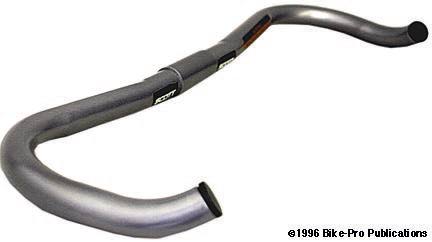
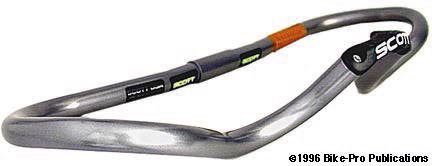
The AT-2 is a combination bar with short Ski-type bar extensions. Two pieces of 6063-T832 straight gauge, aluminum alloy tubing are used to make the AT-2. Both pieces have an outer diameter of 22mm, and a wall thickness of approximately 1.51mm. The longer of the two pieces is bent to form the handlebar, the other becomes a shim or "collar" to build the diameter at the center out to the needed 25.4mm standard for mountain bars. The collar piece, which is 60mm (2 3/8") long, is cut once lengthwise and slid down the length of handlebar to the center of the tube before it is bent. The AT-2 has a slight rearward bend starting at 1 3/8" from the collar end on both sides. Each side of the handlebar bends forward then inward toward the front tire. A second bend in the bar extension, curves the tubing up slightly, leaving a Ski-bend styled extension with 6 1/2" of grip area. The inner diameter of the tubing at the end is 18.8mm. Included are two of the Rodon Black plastic press-in end plugs we wrote about in the bar extension section. The AT-2 comes in three widths, 21", 22" or 23" and appears to be wet painted in a metallic Grey. The weight of a 21" AT-2, with its end plugs, is 288 grams.
Width-21-22-23/4 $ Price in Catalog
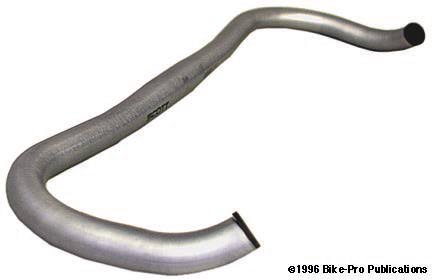
The AT-2 LF is a lighter weight version of the AT-2, made of a 7000 series aluminum alloy, (remember a bigger number for an aluminum means nothing in terms of strength, please read the Metals section for a further understanding). Its weight reduction is performed by making the LF model of a single piece of aluminum tubing that has a tapered wall thickness. Before the tubing is bent into its handlebar shape, the original tubing blank is "swaged" reducing the wall thickness the closer it approaches each tubing end. The center most 40mm of the bar has a 25.4mm outer diameter. Like the AT-2, this handlebar has slight rearward bend beginning at both sides of the bulged center, with the ends curving forward and then in toward the front tire. A upturned end creates the Ski-bend handlebar extension. At two inches from the center bulge, the tapered outer diameter is reduced to 22.2mm, and remains at 22.2 for the remainder of each sides length. The tubing has a wall thickness of .92mm, and an inner diameter of 20.0mm at the ends. Included are two of the Rodon Black plastic press-in end plugs we wrote about in our bar extension section. The AT-2 LF comes in three widths, 21", 22" or 23" measured outer-outer at the widest point of the extension curves. It has a Silver color with brushed outer surface with fine patterned lines around (circumferencially) the tubing concentrically. The weight of a 21" AT-2 LF, with its end plugs, is 182.5 grams.
Width-21-22-23 / L $ Price in Catalog
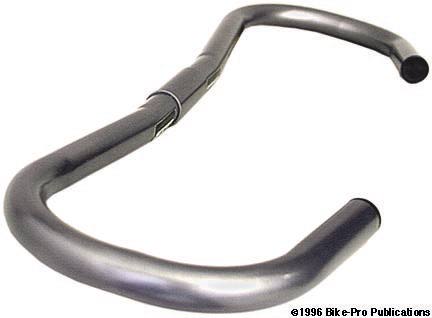
The AT-3 is made using two pieces of tubing like the AT-2. The grip tube is longer, however to make the Ski-bend extensions become L-bend extensions on the AT-3. The split inner sleeve, or collar is identical to that used on the AT-2. The AT-3 uses the same rearward curve away from the collar, with about 7 1/2" of length until it reaches its full forward curve. The forward bend making the primary grip section of the bar extension is 3 1/2" long. The inward curve toward the front tire makes a secondary grip section that is 4 inches long. The AT-3 come in the same three widths, 21", 22" or 23" measured outer-outer, and is has what appears to be a wet painted metal Grey finish. Like the two previous AT bars, it also comes with Black press-in Rodon end caps. The weight of the 21" AT-3, with end plugs, is 333.5 grams.
Width-21-22-23 $ Price in Catalog
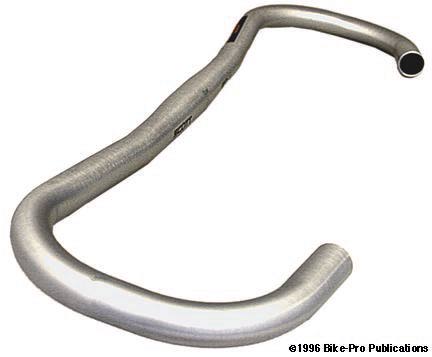
The AT-3 LF is made using the same 7000 series tubing and techniques used to make the AT-2 LF, but the tubing is longer to make the L-bend extensions. The AT-3 LF faithfully replicates the bends of the AT-3 exactly, however the secondary grip section of the L-bend extension is 3/4" shorter on each end. Like the AT-2 LF, the this bar is Silver in color and has a the same brushed finish leaving fine circumferencial lines around the tubing. The AT-3 LF comes with a pair of Black Rodon press-in end plugs and is available in a 21", 22" or a 23" measured outer-outer. The weight of the 23" AT-3 LF, with plugs, weighs just 219 grams.
Width-21-22-23 / L $ Price in Catalog
The AT-4 Pro brings the aero clip-on style to the mountain bike environment with the L-bend extension styled ends. The AT-4 Pro is made of 6063-T832 straight gauge aluminum alloy tubing like the AT-2 and the AT-3. Like them, it also uses a two piece tubing design with a 60mm split collar used to build the stock 22.2mm outer diameter of the tubing to the needed 25.4 mm for the mountain stem. The bar bends rearward slightly 1 1/2" from each side of the collar. The relatively straight rear of the bar is 370mm long, on the 21" size, before bending forward. The bends turn the bar at 90 degrees making the 4 1/2" long primary grip section of the bar extension. The second bend making the secondary grip section turns the past 90 degrees further so it actually turns back slightly toward the head tube for about 4 1/2". The final turn bends the bar forward again, and upward so forearms will rest on the rear section of the bar with clenched hands around the upward tubing section. The open ends of the bar tubing are closed and held together using the included Scott bar bridge. Made of three pieces of molded Neon Yellow plastic which uses an expanding wedge principle to tighten and hold the bridge in the tubing ends. The AT-4 Pro comes in three widths 21", 22" or 23" measured outer-outer at the curves. The tubing is painted a metal Grey. The 21" AT-4 Pro, with bar bridge, weighs 488 1/2 grams. Made in USA
Width-21-22-23 $ Price in Catalog