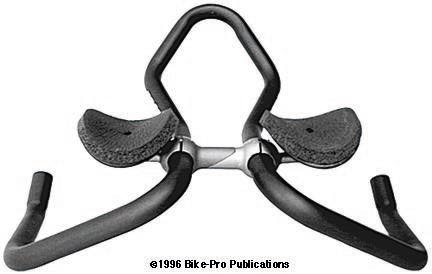
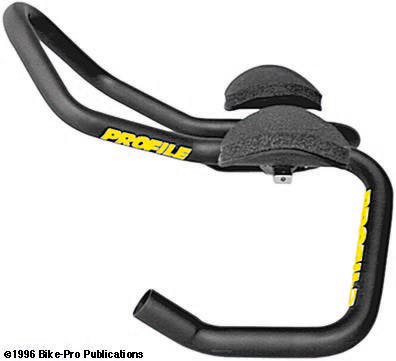
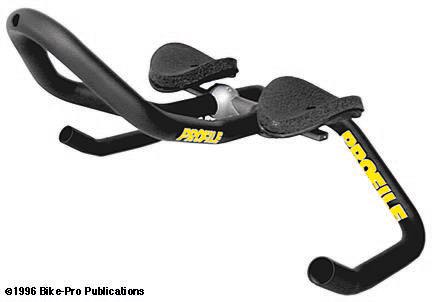
This is the only handlebar to have the appearance of a Romulan Bird of Prey. The Airwave is made of a single piece of aluminum alloy tubing having a 7/8" (22.4mm) outer diameter and a 1.5mm wall thickness. The single tube has many bends performed on it, leaving several hand positions. At the extreme sides of the bar are grip areas that are 85mm lower than the stem mount. These lower grips turn up slightly at the bar end so your hands won't merely slide off. The top of the bar slopes down and away from the stem mounting area to the lower drops. This 30 degree downward slope is actually more comfortable to hold onto, lifters will recognize this is the basis of the EZ curl bar. The two curves forming the bends of these two grips also work for firm, alternative palm placement. The stem mounting system is made of four pieces of forged aluminum which clamp around the handlebar and create a cantilevered bolt to surface for the forearm cup. There are two clamp pieces which interlock and are joined by a bolt passing through one piece and anchoring the other. These two bolted pieces form the inner structure of the stem mount. From the outside of the stem mount, each side has an outer clamp piece held to the inner structure by two bolts, one through the top, the other through the bottom anchoring into the inner clamp. Each outer clamp has a 14mm wide, 8mm thick and 50mm long aluminum bar extending outwardly from it. This bar has three holes drilled through it, each tapped with threads for the arm rest cup to bolt into. The first hole occurs 1 1/2" from the handlebar tubing center, each of the other two occur at 1/2" intervals from the first. These four clamp pieces occupy just 1 1/4" (31.75mm) of the forward extending bar tubes. Of the 4 1/2" length of these forward extending tubes, a 2 3/4" middle section is knurled to grip the inner ridges of the four clamp pieces, locking all parts together, once the bolts are tightened. The plastic arm rests cups are cushioned by foam vinyl pads that are held in place on the cup with adhesive backed Velcroª hooks that grab a loop structured fabric on both sides of the foam pad. The front grip tube is 6 1/2" long and achieves up to a 5 1/2" rise at the apex of the grip tube curve. A hole drilled through the apex of the grip tube allows the Profile SwiftShift shifter bridge to be fastened to the front of the Airwave. With the SwiftShift (not included) in place, Road riders can shift their bikes from the forward leaning, streamlined position, (read more about in the shifter section). The Airwave's tubing section has a 22.2mm (7/8") outer diameter except at the upturned ends where it is 23.8mm O.D. The tubing section is made in Black only, the clamp pieces are anodized in a Grey color, the arm rests and pads are Black. The Airwave is made in a small and large size, having to do with the length of the tubes the stem mount bolts to. The small Airwave tube weighs 401 grams, the clamps, arm rests and mounting hardware add an additional 247 grams totaling 648 grams. The outer diameter of the two inner clamp pieces is 22.2mm, not a diameter recognized as an inner stem diameter. To use the Airwave will require a shim that the inner clamp pieces are bolted together within. There are three available shims, which build the clamps to either a 25.4mm (mountain stem diameter), 26.0mm (road stem standard diameter), or 26.4mm (Cinelli only standard diameter). When you order the Airwave be certain to state the needed shim diameter.
Small $ Price in Catalog
Large$ Price in Catalog
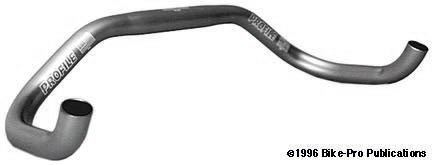
The AirWing like the Profile Hammer is made from 6061-T4 aluminum alloy tubing. As a trial bar the tubing bend descends forward and to the front, the open ends of the tubing face forward. At the ends, the tubing has a 23.7mm outer diameter, and a wall thickness of 1.7mm, so it appears the same tubing blank is used for both the Hammer and the AirWing. Between the ends, the wall thickness may vary because of bends and bulges. The centermost 3 inches is bulged from the 23.7 up to 26.0mm, the standard for Road stems other than the Cinelli 26.4 I.D. stems. The AirWing slopes downward, at 40 degrees, at both sides of the stem. The bar then bends forward creating a 95mm long flat grip area before it turns upward slightly at the tubing end. The upward turns at the tubing end are to mount the brake levers on. Along the inner side of the flat grip section and through the large lower curve is a depression to recess the brake cable beneath the grip wrap if aerodynamic levers are used. The distance from the tubing center at the bulge to the tubing center of the flat grip area is 84mm. The AirWing comes anodized in a Gun Metal Blue color, in two widths, 40cm or 42cm. The 40cm version of the AirWing weighs 240.5 grams.
Width-40-42$ Price in Catalog