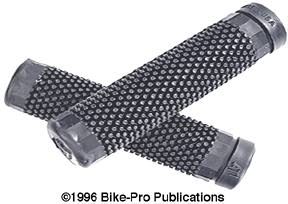
The Iso-Grips are designed with wet weather riding conditions in mind. They are a thin walled grip so that a gloved hand still has a firm feel of the bike. They are made from a compound that ATI calls "Newtron" rubber, which has a soft rubber-like feel but doesn't have the tacky adhesion quality of the Kraton-type rubber compounds used in other grips. At the inner side is there is a groove cut so the grip can be wired or zip tied on the handle bar to hold it more securely. The palm area of the grip has small 2.5mm in diameter tapered points that are raised from a recessed bed in the grip, so the grip itself maintains a constant diameter from and to and. The use of these points provides many, many small contact surfaces which give under pressure, but permit water to drop in the recess, roll around the grip and fall off the lower side of the handlebar. The outer end is molded extra thick to help prevent the grip end from ripping off in an accident. The Iso-Grip weighs 88 grams per pair, have a durometer hardness of A/52, are 4.7 inches long, and made in Black only. Made in USA. $ Price in Catalog
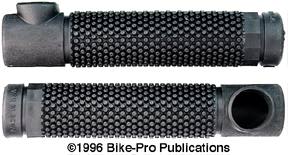
The Iso-Grip Bar End Gloves are a variation on the ISO-Grips made by extending the outer end an additional 1.1 inches to accommodate handle bar extensions. The Bar End Gloves have circumferential grooves for wire-on applications, one at the inner end, the other at 1.2 inches from the outer end. The palm and fingertip area of the grip is the same as the ISO-Grip. The outer added end adds a smooth surfaced enclosure of the final 1.2 inches, with added thickness over the end of the handlebar. It has a 3/4 inch diameter hole centered 7/10 of an inch from the grip outer end, for the handle bar extension to protrude through. This style of grip will accommodate wedge styled bar extensions or handlebars bent at the ends to provide an extension (Brahma Bar, Flite Control Steerhorn) easily. The cinch type of bar end will have problems because the Bar End Glove has no place to house the cinch mechanism. The ISO-Grip Bar End Gloves are made only in a Black Kraton-like rubber that ATI refers to as "Newtronª" being their trademarked name for whatever the actual compound is. The pair weighs 96.5 grams, are 5.8 inches long and made in the USA. We found they had a durometer hardness of A/48. Made in USA. $ Price in Catalog
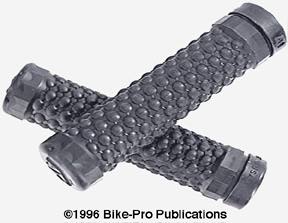
The ATI Newtron grips are also made of their Newtron rubber compound and designed for "all climate conditions". The grip is similar to the Iso-Grip, it is thin walled for use with or without gloves. The inner end has a deep groove for wire or zip tie fastening to the handlebar and the ends are extra thick to prevent the grip end from ripping in a fall. The palm area is where they differ. The Newtron grip palm area is again recessed, but instead of using small raised points , the Newtron grip has linked round bumps that are 6mm in diameter. The larger bumps give more surface to grip, while there is still give to each of them to cushion the ride. The bumps provide some area for water to run off the grip yet there is a large contact area. The weight of the Newtron grips is 76 grams per pair, and have a durometer hardness of A/46. They are 4.7 inches long and made in Black only. Made in USA. $ Price in Catalog
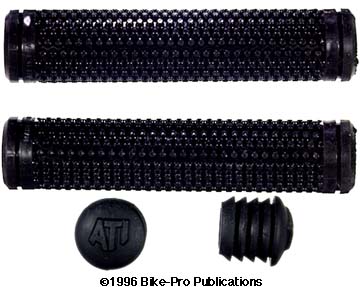
ATI SLIM LINE NEWTRON GRIPS
These are made by ATI, in their plant in Southern California. The Slim Line model is made considerably thinner in the central grip area. The total thickness of the raised dots is just 1/10". The grip bed linking them is much, much thinner. (From a manufacturing point of view, it takes much less time to make a pair of thin wall grips because the "fill time", that is the amount of time taken to fill the "insert" is less. An injection molding machine filled with inserts to make thin wall grips will produce far more, in the same amount of time, than one filled with inserts to make thicker walled grips) The Slim Line Newtrons are open at both ends, and come with a pair of molded hard Black rubber press-in end plugs. These grips are too thin to measure the durometric hardness. They are available in Clear, Black, Translucent Blue or Translucent Lavender. A pair in Clear weighs 34 grams, the end plugs weigh 9 grams more. Remember these grips are so thin wearing gloves to reduce any of shock or vibration is a must. $ Price in Catalog
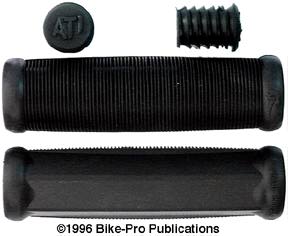
The ATI Tanzer mountain grip has some features that we've seen before in the ODI Attack and the Scott AT-Pro grips. The Tanzer has raised spiral groove on the top half in contact with the palm. This rubber raised groove has a soft "give" cushioning the hand against vibration. The bottom half of the grip has three smooth sides, in essence one half of a hex-shaped grip like the Scott grips have featured. The Tanzer has a very slightly raised flange at each end which will not interfere with brake or shifter operations. The Tanzer grips are open at each end, with a raised ridge in the interior of each end to seal the grip to handlebar contact from outside elements. Each pair of Tanzer grips comes with a pair of Black, hard rubber bar end plugs. The pair with end plugs weighs 118 grams, of which 9.5 grams is the plugs. They are 4.8 inches long and made in the USA. We found the Tanzer grips had a durometer hardness of A/54. $ Price in Catalog
The Tomac grips are made in the ATI plant in California, and draw their name from a former BMX racer grown up to Mountain Bike racer, John Tomac. (We very rarely allow ourselves to further a sponsored riders career by further advertising their name with a products under review, but ATI called these "Tomac" grips, making it un-avoidable, while claiming they were designed by same. As a policy, we try to keep sponsored personalities away from product reviews. The product should stand on its own merit, not the amount of money paid to use someone's name or reputation.)
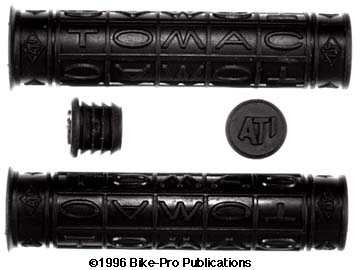
The Tomac grip is a thin walled grip with the 9/100" thickness that has long horizontal ribs running nearly the length of the grip that are 15/100th of an inch thick, (6/100ths or 1.5mm of added height from the bed area). Joining these horizonal ribs are vertical ribs that create 5 rectangles, within each of these rectangles is one the letters of the Tomac name. About 1/2" from each end is a vertical groove within the raised area so the grip can wired onto the handlebar. Cutting through the groove at the outer end of the grip shortens it to the proper length for Grip Shift application. The Tomac grip has a tiny tapered flange at the inner end. Because the grip is open at both ends, Tomac grips come with a pair of hard Black rubber press-in end plugs. Tomac grips weigh 51 1/2 grams per pair (translucent Lavender), the end plugs add another 9 grams. They are available in Black, Clear, Translucent Blue or Translucent Lavender. $ Price in Catalog
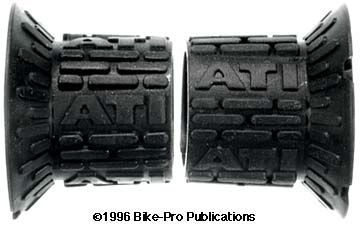
ATI Links Grips for SRT 8/900
$ Price in Catalog
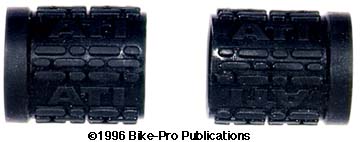
ATI Rotary Shifter Grips for SRT 5/600
$ Price in Catalog