Mavic has always had the reputation of building bike parts without compromise to just one set of high standards. They have never adopted a "second best way". This front derailleur isn't an exception. It uses the pantagraph lift and push style of the other fronts, so it smoothly transfers the chain back and forth. It is made in a clamp style only, and Mavic has figured out a clever way to address multiple clamp sizes. The cast aluminum clamp pieces are made to create a 34.3mm opening, inside of which a firm plastic ring slips. The derailleur comes with three rings, each is a different thickness that make each a different inner diameter. The ring slips around the seat tube, and the derailleur bolts around the ring. You are provided rings to fit, 1 1/8", 1 1/4" and 1 3/8" seat tubes. Another benefit of this thinking, is if you ever change frames, and the new one has a different seat tube diameter, purchasing a new front derailleur will be unnecessary. The clamp section is made of hard anodized aluminum, while the pivot links are Black painted aluminum, with the Mavic logo laser etched in the side. The cage on the derailleur is case hardened steel with a matte chrome finish. There are cut-outs on the inner side of the cage to reduce the weight. Set screws are placed on the top. A real virtue of this derailleur is that every part of it can be disassembled, nothing is riveted, this is unique, among all the fronts we sell. Mavic parts should they ever fail, are made to be repaired, and replacement parts are available. It can't be overstated this should be the last front derailleur you ever have to buy. The cage can be opened at the rear by removing a bolt and spacer, so the derailleur can be removed from the bike with out having to break the chain. Intended for triple chainring cranks. With the 1 1/8" clamp, the 875 weighs 128 grams. This is not available in a top pull style. The cable fastening and the clamp bolt have the same thread and approximate length. These steel bolts can be replaced with Titanium models using the SRP Ti cable fastening bolt. The 875 is no longer made but sold for $89.99. We include it here because the subsequent reviews build on this information.
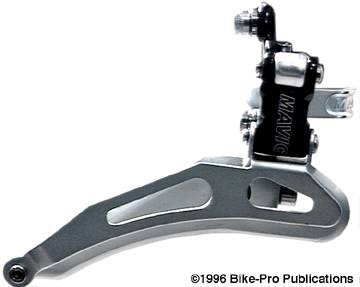
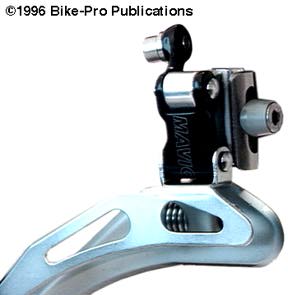
The 860/862 Road front derailleurs use most of the same small parts and employs the same rebuilding principle found in the Mountain version. None of the parts are riveted together with spares available if you "dab". For the record, the 860 is the clamp version of this double chainring front derailleur, while the 862 is for frames required a braze-on mounting. The cage has been made lighter by reducing its structure and cutting holes into both the inner and outer sides of the cage. The springs and fasteners holding the cage and the pivot linkages on both models are the same as those used on the 875, just the clamping/mounting link is different. The cage has a removable screw and spacer at the rear, which when opened permit the derailleur to be removed from the bike without needing to "break" the chain. Set screws to adjust the throw of the cage are on top of the link assembly. The clamp bolt on the 860 is made of steel, 5mm x .8mm with a 15mm length and replaceable by the Titanium SRP clamp bolt. The 860 clamp model is available only to fit a 1 1/8" down tube and weighs 101 grams. The 862 braze-on mount model is a little lighter, weighing just 92.5 grams. The steel mounting bolt on the 862 is a short 5mm x .8mm that is 12mm long. It can be comfortably replaced by the shorter Titanium SRP cable fastening bolt. The steel cable fastening bolts on both models can be replaced by the SRP Ti model cable bolt. The ability to repair these front derailleurs can't be understated. No Japanese or Italian parts maker has adopted, as completely, this attitude.
1 1/8" clamp/band type $ Price in Catalog

Braze-on mount       S $ Price in Catalog