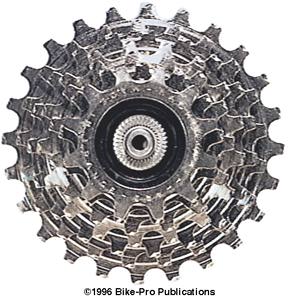
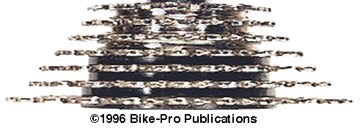
The Sachs, French made, Aris (Advanced Rider Index System) freewheel has taken off in popularity, because it is well thought out and crafted, but most of all the thickness of the cog and the spacing make it trouble free with index systems other than ARIS including, Campagnolo Synchro, Mavic, Shimano SIS & HG systems, and Suntour Accushift. And if that weren't enough, (and golly gosh, it ought to be), it will of course work with every friction shift system ever made! The cogs measured by micrometer to a 1.9mm thickness, while the spacers are 3.0mm thick, well within the machine tolerances of bicycle parts to be compatible with all the previously described index systems.
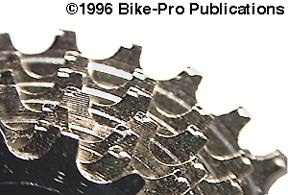
The tooth profile, Sachs calls "RGS" for "Rapid Grip and Shift". Each of the teeth on the cogs are the same, and they are the same on all cogs in the set. The front of the tooth is machine beveled, to make it thin at the top, and thicker at the bottom. The top of each tooth has a V-shaped groove in it running lengthwise, then the back half of each tooth top is crimped, pushing the V on the back closed, and raising the tooth height slightly at the rear. A single, simple system.
The cogs are made of steel, that is hardened prior to being nickel plated, giving them a bright Silver color. The 4 largest cogs have plastic spacers between them, the set of three weighs 8 grams. The 2nd, 3rd, or on an 8 speed freewheel, the 4th position cog thread onto the freewheel body. The 1st, or on an 8 speed F/W, 1st and 2nd position cog thread internally into the cog ahead of them in line. This threading of the first, or first and second cog, into the next is why the Sachs Aris freewheel can make an eight cog freewheel still fit, and work, on just a 130mm over lock nut dimensioned rear hub.
The outer cone race is forged of steel, that has four dimples pressed into the outside face to remove it, by turning it clockwise, with some difficulty. The cone race itself is ground and polished before it's given its Black color. The inner and outer body pieces are forged as a single piece of steel, with all races ground and polished, before they are given their Black color. Beneath the outer cone race are thirty-one 3.0mm diameter steel ball bearings revolving in a polished cup race built as a part of the inner body piece.
There are thirty-eight 3.0mm steel ball bearings that make the inner bearing assembly, again revolving on two polished surfaces. The Aris freewheel uses two steel pawls held in place and operated by a circular wire spring. There are no lubrication ports on the freewheel body to permit external lubrication of the bearing cavity, you will have to take it apart, or use a Phil Wood grease injector to re-lubricate it. Sachs chose to use the Shimano freewheel notch pattern for their freewheel, so a Shimano TL-FW30 or a Park FR-1 freewheel removal tool will be the proper removal tool.
Sachs naturally recommends the use of their Sachs-Sedis chains with this freewheel, but this isn't viewed as a necessity. This freewheel is available in 6, 7 or 8 speed models, the sprocket combinations follow. There is very limited availability of the 6 speed freewheels.
13/18 - Cogset Type D6  (   g)$ Price in Catalog
13/21 - Cogset Type E6  (   g)$ Price in Catalog
13/24 - Cogset Type F6  (   g)$ Price in Catalog
13/26 - Cogset Type H6  (   g)$ Price in Catalog
13/28 - Cogset Type I6  (   g)$ Price in Catalog
13/30 - Cogset Type L6  (   g)$ Price in Catalog
13/32 - Cogset Type N6  (   g)$ Price in Catalog
12/18 - Cogset Type B7  (   g)$ Price in Catalog
12/21 - Cogset Type D7  (   g)$ Price in Catalog
12/24 - Cogset Type G7  (412g)$ Price in Catalog
12/26 - Cogset Type H7  (   g)$ Price in Catalog
12/28 - Cogset Type I7  (439g)$ Price in Catalog
12/30 - Cogset Type M7  (   g)$ Price in Catalog
13/21 - Cogset Type R7  (   g)$ Price in Catalog
13/24 - Cogset Type T7  (   g)$ Price in Catalog
13/28 - Cogset Type W7  (489g)$ Price in Catalog
13/30 - Cogset Type X7  (499g)$ Price in Catalog
13/32 - Cogset Type AA7 (564g)$ Price in Catalog
12/19 - Cogset Type B8  (   g)$ Price in Catalog
12/21 - Cogset Type C8  (   g)$ Price in Catalog
12/24 - Cogset Type F8  (419g)$ Price in Catalog
12/28 - Cogset Type I8  (487g)$ Price in Catalog
13/21 - Cogset Type K8  (   g)$ Price in Catalog
13/24 - Cogset Type M8  (   g)$ Price in Catalog