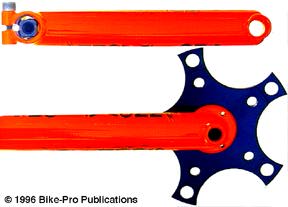
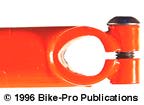
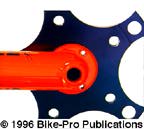
Grove Innovations brings some new features to 2-piece crank design. The Hot Rods are made using light weight, hollow 4130 cro-moly steel tubing that is heat treated after manufacture to raise the tensile strength. The left arm is made of hollow oval shaped cro-moly tubing, that is miter cut at both ends, in a half-round shape to allow long joining surfaces for the pedal and spindle lug welds. The pedal lug is made of 1" long cro-moly tubing that is drilled and tapped 1/2" deep on the pedal side. To reduce weight, the chainstay side is drilled 1/2" deep with a larger diameter hole. The pedal lug is TIG welded with one continuous, clean, pulsed bead along all joining surfaces. The spindle lug is machined from cro-moly rod and uses a three sided, elliptically round fastening hole. This is a major advance in crank arm pinch style fastening, because the entire surface of the three sides actually bears the load placed on the spindle. Typically the load is born only on the peaks of the points, where the spindle and cranks arms join, which is why aluminum arms that are slightly loose "round out" so frequently. On traditional cranks, each of the peaks on the tapered spindle puts fantastically high amounts of stress on the remaining aluminum that it's in contact with.
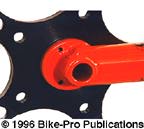
The Grove three sided spindle, (shaped like the Wankel engine's "piston"), is what the military specifies frequently in axle design. The spindle lug is welded like the pedal lug to the arm. The pinch bolt assembly on the left arm is made from cro-moly steel rod that is drilled and tapped for the bolt, then welded onto the crank spindle lug. The top of the spindle lug and pinch bolt is then sawn through to make the arm opening, cleaned of burrs with hand filing and then heat treated prior to painting. The right arm is made like the left, with just a few differences. It has the spindle itself welded where the pinch bolt system is, and a spider mounting plate is welded behind the arm.
The aluminum spider is made of plate stock that is cut to shape, milled with chainring recessions, then drilled and tapped for the fixing bolts. The spider, (chainring mounting plate), uses the standard 74mm and 110mm fixing bolt pattern. Groves cranks use the "hidden fifth arm" principle, meaning one of the spider arms rests beneath, and is bolted to, the right crank arm. Although any chainrings conforming to the 74/110mm standard can be used on these cranks. The Hot Rods come with a "floating," sealed bearing, bottom bracket.
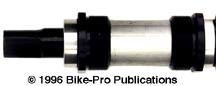
The bottom bracket cups are turned on a lathe of 6061 aluminum billet, sawn to give the square edges and threaded for English B/B shells. Inside each bearing cup are two precision sealed bearing cartridges sitting side by side, which distribute the load vertically over twice the distance of many other B/B makers. Each cartridge houses 24 ball bearings so the total load is born by 96 1/8" ball bearings. The inner side of the bearing cup has a recess on the inner lip with a rubber O-ring set in it for moisture and dirt prevention. On the outer side of the bearing cup is a lathe cut aluminum plate with a half round recess cut in it for an O-ring to protect the bearing assembly from outside contamination. The floating cups are held in place around the B/B shell by aluminum locking collars that bind on the spindle using a small allen head cap screw. Included with the cranks is a set of five aluminum spacers for the inner fixing bolt set.
The cranks are made in Screaming Warning Orange, (neon orange), or glossy Black. Hot Rods are painted using an activated, epoxy, polyurethane paint, (DuPont Imron is such a paint), and come in 175mm lengths. Hot Rods come as right arm, with spider, left arm, bottom bracket, and a set of five aluminum spacers. Chainrings, a double chainring bolt set, and inner fixing bolts will be needed separately. The 180mm crankset, with spider, B/B, and spacers weigh 747 grams. Specify length and color.
Size-75 / Color-BK-O $ Price in Catalog