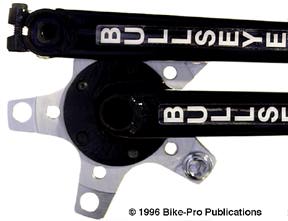
Bullseye has always been synonymous with one-off, hand finished quality. The Bullseye 2-Piece Steel Cranks were the first aftermarket crankset with any originality, and offer the best combination of strength, rigidity, and light weight of any cranks ever made. These tubular steel cranks with the included sealed cartridge bearing B/B are in a class of they're own, protected by two U.S. Patents. Bullseye cranks are made of tubular cro-moly steel which in this application islighter than solid aluminum. It is also stiffer, stronger and less subject to flex. The left arm is made of hollow rectangular cro-moly steel tubing that tapers in size from 30mm at the B/B spindle to 21mm at the pedal spindle. Both ends of the crank arm are miter cut with a half-round to fit the spindle and pedal lug. The pedal lug is machined from steel rod, tapped with 9/16" by 20 TPI threads for the pedal, and drilled with a small hole on one side. This hole faces into the crank arm as the lug is TIG welded to relieve heat build up. The joined surfaces are entirely welded together in one continuous pulsed bead. The B/B spindle lug has a similar hole and is similarly welded with one continuous weld.
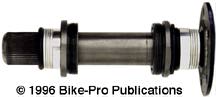
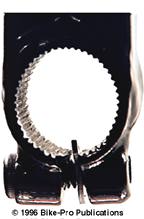
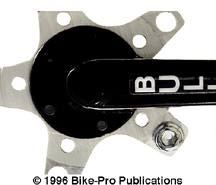
At the top of the arm, machined from Cro-moly rod pinch bolts have been welded, (which are like the pieces used on the binder bolt area on a stem). A 4mm steel allen head bolt tightens the arm onto the B/B spindle. There are splines on the inside of the B/B spindle lug that line with and grip mated splines on the B/B spindle. When the arm is tightened on, each of the 46 splines provides two surfaces of common contact between the parts. The right arm is made like the left, but instead of a spindle lug, the spindle itself is welded to the top of the arm. Also welded to the arm and spindle, behind the arm is a 2 1/2" round steel plate that has 5 holes drilled and tapped into it.
The crankset at this point is heat treated to increase it's strength to weight ratio further, and then painted. The round adapter plate was first devised to permit chainrings from a French company called TA to be bolted to it directly using a TA Cyclotourist chainring plate. TA chainrings fell out of favor with riders several years ago, and Bullseye made another aluminum adapter plate to be used with the emerging standard 74mm inner and 110mm outer chainrings. This spider plate is machined from 7.88mm aluminum plate stock, milled to shape, and for the chainrings to recess in, then drilled and tapped for the fixing bolts. This machined plate bolts directly to the 2 1/2" round steel disc, and the chainrings bolt to it. Because of it's 2-piece nature, (instead of the common 3 piece design, left arm B/B and right arm) the Bullseye crankset comes with it's own precision sealed cartridge bearing "floating" bottom bracket.
The bottom bracket cups are machined of steel, threading into each side of the B/B shell as though they were both "fixed" cups, using small aluminum spacers, and the left arms ability to adjust laterally to "dial in" the crankset perfectly on your frame. The B/B is also available with press-in cups for Klein Frames. For you 10 foot tall riders, with a 19" high bottom bracket, Bullseye cranks are available in up to a 222mm long arm version. These tubular steel cranks can be that long, because they are strong enough to accept the cantilevered weight of a big, heavy rider, without failure, that far from the B/B spindle. If they can accept this type use without failure, it easily understood that they will hardly flex under the weight of an average rider.
The cranks come painted in a high gloss Black or White only, and come in 152mm, 157mm, 162mm, 167mm, 172mm, 178mm, 181mm, 184mm, and 222mm lengths. Bullseye cranks come as right arm, with spider, left arm, bottom bracket, a set of five steel inner chainring bolts with aluminum spacers and an aluminum grease sleeve that (when properly installed) allows you to grease your B/B without crank removal. Chainrings, and a double chainring bolt set will be needed separately. The 178mm crankset in Black, with spider, B/B and sleeve weighs 882 grams. Out of that 819 gram weight the inner bolt, and bolts to hole the spider to the plate, and aluminum spacers weigh 73 grams. Unfortunately the bolts are steel and not metric so there is no easy aluminum or Ti lightweight replacement available. The 172mm length, with bolts, weighs 819 grams. Because the left arm "floats" until cinched we have deliberately omitted the Bike-Pro Q measurement. Specify color and length when ordering. $ Price in Catalog