For those of you that like to work on your bike, to properly maintain the strength of your Hyperglide chain, whenever you remove your chain, Shimano insists you use Hyperglide chain pins to reinstall it. They are special re-inforced pins that have a breakaway end to make the pin ends flush on both sides. They come in packages of three Black pins. $ Price in Catalog
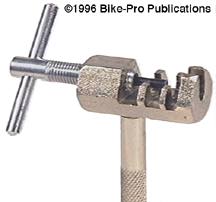
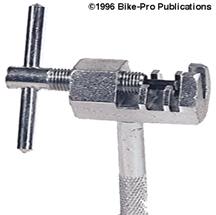
The Rivoli tool is made from machined steel hex bar stock. This is how it works. The chain lies vertically, over the 2/3 height chain rest farthest from the rivet pusher piece. The roller rests in a contoured trough with the rivet to be extracted available to be pushed by the black steel pin at the end of the pusher piece. As the pusher piece is turned clockwise, it slowly advances forward to the rivet, makes contact and pushes it out of one outer link plate, then the inner link plate, through the roller, then the inner link plate on the other side. The chain will now come apart in your hands. To re-install the rivet, the chain is put vertically in the tool, this time with the previously extracted rivet facing into the black steel pin. Turning the pusher piece this time inserts the rivet. Cyclo Rivoli make two models of chain tools, the original "standard" model comes in a Silver box, is all Silver in color, and works well with all chains that have flat outer link plates. The other is the "narrow chain" model, which comes in a Green box. The narrow model is for use with Hyperglide or other chains, which have rounded outer link plate. The narrow model is Gold in color, and has additional milling performed to it, to accommodate the rounded outer link plates found on many narrow chains. Both models weigh 83 grams, and both come with a spare steel pin.
Rivoli Standard $ Price in Catalog
Rivoli Narrow $ Price in Catalog
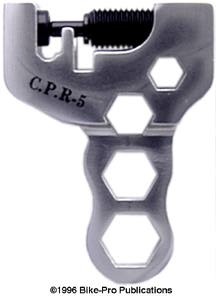
The C.P.R. 5 is a compact tool based on a machined aluminum extrusion. The 7075-T6 piece is 2 1/8" tall, 1 1/2" wide and just under 1/2" thick in upper the chain tool area. The chain tool, has a steel seat pressed into the side opposite the pusher piece to guide the rivet out. The steel pusher piece is driven by a 4mm hex wrench (not included) that fits into a hex fitting in the back end of the pusher. At the lower part of the anvil of the chain tool is a 3.4mm wide square channel that is to be used as a spoke wrench for either 14 or 15 gauge nipples. The handle area is milled to a 4.88mm thickness, and includes extruded hex holes in three sizes to be used as little sockets. From bottom to top they are 10mm, 9mm, and 8mm in size. The aluminum structure of the C.P.R.-5 is clear anodized, leaving it a Silver color. The tool weighs 27 grams. Made in Taiwan. $ Price in Catalog
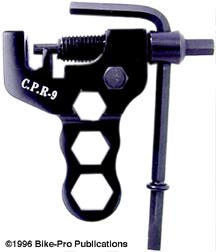
The C.P.R.-9 builds on the 5 model. It is made using the same 7075-T6 extrusion. A fourth 6mm hex hole that went unused in the C.P.R.-5, located in the upper pusher anvl is put to use here. A 17.9mm long steel 6mm hex is pressed through the 11mm deep hole, leaving an exposed near 6mm length for use as a hex wrench. The pusher piece of the C.P.R.-9 is different from the C.P.R.-5. It has a 5mm hex wrench fashioned at its rear, with a 4mm hole passing through the area joining the pusher to the 5mm hex wrench. Through this hole a 70mm long, 4mm hex wrench passes. The short length of the 4mm wrench is left as a 4mm wrench, the long end is run into a rotating grinder that grinds the hex shape into a 4mm by .72mm flat blade screwdriver. There is a groove cut around the wrench used to recess an O-ring. With the O-ring in place, the wrench won't slide out of the 4mm hole in the pusher piece. To sum up, we have added a 4mm, 5mm, 6mm hex and a small screwdriver to the C.P.R.-5 The aluminum structure is Black anodized, the tool weighs 46 grams. Made in Taiwan. $ Price in Catalog
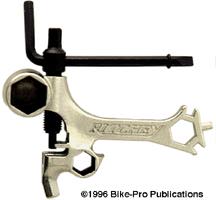
The C.P.R.-14 has its handle, (which provides the majority of the tools), made of cast Cro-moly steel. At the bottom of the handle are two separate spoke wrenches, a 15 gauge on the rivet pusher side and a 14 gauge opposing it. The very bottom has a 3mm hex wrench, and the interior of the handle bottom has a 10mm hex shaped opening to be used as a socket. The chain pusher assembly is the same used on the C.P.R.-9, having a 5mm hex, 4mm hex and flat screwdriver. At the top of the chain tool pusher area, is a 14mm socket for crank arm bolts, (you aren't likely to get the proper leverage to either remove a properly tightened a crank bolt, nor properly tighten a loose one but it might help in a pinch), which has on its reverse side an 8mm hex wrench. At the end of the chain tool anvil, opposing the pusher piece, a 6mm hex wrench angles out and arches downward. Beneath the 6mm hex on the anvil, is a hole that has an 8mm hex opening on one side and a 9mm opening on the other, both to be used as sockets. Just in case to come across the odd beverage that doesn't have a twist- off top there is a bottle opener near handle at the base of the chain tool anvil. The C.P.R.-14 weighs 78.5 grams. Made in Taiwan. $ Price in Catalog
Although their are now several multi-tools now available, this was the original. Produced in Taiwan, the Cool Tool is made entirely of steel and has 8 distinct tools. The most obvious is its adjustable wrench that opens to 20mm (3/4"). The jaws are thin so it can be used as an adjustable cone wrench. The handle section of the adjustable wrench is the anvil of the chain breaking tool which is made to take apart narrow, even HyperGlide chains. The back of the chain anvil is a spoke wrench. The steel pusher piece of the chain tool, has two holes through it. Both holes are hex shaped, one is 5mm the other is 6mm. Each of the holes is used to hold a hex wrench. The 5mm wrench has a 4mm hex on the long side and is 5mm on the short side. The 6mm wrench has a #1 Phillips screw driver on the long side. The remaining tool is the 14mm socket which is held to the tool by the pusher piece. The adjustable wrench is Silver in color with all other steel parts having a Black color. The adjustable wrench can be used to hold 4 other optional tools, three are headset wrench tools sized 32mm (1"), 36mm (1 1/8") or 40mm (1 1/4"). The fourth is the Bottom Bracket lock ring spanner.
Cool Tool $ Price in Catalog
32mm headset tool $ Price in Catalog
36mm headset tool $ Price in Catalog
40mm headset tool $ Price in Catalog
B/B Lock Ring tool$ Price in Catalog
Cool Tool carry bag $ Price in Catalog