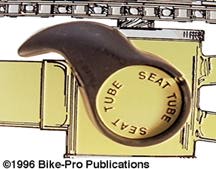
The Third Eye Chain Watcher keeps the chain from overshifting from the low (smaller) geared chainrings and draping around the bottom bracket shell. In some shift conditions even a properly adjusted front derailleur will loose the chain on the front, (such as landing hard with the chain bouncing off). The Chain Watcher is a molded of Black plastic that is cut, with an opening which snaps around the seat tube at slightly below chain line height. It's arm has a sloping rounded surface that returns the chain to the small chainring in an overshift. The Chain Watcher is held firmly in place using an internal steel hose clamp which the Chain Watcher housing slides over. There is no metal contact, and your paint finish won't be marred. The Chain Watcher weighs 15 grams. $ Price in Catalog
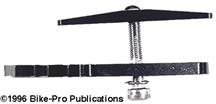
RingleŽ Components has a simple, but very effective, device to prevent a front overshifted chain from lodging around your bottom bracket spindle. In competitive front overshifts, under load, the stress of the chain derailing off the small chainring frequently leads to damaged paint on the frame and possible injury. The RingleŽ Anti Chain Suck Thing uses a machined 6mm thick piece of aluminum plate to create a platform for the chain to land harmlessly on. The plate is cut with graduating square edges that contour the shape and size of your front chainrings. The plate is held in place by a bolt passing through one of twelve 6.3mm holes drilled through it. The bolt anchors in a separate smaller aluminum plate tapped with threads for the bolt. The device bolts behind the seat tube on the chainstay with the "nut" below, like many kickstands. The RingleŽ Anti Chain Suck Thingª comes in two sizes dependent on the size of your middle chainring. There are three types of Anti Chain Sucks. The first fits front chainrings that a 10 tooth difference between the inner and middle chainrings. It fits 24-34-46/48 chainring sets, it also fits 26-36-46/48 and the Hyper Compact 24-34-42 and 22-32- 42 sets. The second fits front chainring sets that have a 12 tooth difference between the inner and middle. It fits 24-36-46/48 chainring sets, and it also works with MicroDrive 20-32-42 chainring sets. The final version is an XTR model made to fit the 26-36-46/48 XTR chainring sets. All weigh 69 grams. They are available anodized in either Blue, Black or 3DV (lavender) or Silver (XTR only).
10 tooth difference Color-B-BK-L $ Price in Catalog
12 tooth difference Color-B-BK-L $ Price in Catalog
XTR $ Price in Catalog
The Dave's Chain Device is made to help eliminate chain suck and chain jumping. The Chain Device is made of stamped plate aluminum that is anodized in Black, Blue, Lavender, or Silver . It is held onto the chainstay using two bolts, one of which acts as an axle for the nylon roller at the bottom of the device. The upper section of the Device has an inner foam rubber lining so your stay isn't damaged when the metal pieces are bolted in place. In a front overshift condition, or a sharp bounce while riding on the inner chainring may induce a "Chain Suck" condition where the chain will be drawn into the gap between the crank arm and the B/B shell. The upper bolt holding the Device in place will prevent the chain from creeping into this Chain Suck condition. At times riding aggressively downhill leads the chain to "bounce" while on the smallest rear cog. A particularly wild bounce will dislodge the chain from the rear cog altogether. The Black nylon pulley holds the chain up preventing a wild bounce. The Dave's Device chain tensioner weighs 101.5 grams
Color-B-BK-L-S $ Price in Catalog