Mathauser Bicycle Brake Pads
SCOTT/MATHAUSER - The Company
We should introduce you to Edward Scott. He has been in the bike industry for some time and is always interested in perfecting the bicycle braking system. Mr. Scott's early work was in the ski industry and his hollow aluminum ski poles and then later goggles became the standard that other makers of poles and goggles had to live up to. Mr. Scott sold this business, now called Scott USA. The business he founded is now a large player in the bicycle market as a maker of handlebars, importer of bikes with Scott USA decals, and more recently the acquirer of the Schwinn brand name, so they now import bicycles with Schwinn decals on them. Mr. Scott is one of the most soft spoken and inquisitive individuals we have run across in the bike industry.
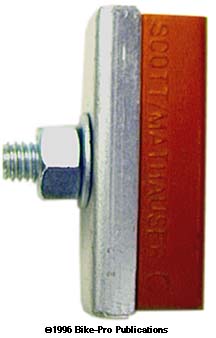
SCOTT/MATHAUSER ECONOMY BICYCLE BRAKE PADS
Made in the United States, these pads use a three piece construction and come with an additional steel washer and nut. The three pieces are the brake pad, the threaded steel mounting stud, and the rectangular aluminum pad holder. The rubber brake pad is made by Kool-Stop. This special pad material is widely considered and privately (in the industry) recognized as the best brake pad compound in use. The pad has a 40.37mm by 8.5mm rectangular rim contact area. The steel post has 6mm by 1mm threads (for use on caliper, U-brake, and some cantilever brakes), with a 10mm threaded length. The bolt end is anchored between the brake pad and the 1mm thick, 13.5mm high, stamped from 5/100's inch (1.27mm) aluminum plate brake shoe (or pad holder). The square sides of the shoe securely holds the bolt and the pad against the rotating force of the wheel. The face of the pad is flat so there is a broad surface area that grips and brings the wheel to a stop. The metal parts are Silver, the pad material is orange in color. The Scott brake pads tested to a hardness of A/91. Sold in pairs, they weigh 34 grams per pair.
Pair $ Price in Catalog
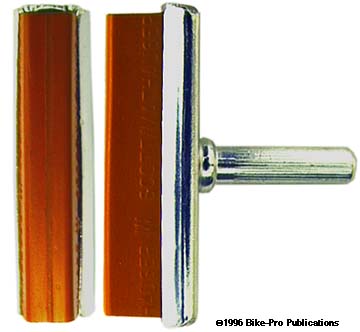
SCOTT/MATHAUSER ECONOMY BICYCLE CANTILEVER PADS
Scott/Mathauser makes a similarly styled cantilever model. The pad (again made by Kool-Stop) in this case is larger because cantilever brakes are used only in torturous conditions, where added contact would be a benefit. The pad has a rim contact area of 53.75mm by 8.5mm. You'll notice that the pad material is the same dimensions except for length. The pad material is cut to a longer length. The three piece brake pad has a 6.92 mm diameter aluminum mounting post with a 26mm useful length. The pad material is again held in a rectangular holder die-cut and stamped to shape from .05" (1.27mm) thick aluminum plate. The holder and mounting post are tightly riveted together, with the edges of the holder pressed tightly around the pad. The metal parts are Silver, the pad material is orange in color. The Scott brake pads tested to a hardness of A/91. The economy cantilever pads are sold sets of four and weigh 38 grams per pair.
set of four $ Price in Catalog
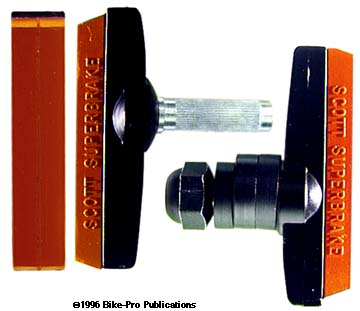
SCOTT SUPERBRAKE ALLOY FINNED BICYCLE BRAKE PADS
These are acknowledged as the best of replacement brake pad sets on the market. These use the same renowned brake pad compound as the economy pads. The flat faced pad is 48.25mm long and 10.9mm high. The pad holder is made of forged aluminum with four 2.8mm tall fins on the back to dissipate the heat generated in strenuous braking conditions. The holders are made so the pad section is replaceable when they finally wear out. The brake pad slides into the holder which is closed off on three sides making a channel. The holder has protruding edges that fit into notches on the pad itself, that guide the pad into the hole and hold it tightly in place once it's properly seated. The finned pads come in both a non-threaded cantilever mounting post and a threaded Road caliper post. The non-threaded steel mounting post is 6.92mm in diameter and hollow having a 3.5mm hole through the entire piece. The mounting tube is pressed onto the aluminum holder making a rivet-like joining of the two pieces. The threaded mounting bolt is made of steel, is solid, and has 6mm by 1mm threads with a 21mm useful length. Each threaded pad comes with three aluminum washers, two are concave that butt against a convex surfaces, the third has two flat surfaces. These mated convex/concave surfaces allow the angle of the pad to be infinitely adjusted in small degrees to permit extremely fine tuning of the toe-in adjustment at installation. A machined aluminum nut cinches the pad and washers in place. The steel parts of each pad are cadmium plated, the aluminum pieces are Black and the brake pad is Orange. We found the pad material tested to an A/91 hardness. The Scott SuperBrake finned pads are sold in pairs. The non-threaded cantilever type weigh 34 grams per pair, the threaded pair with all washers and the nuts weighs 47 grams a pair.
Pair $ Price in Catalog