

Product Overviews  |   Archive Reviews  |   Comparison Tables  |   Tables  |   Metals Guide  |   Frank's Picks  |   News & Gossip
Additional Knowledgable Resources


Reach BikePro on a 24 hour basis at 803-280-1537 Terry Dunbar is on duty as the technical expert, who also speaks Spanish as well as English and has quantities on hand information. Call her now for any questions about Bike Pro you may have.


Bottom Brackets
Brake Systems Chains
Computers
Cranks and Chainrings
Forks
Frames & Framesets
Freewheels and Cassettes
Front Derailleurs
Grips
Handlebars
Handlebar Extensions
Headsets
Helmets
Hubs and Skewers


Lubricants
Metal Guide - Bicycle Metallurgy
Mirrors
Pedals and Toe Clips
Pumps and Inflation Systems
Racks
Rear Derailleurs
Rims & Rimstrips
Saddles
Seatposts and Binder Bolts
SRP Replacement Titanium &
Aluminum parts - Master Index

Stems
Tires
Tubes
Shoes
Spokes (Tables Only)
Tools - Bicycle Repair Tools
Yakima Fit List -to fit all cars

Notes
Home

Ritchey Brake Pads


RITCHEY LOGIC CANTILEVER BICYCLE BRAKE PADS

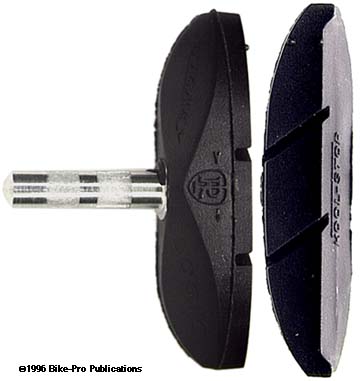
These brake pads are made in Lake Oswego, Oregon using Mr. Ritchey's design, by Kool-Stop. The pad is 68.5mm long and 17mm high. The Logic pad has a rim contact area 68.5mm long that is flat on the bottom, with an arching top reaching an 11mm height at its apex. This arch mimics the shape of the rim. Two 1.5mm wide sipes allow water to drop through the pad. The Logic pad uses a 6.93mm diameter non-threaded aluminum post with a 28mm useful length. The post, and added metal to give the pad structure, is imbedded into the molded brake pad.

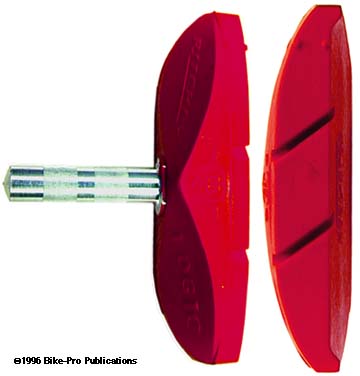
Now to talk about pad compound and brake pad color. As we've said Kool-Stop is the actual maker, these pads are made using the same plastic-like material that the Eagle Claws are made of. Ritchey sells the Logic pad in a Black and a Red color, with the Red color expected to be used for "severe weather". This red for sever weather would lead you to believe that there were made with some unusual or different property or material. We can't find it. Both pads feel the same, they both test by durometer to have an A/90 hardness. In our learning about grips, we found that as a practical matter changing the rubber compound, or the hardness of rubber composition is rarely ever done once the maker has a knowledge and confidence of how a certain material works.

We know that Kool-Stop can, and has, added color to brake pads to cosmetically enhance them before, without the coloring affecting the hardness or braking ability. Anyone who went through adolescence in the 1980's will remember the 10 colors that Skyway¨ Tuff-Pads came in. Kool-Stop made the Tuff Pads, and this appears to be just a coloring of the pad (in fact, these are the same color as Red Tuff-Pads). We want to point out that both Ritchey and Kool-Stop insist there is something different about the Red rubber compound, but we can't determine what it is. Blindfolded, we tried to pick out a Black Logic pad from a Red Logic pad and were unable to discern the difference.

So here's the advice, buy Red pads if you like the way Red will look on your bike, Black if you don't care, and maybe Eagle 2's if you want to save money. Logic pads are sold in pairs, and have a pair weight of 45 grams. Made in USA.

Pair $ Price in Catalog



In-depth Information About Metals

Aluminum
Aluminum is extracted electrolytically from bauxite ore. It is made by the electrolysis of aluminum oxide which is found in larger concentrations within bauxite ore. Bauxite is a mixture of the hydroxides of aluminum, together with other impurities such as oxides of iron, titanium, and silicon. Bauxite is produced by the weathering and change of aluminum silicate rocks usually found in tropical and semitropical regions where climate has produced an accelerated weathering process. Bauxite is not a rare ore and is widely available in the US, the Caribbean, and Europe. Approximately 4 pounds of read the full article...

Beryllium
Beryllium is a specialty metal that is steel-grey metal in color, with an extremely low density, making it very light weight. At 1.85 grams to the cubic centimeter, its density compares to that of magnesium. It is also a high strength metal, making it possible to design light weight, thin membered parts with ahigh stiffness. A column made of beryllium to support a load placed directly downward on top of it, will have a greater load carrying capacity, and be lower in weight than any other metal of equal size.

Until the 1950's beryllium was used read the full article...

Titanium
The element titanium was discovered in 1763 by an English cleric, William Gregor who was an amateur chemist with an inquiring mind. It was in the black sands of Cornwall that he discovered the new element that had up to that time, attracted little scientific interest. A few years later, an Austrian, Klaproth, extracted the same element from an ore widely known as "rutile", which is a mineral consisting of titanium dioxide (one titanium atom, two oxygen atoms), that is a reddish-brown substance with a slight metallic luster. While rutile is the highest grade read the full article...

Metallurgic Hardness Testing
There are three types of tests used with accuracy by the metals industry,they are the Brinell hardness test, the Rockwell hardness test, and the Vickers hardness test. Hardness is the property of a metal which gives it the ability to resist being permanently deformed (bent, broken, or have its shape changed), when a load is applied. The greater the hardness of the metal, the greater resistance it has to deformation. Since the definitions of metallurgic ultimate strength and hardness are rather similar, it can generally be assumed read the full article...


Copyrighted material - All rights reserved

This site sponsored by
Crinella Winery Sauvignon Blanc and Pinot Noir