|
Product Overviews |
Archive Reviews |
Comparison Tables |
Tables |
Metals Guide |
Frank's Picks |
News & Gossip
| |
| Additional Knowledgable Resources | |
|
Reach BikePro on a 24 hour basis at 803-280-1537 Terry Dunbar is on duty as the technical expert, who also speaks Spanish as well as English and has quantities on hand information. Call her now for any questions about Bike Pro you may have. |
![]() |
|
Bottom Brackets Brake Systems
Computers Cranks and Chainrings Forks Frames & Framesets Freewheels and Cassettes Front Derailleurs Grips Handlebars Handlebar Extensions Headsets Helmets Hubs and Skewers Lubricants Metal Guide - Bicycle Metallurgy Mirrors Pedals and Toe Clips Pumps and Inflation Systems Racks Rear Derailleurs Rims & Rimstrips Saddles Seatposts and Binder Bolts SRP Replacement Titanium & Aluminum parts - Master Index Stems Tires Tubes Shoes Spokes (Tables Only) Tools - Bicycle Repair Tools Yakima Fit List -to fit all cars Notes Home |
Ritchey Logic Cantilever BrakeRITCHEY LOGIC CANTILEVER BRAKE(Reading the Dia Compe 987 & 986 reviews before reading this review is suggested)
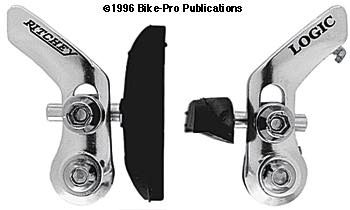
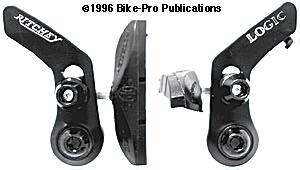
Because the Logic canti is made by Dia-Compe and based on the same thinking used in the 986 and therefore uses the same parts found in the 987, reviewing it after the Dia-Compe brakes will save a lot of time and space. First the brake arms are cold forged and they come in Black, or Silver or at a slightly greater price they are available in a Ti Grey or what is referred to as "WCS". (When you read about anodizing of aluminum you come to realize that anodizing to leave a Silver color or a WCS color requires close to exactly the same effort and expense. We aren't sure why Ritchey charges more for the "WCS" color, but there is no basis in cost that we are aware of.) Mechanical explanation of the Logic. We've mentioned in describing the 986 that the Logic is stylistically very similar. There are differences. The Logic canti lacks the machined steel inner bushing that slides between the inner brass sleeve and the mounting stud on the frame used in the 986 and 987 brakes. Instead the aluminum of the arm is made thicker at the base and a brass inner sleeve inside the arm has a smaller inner diameter, so it uses the brass contact to turn on the mounting stud. Because the aluminum base of the arm encloses more of the spring a smaller plastic shroud is required to close the tension spring compartment. Remember that the 986 & 987 used a 13mm hex base nut to adjust the spring tension? The Logic doesn't have this 13mm base adjusting nut. Most mounting studs have three holes on the inner side of the fork blade or seatstay. These holes are for the spring end to slide into. Anchoring one end of the spring in the fork or stay gives a "push from" point for the brake arm. The 3 holes permit a small range of adjustment and there is a two hole choice inside the brake for the other spring end to fit into. None of these five holes provide the variable range of the 986 or the 987. All of the hardware to hold the brake pad is identical, including color, to the parts used in the 987, reading the 987 will tell you about them and SRP Ti pad holder replacements (our part #06-91-PH). The same straddle cable and cable carrier used in the 987 are again seen here, and in the same Black color. The straddle wire is again fastened to the top of the right arm using the same bolt employed for fastening on the 987 and 986. The Logic Brake also comes with Black steel mounting bolts and washers, the same one set that comes with the 987 brake. The singular biggest difference is the brake pads. End of Mechanical. The Ritchey Logic comes with Black Ritchey Logic brake pads made by Kool-Stop. These are written about in the Brake pad section of this article. We found the Ritchey Logic had a Bike-Pro brake profile measurement of 70mm, but was disadvantaged in this measurement because of the points at the end of the arms. The Logic can be used as either a front or a rear brake. The brake weighs 154 grams. Add to this 15.5 grams for the straddle cable and carrier, and 12.5 grams for the for the mounting bolts and washers and the total weight becomes 182 grams. The Logic model with Silver arms comes with all Silver parts, mounting bolts, conical nuts, cable carrier and the like. Made in Japan, except the brake pads which are made in America. Color -BK-S $ Price in Catalog |
|
In-depth Information About Metals Aluminum Aluminum is extracted electrolytically from bauxite ore. It is made by the electrolysis of aluminum oxide which is found in larger concentrations within bauxite ore. Bauxite is a mixture of the hydroxides of aluminum, together with other impurities such as oxides of iron, titanium, and silicon. Bauxite is produced by the weathering and change of aluminum silicate rocks usually found in tropical and semitropical regions where climate has produced an accelerated weathering process. Bauxite is not a rare ore and is widely available in the US, the Caribbean, and Europe. Approximately 4 pounds of read the full article... Beryllium Beryllium is a specialty metal that is steel-grey metal in color, with an extremely low density, making it very light weight. At 1.85 grams to the cubic centimeter, its density compares to that of magnesium. It is also a high strength metal, making it possible to design light weight, thin membered parts with ahigh stiffness. A column made of beryllium to support a load placed directly downward on top of it, will have a greater load carrying capacity, and be lower in weight than any other metal of equal size. Until the 1950's beryllium was used read the full article... Titanium The element titanium was discovered in 1763 by an English cleric, William Gregor who was an amateur chemist with an inquiring mind. It was in the black sands of Cornwall that he discovered the new element that had up to that time, attracted little scientific interest. A few years later, an Austrian, Klaproth, extracted the same element from an ore widely known as "rutile", which is a mineral consisting of titanium dioxide (one titanium atom, two oxygen atoms), that is a reddish-brown substance with a slight metallic luster. While rutile is the highest grade read the full article... Metallurgic Hardness Testing There are three types of tests used with accuracy by the metals industry,they are the Brinell hardness test, the Rockwell hardness test, and the Vickers hardness test. Hardness is the property of a metal which gives it the ability to resist being permanently deformed (bent, broken, or have its shape changed), when a load is applied. The greater the hardness of the metal, the greater resistance it has to deformation. Since the definitions of metallurgic ultimate strength and hardness are rather similar, it can generally be assumed read the full article... |