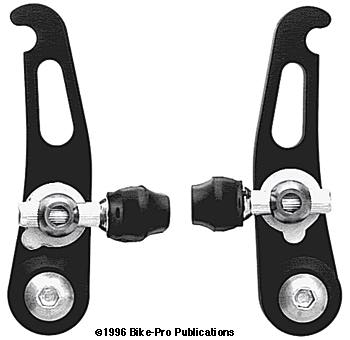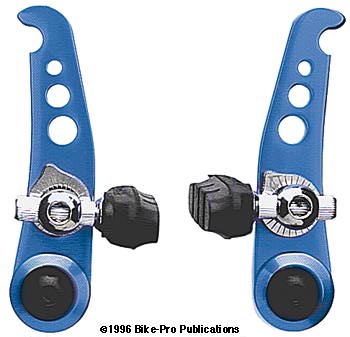
The bike industry owes John Grafton a debt for bringing to it the concept of short run, high quality replacement parts. Expensive, short run manufacture, of after-market replacements parts didn't really exist and a shopper for good quality parts was left with only the choice which expensive, but mass produced part they would buy. The Speed Controller was Mr. Grafton's first product.
Mechanical explanation of the Speed Controller. The "Speed Control" arms are machined from 1/4" (6.35mm) thick aluminum plate. The arm is approximately 23mm wide at the base and narrows to 14mm near the top of the arm. A recessed slot is milled into the back of the arm for the pad holder assembly to adjust within. There are three holes drilled through the upper arm to reduce weight and add distinction to the SC arm. Like many after-market high performance brakes that followed it, the SC uses a honed brass bushing that is machine pressed into the arm, for the arm to mounting stud contact.
The internal tension spring of each arm is adjustable and replaceable. The tension is adjusted by the movement of a long set screw that pass through the arm from the outer side. This set screw presses against a machined aluminum disc that rotates around the brass bushing area. On the perimeter of the disk is a hole that the spring end fits into, so when the disc is rotated one direction the spring tension is increased, the other direction allows the disc to slip back and decrease the tension. A smartly machined aluminum cap covers the spring with a hole through the top that other end of the spring passes through. The spring end extends 3mm beyond the cap to anchor in one of the three holes on the plate that the mounting stud rises from.
This is one of the few brakes that doesn't use the mounting bolt to hold the springs position. There is a seal between the arm and the cap, and an O-ring that is recessed into the top of the cap where the mounting bolt screws through into the mounting stud. The pad holding hardware of this brake is a disappointment. This is the same imported set low quality steel parts that are imported and sold with the Joe's cantilever brake. (Some have said this hardware isn't so bad just ugly) There are six poor quality pieces that make the pad holding assembly including an eyebolt type pad holder, a wedge shaped washer for the pad holding base washer that when rotated adjusts the pad "toe-in". Behind the arm is a convex and concave washer to adjust the pad angle, a friction reduction washer and the 6mm by 1mm steel hex nut for a 10mm socket or box wrench to tighten. The pad holder is eyebolt style, bulb shaped steel with a 5mm hex fitting to make final adjustments and weighs 8.5 grams. We found all three of the SRP Titanium replacements worked in place of this steel model, because of its size and weight the short shank bulb shape (our part # 06-91-PH) would be our choice.
The SC comes with a 375mm long Dia-Compe straddle cable that has a lead anchor at one end. The other end uses a cable end clamp to make a movable anchor. The end clamp is machined from steel in a tube shape with a threaded interior. A hole is drilled through the sides for the cable and a set screw tightens against the cable holding the end firmly in place. Either end of the cable can fit in either brake arm top. The included cable carrier is made by Dia-Compe with a hanging plate stamped from sheet aluminum. It uses a keyed bolt, two steel washers and an aluminum nut to compress the brake inner wire against the plate which holds up the straddle cable. Two Black steel mounting bolts and washers come with the SC. The bolt has a 5mm hex fitting , 6mm by 1mm threads and an 11.5mm length. End of Mechanical.
Black Dia-Compe brake pads are included with each Speed Controller. The pads are one-piece construction and have a non-threaded steel mounting post, and a pair weight of 51.5 grams. We found the Speed Controller had a Bike-Pro brake profile measurement of 33mm. The Speed Controller can be used as a front or a rear brake. The brake weighs 175 grams (51.5 grams of which are brake pads). To this add 10 grams for the mounting bolts and 8 grams for the cable carrier for a total weight of 193 grams. The Speed Controller comes with the arms and caps anodized in Blue, Black, Pewter Grey, Lavender, Red, or Silver.
Color -B-BK-GY-L-R-S $ Price in Catalog
Grafton makes a reduced weight version of the Speed Controller they call the Mag-Lite. This version of the brake has several pieces changed to reduce weight including the arm, spring cap and back plate being made of magnesium, and the pad holder pieces are made of aluminum.
Mechanical explanation of the Mag-Lite. The Mag-Lite design is identical to the SC with some parts substituted. The aluminum Speed Controller arm with the brass bushing pressed into it weighs 21.5 grams, the magnesium Mag-Lite version weighs just 15 grams. The aluminum back plate and cap, which enclose the tension spring, weigh 6.5 grams in aluminum but just 4 grams in magnesium. The Mag-Lite's pad holder is made of Titanium and weigh 5 grams. The inexpensive steel washers of the SC which weigh 10 grams, have been replaced with aluminum and thin steel versions weighing 4 grams. The 2 gram steel tightening nut in the SC had a 4.81mm thickness, and is replaced by a 1.5 gram steel nut of the same type but is just 3.2mm thick which accounts fopr the weight reduction. The straddle cable is still made by Dia-Compe and is slightly lighter, but just 300mm long. The same 8 gram cable carrier is used here.
The final way used to drop weight on the bike is done by providing aluminum mounting bolts. These aluminum bolts aren't intended to tighten the brake on, a separate pair of the original steel bolts is also included. The idea is to use the steel set to tighten the brake down, then back them off and replace them with the light aluminum ones to hold it down. End of Mechanical.
On the side of misfortune, for all the efforts to make this brake lighter, and its considerably added expense, it is still shipped with the same Black Dia-Compe pads weighing 51.5 grams a pair. Because this brake is the mechanically the same as the SC it also has a Bike-Pro brake profile measurement of 33mm. The Mag-Lite weighs 132 grams (with the brake pads). To this add 5 grams for the aluminum mounting bolts and 8 grams for the cable carrier for a total weight of 145 grams. The Mag-Lite is made in Black only. $ Price in Catalog
At the time this section was being written (June, 1994) the parts for the SC II were being machined in Southern California and the brake wasn't yet available. The SC II is said to have a sealed design and multiple adjustments. It will have Dia Compe brake pads and be available in Blue, Black, Lavender, Red, or Silver.
Color-B-BK-L-R-S $ Price in Catalog