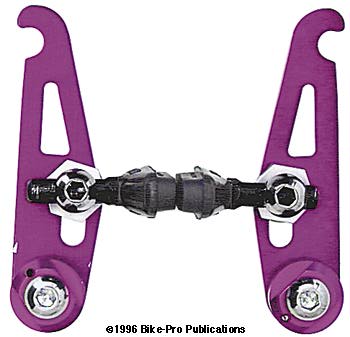
Piranha Racing has found itself having to change names because the Piranha name has been used by 2 or 3 other bike parts companies, including one that has a dorsal type fin on the top of helmet that was displayed in an aquarium at the Las Vegas trade show. They have changed their name to "Curve" to just bail out of the conflict. Their cantilever is an after market canti that is incomplete in its thinking. While some attempts are make it lightweight and original, for the same money there are makers that are more thorough in the design, and execution.
Mechanical explanation of the Curve Jaws Brake. The arms are machined from 1/4" (6.35mm) thick 7075-T6 aluminum plate with a honed brass bushing pressed through the base of the arm and pinned with a steel rod from the end. The arm rotates on the brass piece around the mounting stud. A 6.92 by 19.3mm slot is milled for the pad holding to pass through and move within. A second slot in the upper section of the arm is triangular in shape with an 8mm bottom and a 20mm height. The anodized finish of the arms is not even in depth of color, and has splotchy areas where the color is darker, or dull. This condition is probably because the arm wasn't polished before the cleaning, anodizing and dyeing baths. Each of the internal tension springs are accessible, adjustable and replaceable. The arm has a small hole drilled over the brass piece, to hold the one end of the spring. A machined aluminum cap covers the spring. The cap has a hole drilled through the top for the mounting bolt, and has two cuts made across the top for a 13mm cone wrench to grip for spring tension adjustment. A hole drilled through the cap allows the other spring end to pass through the cap. Once the proper tension is located with the 13mm wrench, the mounting bolt is tightened holding the tension on the arm while still rotating smoothly on the mounting stud. The pad holding hardware is made of five pieces. The pad holder is the eyebolt type and made of Titanium by SRP (our part # 06-91-PH). An aluminum wedge shaped washer with a 16mm outer hex under the pad holder can be rotated to adjust the "toe-in" of the pad. Beneath the arm a brass convex washer and a steel concave washer are used to adjust the angle of the pad. A 6mm by 1mm steel lock nut hold all the pieces in place.
The Piranha brake comes with a set of SRP Titanium mounting bolts and bolts. The bolt has a mushroom head with a 5mm hex fitting, 6mm by 1mm threads, a 12.5mm length and a 3.5 gram weight. The washer has a 16mm outer diameter, a 1.25mm thickness and 1/2 gram weight. A Dia-Compe straddle cable comes with each brake. The 380mm long cable has a lead anchor at one end. A cable end clamp is used at the other end of the cable. Made from aluminum, it is tube shaped with interior threads.
A hole is drilled through both sides for the straddle cable to pass through it and a set screw is tightened through the center clamps against the cable making the second end. Either cable end will work in the top of either arm. The included cable carrier is an un-inspired device made of five steel pieces. The hanger plate is stamped from steel with a keyed pin anchor bolt and steel nut used to compress two steel washers clamping the carrier to the brake inner wire. End of Mechanical.
note: some people will want to know why this Curve "Jaws" costs more than the one Performance is selling. Curve makes a "Jaws" model that has all steel hardware and "generic" brake pads, which is what Performance is selling. They also make the all steel model with Black Logic pads and finally the Ti (eyebolt) pad holder and Black Logic pads model that we sell.
Each Curve Jaws brake comes with a pair of Black Ritchey Logic brake pads that weigh 45 grams per pair. What ever weight savings might have been achieved in the use of the SRP Ti hardware completely disappears with the use of these brake pads. We found the Piranha brake had a Bike-Pro brake profile measurement of 45mm. This brake can be used as a front or a rear. The Jaws brake weighs 152 grams (including the 45 gram pads). To this the add the 7 grams for the mounting bolts and 12.5 grams for the cable carrier bring the brake to a total weight of 171.5 grams. The arms are anodized in Blue, Black, Lavender, or Silver.
Color-B-BK-L-S $ Price in Catalog