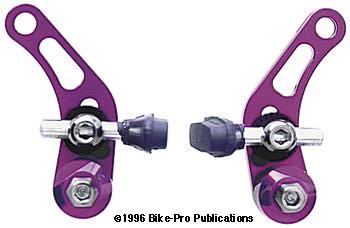
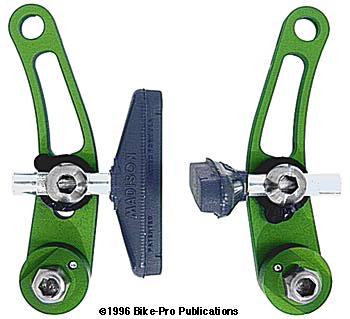
The Critical Racing brake is machined from billet aluminum and comes in two versions, a "Standard" profile that has shorter arms that splay outward to the sides, or a "Low" profile model that has longer arms, to generate the needed leverage, which curve outward only slightly.
Mechanical explanation of Critical Brake. Both arms are milled from 7.92mm thick aluminum plate. The arm of each model, at the base, is 20.84mm wide and remains at this width for the first 41mm up from the bottom. The character of the arm is revealed after this initial 41mm. The Standard profile model turns outward at 45 degrees and narrows to 14.7mm at the arm end, while the Low profile model turns outward at 25 degrees and narrows to 14.7mm. The Standard profile arm has a 73mm height and measures 62mm from the center of the mounting stud to the center of the straddle cable fastening point. The Low profile arm has a 94mm height and measures 78mm from the mounting stud center to the straddle cable fastening point. A slot milled in the lower section of the arm is 6.3mm wide and 13.5 mm long for the pad holding hardware.
Each arm type has a milled slot to reduce weight from the upper section leaving the Standard arm with a 27 gram weight and the Low profile arm weighing 28.5 grams. A machined brass bushing is pressed into a hole in the base of the arm. This bushing is what will revolve around the brake mounting stud. Each arm has an internal tension spring that is accessible, adjustable and replaceable. A small hole directly above this bushing seats one end of the tension spring. With the spring in place a machined aluminum tension adjusting cap is placed over it. The cap has a small hole for the other spring end to pass through anchoring it for tension adjustment. Two parallel flats are cut in the top of the cap for a 13mm wrench to grip and turn. A hole drilled through the center of the cap is for the brake mounting bolt.
The adjusting cap is turned to generate the proper tension and then the mounting bolt is tightened to fix the tension, holding the cap, spring and arm to the mounting stud. This allows the arm to revolve smoothly while under spring tension. The brake pad is held by five pieces. The pad holder is machined from 6Al-4V Titanium using the bulb shaped, eyebolt styling and a 6 gram weight. The pad holder has a 5mm hex fitting on the face to make final adjustments. Beneath the holder is a Black aluminum wedge. When rotated it can be used to adjust the "toe-in" of the pad. Behind the brake arm, two machined aluminum washers, one convex other concave are used to adjust the angle of the pad. A stainless steel nut with 6mm by 1mm threads and a 10mm outer hex shape is used to tighten all the pad holder pieces to the arm. Critical includes two machined from Titanium brake arm mounting bolts. The bolts have 6mm by 1mm threads and a 12.5mm length. The head of the bolt can be gripped two ways, there is a 5mm inner hex fitting and also there are hex shaped outer sides that a 10mm box or socket wrench can grip.
Both brakes come with a 300mm long Dia-Compe straddle cable that has a lead anchor that fit in the top of the brake arm and a second finger grip to quick release the cable. A machined cable end clamp is fastened to the other end of the straddle cable using a set screw. End of Mechanical.
Critical brakes do not come with a cable carrier, you will need to buy one separately. Both Critical brakes come with Madison Aztec brake pads weighing 34 grams per pair. We found the Critical Low profile model had a Bike-Pro brake profile measurement of 48mm, the Standard had a 67mm profile. Either model of the Critical brake can be used as a front or rear. Present tradition is to use the Low profile of long arm model in the rear, and the Standard profile in the front. The Standard brake weighs 141.5 grams (without carrier), and the Low profile model weighs 143.5 grams (without carrier). To these weights you should add 7 grams for the mounting bolts. Critical brakes come in Blue, Black, Green, Lavender, Red or Silver. Please specify model, color and remember that you will need a cable carrier.
Standard profile Color-B-BK-GN-L-R-S $ Price in Catalog
Low profile Color-B-BK-GN-L-R-S $ Price in Catalog
with Titanium Hardware - Standard or Low Profile - BLACK - SILVER - PURPLE - Green - Blue - Red $ Price in Catalog