Avid Tri-Align Cantilever Brake
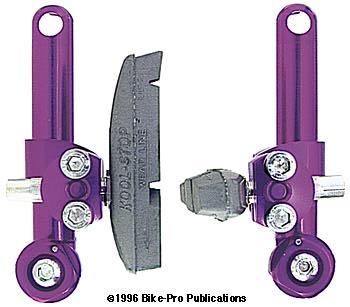
The Tri-Align brake is a monstrously clever device that covers all the mechanical bases. The brake arms are machined from billet aluminum with a 3" (75.4mm) length in the short version and 3 3/8" (85.72mm) in the long arm version.
Mechanical explanation of Tri-Align. Each arm is straight with a 15mm tall base. The upper arm over the base on the short version is 61mm long and is 71mm long for the long version of the brake. The arm is round and hollow with 1/2" (12.7mm) outer diameter. The top of the arm that the straddle cable fastens to, threads into the top of the hollow arm. The base has a rounded bottom and is drilled through for a bushing with a 9.6mm diameter hole. A machined stainless steel bushing slides into this hole, both its inner and outer surfaces are honed to make them smooth. The bushing makes the common contact between the mounting stud and the alloy arm. A small hole is drilled through the outer side of the base to serve as a lubrication port for the arm to bushing contact. A 2.2mm hole over the center of the mounting hole in the base is for the end of the tension spring.
The internal tension spring in each arm is very accessible because it's exposed, also adjustable, and replaceable. The spring sits on top of the arm. A machined aluminum adjusting washer fits into the spring. A hole on the washer allows it to anchor the other end of the spring. Parallel flat cuts into the top of the washer at 15mm spacing provide a grip for a wrench to turn the adjusting washer. Turning it one way tightens the tension, the other direction loosens it. The adjusting washer has a hole drilled through the center to recess the brake mounting bolt. Once the spring has the proper tension, the mounting bolt is tightened holding the spring and adjusting washer in position relative to the arm, which pivots smoothly under spring tension. Mounting bolts are included. Made of steel, they have 6mm by 1mm threads, a 15.5mm length, have a 4mm hex fitting and each weigh 4 grams.
The pad holder is the most clever aspect of this brake. The pad holder uses two bolts to adjust the pad's height on the arm, rotation around the arm, and tilt up and down (pitch). The holder clamps onto the arm, so you can move it up and down then tighten it into position. Prior to tightening it you can rotate it around the arm to "toe-in" the pad. The pad clamp (the piece mechanically gripping the pad) is a separate piece from the height and rotation clamp. The pad clamp uses the lower, second bolt to adjust the tilt of the pad. The upper bolt controlling the height has 5mm by .8mm pitched threads with a 30mm length. The steel bolt has a 4mm hex fitting and weighs 6 grams. The lower bolt is also steel with the same threads but just 20mm in length and weigh 4 grams. The brake comes with a Dia-Compe straddle cable that has a lead anchor and a lead finger grip for quick release removal of the cable. The other end is anchored in the brake arm by a machined cable end clamp. The end clamp is machined from steel rod in the shape of a tube with inner threads and a metric cap screw. A hole drilled through both sides of the clamp allows the straddle cable to pass through and the cap screw clamps down on the cable to hold the arms in position. The lead end and the end clamp fit similarly into the top of both brake arms, either end will fit in each arm. End of Mechanical
The Tri-Align comes with a cleverly machined from aluminum plate cable carrier. Made in the shape of a dangling triangle, the upward curved, wide base give the cable 30mm of bottom support. There are four set screws on the carrier, one in each lower corner and two at the top one over the other. The lower screws firmly hold the straddle cable. There is a single small hole drilled downward behind the two set screws. This hole is for the brake inner wire, and the two set screws clamp the wire to the carrier holding it securely. The Tri-Align comes with a pair of Kool-Stop Eagle Claw 2 brake pads weighing 45 grams.
Because these brakes have straight arms they technically have no profile, and therefore no Bike-Pro brake profile measurement. The angle of the arm and its profile, and any angle the arm will have when installed, will be determined only by the rim, brake pad, and user. Both versions of the Avid Tri-Align can be used as either a front or rear. The short version weighs 139 grams (of which the pads are 45 grams). The long version weighs 142.5 grams. To each of these weights add 6 grams for the mounting bolts and 4.5 grams for the carrier bring the total weight of the short brake to 149.5 grams and the long arm model to 153 grams. Tri-Align brakes are available with the arms anodized in Blue, Black, Lavender, Red, or Silver. SRP makes, and we sell an 12 piece Titanium replacement kit which replaces out all the steel parts used in two of the Tri-Align brakes. It replaces the steel pad holder bolts and the mounting bolts. This kit is available at the end of this article. Specify model and color when ordering. This brake is the first choice of everyone who works here. Made in USA.
Tri-Align short arm $ Price in Catalog
Tri-Align long arm $ Price in Catalog