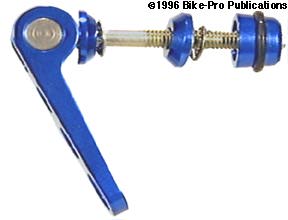
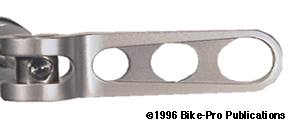
The RingleŽ seatpost lever is styled after the famous skewer set. It is made using aluminum and steel parts to develop a mechanically solid seat locking device. The lever is machined aluminum, that isdrilled with three distinctive holes to reduce the levers overall weight, then tumble polished to give it a smooth surface texture. Through the lever on the skewer end is a stainless steel rod that the skewer rod is threaded and bonded into. There are two aluminum washers that are lathe cut, to apply the pressure of the skewer closed, evenly on the seatpost clamp. A small volute spring assists in the seatpost bolt positioning, and makes the tension even as the lever is threaded onto the bike. The nut is cut on a lathe, drilled and threaded for the steel skewer rod. A small recess is cut into the nut at the half way point for an O-ring to seat, giving easy fingertip grip as you tighten the lever. RingleŽ seatpost levers come in two lengths, Standard and Long.
The reason for the Long bolt is frames with any of the oversized seat tubes will generally need a longer threaded rod. The largest distance the Standard skewer, (weighing 41 grams), will close on is 32mm, the smallest distance it will close on is 6mm. The largest distance the Long skewer, (weighing 43 grams), will close on is 42mm, the smallest distance it will close on is 6mm. The skewer may be shortened by marking and cutting the extra threaded rod length, then cleaning up the threads with a file afterward. The RinglŽ Cam Twist bolt is available with lever, washers, and nut anodized in Blue, Black, Red, or Silver. Made in USA.
No longer made, both versions sold for $16.99
This is exactly the same as the Long lever above, using the same parts and manufacturing techniques, with two exceptions. The lever section in the area of the holes has been milled away on the interior, so when it is closed there is a flush surface. The inside of the lever, (revealed when open), has roughly two thirds of the thickness milled away to reduce weight. Secondly, the threaded rod for this skewer is made of Titanium, also to reduce weight. This quick release lever is made only in the Long size, so it will fit all framesets.
The largest distance the Ti Stix Titanium skewer will close on is 42mm, the smallest distance it will close on is 13mm. The skewer may be shortened by marking and cutting the extra threaded rod length, then cleaning up the threads with a file afterward. Weighing 34.5 grams, the RinglŽ Ti Stix bolt is available with lever, washers, and nut anodized in Blue, Black, Camo-Green, Gold, Lavender, Red, or Silver. Made in USA.
No longer made, the lever sold for $24.99
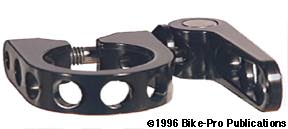
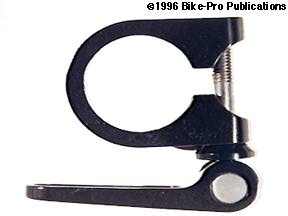
The Ti Stix Collar recognizes that some expensive framesets that come with oversized seat tubes, come with considerably "low tech" seat clamps. They are often just stamped out of steel, with a steel bolt, relying on you to upgrade to something that, up to now, hasn't existed.
This seatclamp is made of machined aluminum, which is drilled through, around the circumference, and has a Titanium pull-up rod for the clamp in the quick release seat bolt assembly. The Ti Stix lever is the same used in the Ti Stix quick release bolt, merely cut down, without the end fitting. The Titanium threaded rod is screwed into one side of the collar and remains fixed, while the lever slides through a drilled hole on the opposing side of the collar. The RinglŽ Ti Stix collar is made in three diameters to fit any frame. The standard 1 1/8" size used on most steel frames, a 1 1/4" size used on over sized steel, some Ti and aluminum frames, and a 1 3/8" diameter used on many aluminum and carbon fiber framesets. Generally the diameter of the seat clamp is the same as the front derailleur. The Ti Stix Collar weighs 41 grams in the 1 1/8" size, in the 1 1/4" size weighs 44 grams, and in the 1 3/8" size weighs 45 grams. The Ti Stix Collar is made in Black, Silver, Lavender, Blue, Red, Gold, or Green.
No longer made all three sizes sold for $42.99
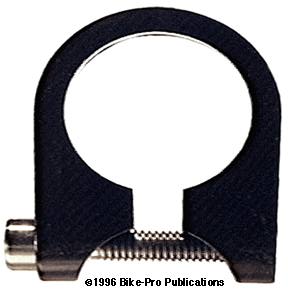
This is the clamp piece from above, but instead of a Ti Stix locking quick release lever, it has a fixed length Titanium bolt to cinch the clamp. The bolt is machined from Titanium 6Al-4V rod with a 6mm by 1.0mm thread pitch, and has a 5mm allen head fitting on the bolt head.
Again, the RinglŽe Collar with bolt is made in three diameters to fit any frame. The standard 1 1/8" size used on most steel frames, a 1 1/4" size used on over sized steel, some Ti and aluminum frames, and a 1 3/8" diameter used on many aluminum and carbon fiber framesets. The Ti Stix Collar in the 1 1/8" size weighs 22 grams, in the 1 1/4" size weighs 23 grams, and in the 1 3/8" size weighs 24 grams. The RingleŽ Collar with bolt is made in Black, Silver, Lavender, Blue, Red, Gold, or Green.
No longer made, Gonzo has stepped into to fill the East Coast gap for this type of part. It sold for $39.99