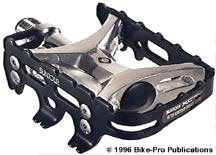
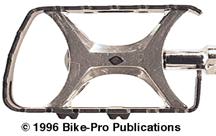
Suntour licensed, for their use, the Wilderness Trail Bikes Grease Guard system in the bearing systems of the XC Pro group of components. The Grease Guard system uses small holes to inject fresh grease into bearings that have a one-way purge seal on them ,permitting the old grease to flow to the outside of the bearings so it can be wiped off. The XP02 pedal uses this principle on the inner bearing only, but to be fair this is the bearing in a pedal that really bears the most load on a continual basis. The body of the pedal is cast aluminum that is barrel polished in liquid polishing compound to give a smooth outer surface. This cast body has been seen before, it's the same body that has been used for the Suntour Superbe Pro pedal for several years. All braces have holes for toe strap use and weight reduction. There is enough distance between the braces for a twist in the toe strap, so it will remain in a fixed position.
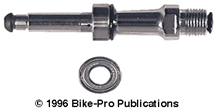
The spindle is made of forged Cro-moly steel, then chrome plated. The spindle is hollow with a 6mm allen head fitting at the thread end for easy installation. The areas where the bearings contact the spindle have been ground after plating, so they are extra smooth; the outer end of the spindle's interior has been tapped for a retaining bolt that holds the entire pedal assembly together. At a point 50mm from the thread end there is one small hole that leads to the interior of the spindle. It's through this hole, that fresh grease pumped into the threaded spindle end flows to reach the inner bearing assembly. A Black plastic seal and a sealed bearing cartridge, having nine ball bearings with the inner seal removed, is pressed onto the spindle so the open bearing side faces into the spindle hole. The position of these two parts is firmly fixed. There is a firm rubber seal, mounted in the interior of the body, that forces the pumped grease to migrate back into the open bearing to push the old grease out the one-way seal where it can be wiped off of the spindle near the crank. The outer bearing is a Japanese precision sealed cartridge bearing, labeled Nachi 968Z; it has no implementation of the Grease Guard principle, and is pressed into the aluminum body. The spindle with the inner bearing slides into the body and inner race of the outer bearing. They are held in place by a steel bolt threaded into the outer end, with a 4mm allen head that also seals the outer spindle end. An outrageously tight fitting Black plastic dust cap snaps over the outer end of the spindle into the body. A small rubber plug presses into the open threaded spindle end, closing it off. The cage is made of die cut aluminum plate and formed to shape. It is held onto the body with 7 nickel finished bolts that have 3mm allen head fittings. The body braces are tapped with the threads for the cage, so the bolts fit flush with the pedal. The cage has small square teeth at the front and broader square teeth at the rear, with two toe flips on the back bottom for easy toe clip use. The front of the cage has two holes for toe clips that are tapped with 5mm by .8mm thread pitch holes so the toe clip can bolt directly to the pedal without the use of nuts on the bolts. At the bottom of the body, there are two steel pins driven into the strap braces, so you can invert the pedal and use it without the toe clips. The body is Silver and the cage is a hard anodized Grey color. The weight of a pair of XC Pro Grease Guard pedals is 306 grams. Made in Japan. No longer made, we sold these for $69.99 a pair.
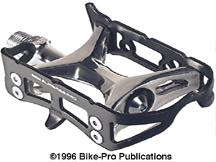
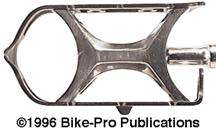
For several years this pedal has been the choice of serious Road Racing cyclists who don't use clipless pedals. The Suntour Superbe Pro pedals are similar to the XC Pro pedals, and use many of the same parts and construction style. The body is made as a single piece of cast aluminum, in fact it's the same body used in the XC Pro. Rather than a barrel finish polish, the body is polished on a buffing wheel leaving a smooth mirror finish. There are the same holes in the braces for toe strap and weight reduction. The spindle is the same one used for the XC Pro, cast of Cro-moly steel, hollow, chrome plated, ground bearing surface, with a 6mm hex fitting on the thread end.The interior of the outer end is threaded and it even has the Grease Guard hole in it, though it's not used on this pedal. The Superbe Pro pedal uses sealed bearing cartridges for both the inner and outer bearings of the pedal. The inner bearing is larger in diameter, because it carries more load, and is a Japanese Nachi 6800 LR bearing. The outer bearing is a Nachi 698NSE. Both bearings are pressed into the aluminum pedal body. A Black plastic dust cap is placed over the inner bearing and the spindle slides snugly through both bearings. At the outer side a Black plastic dust cap seals off the bearing, with a chromed bolt passing through into the tapped spindle end.
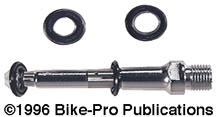
The cage is die cut from plate aluminum and formed to shape. The cage is held by the same 7 screws, in the same fashion as the XC Pro pedals. There is a single toe flip at the back bottom of the cage and there are two holes on the front for toe clip installation. The holes are tapped for bolts with a 5mm by .8mm thread pitch so the use of a nut to hold the clips on won't be necessary. Suntour includes a set of four chrome bolts with a 4mm allen head and four cadmium plated washers for toe clip installation. The body is Silver, the cage is Black, a pair of the Superbe Pro pedals without toe clip bolts and washers (11 grams), weighs 293 grams a pair. Made in Japan. No longer made, we sold these pedals for $94.99 a pair.