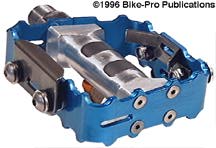
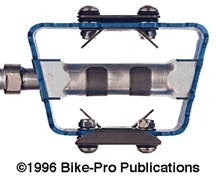
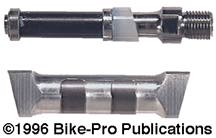
Many in the bike industry have come to believe that to introduce and manufacture a clipless pedal must necessarily require millions of dollars and a monstrous advertising campaign to establish a new pedal system. But what is really needed, is a fundamental understanding of what the cyclist really desires and needs for their cycling use, based on actual experience. This is why the Grafton pedals are so startling. These pedals are well conceived from experience, light, outrageously well machined, and simple in both their design and operation. Using aluminum construction with a Titanium spindle and sealed bearings, John Grafton has introduced a reversing clipless pedal made in the USA that rivals or blows away those made in France or Japan. The "body" of the pedal is the smallest we've seen, and is complexly machined from rectangular aluminum stock that is turned on a lathe to reduce the center diameter. The body is milled on the outside to recess two .7mm thick steel spring clips that cover 2/3 of the body's circumference. The spring clips prevent possible damage to the body by any contact with the clip. The body is bored with a graduating drill bit that leaves the body a thin walled casing for the spindle and bearings. The finished body weighs only 26 grams. The spindle is machined from Titanium 6Al- 4V rod, with a shoulder machined for the inner bearing to rest against. A Teflonª seal cut to follow the shape of the cage slides down the spindle, and a sealed bearing cartridge follows it is positioned against the shoulder. After the bearing, there is a 1 5/16" long Delrin tube that snugly fits the spindle and the outer bearing slides on behind it. The tube insures correct bearing spacing so the body will be loaded properly. The outer bearing, and the entire assembly, is held in place with a steel cir-clip at the end of the spindle, making the spindle and bearings a single complete cartridge type unit that weighs just 50 grams. This unit fits so well into the body that it makes a "pop" as the last bearing slides out of the body. The cage is made of die-cut plate aluminum. The eight holes for bolts that hold the cage to the body are drilled with a countersink so the bolts fit flush with the cage surface when installed. The cage is then formed to shape and buff polished on a wheel if they are to be Silver or anodized if they are colored cages. The cage fastens using the four countersunk screws with a 2mm allen head at each end of the body.
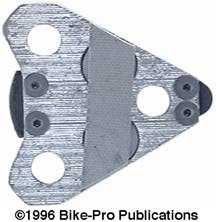
The Grafton pedals have a cleat retention system on the top and bottom of the pedal so you can clip into them regardless of what side is "up". The system uses a cleat machined from aluminum plate that has a round ended steel tip at the front and the back. The steel tip is given a rounded curve at the bottom to help locate it's position in the front retention system. The front cleat tip slides into a slot on the front retainer then downward pressure lock the rear tip into the rear retention system. The rear retainer is made of a steel plate with a rounded front that has a rearward "give". This 90¡ angled steel piece holds the rear tip down or "in". The release tension is adjustable on the rear retainer by tightening or loosening two bolts that squeeze two firm O-ring washers. Turning the bolts clockwise makes release more difficult. The Grafton pedal set comes with nylon grips, so you can walk, with traction, in the cleats. Also included is a small replacement parts kit and the tools necessary to work on the pedals. Each of the pedals, without cleats weighed exactly 171 grams with a pair weight of 342 grams. They included Silver cleat set with the mounting hardware weighs 62 grams. The cleats are compatible with shoes that have the standard two hole SPD compatible drilling. They are available with the body in Silver only, however the cages can be Blue, Black, 3DV (lavender), Red, or Silver. These were first manufactured during the "Sims period" when Benson Sims machine shop was used as the machining sub-contractor. No longer made they sold for $227.99
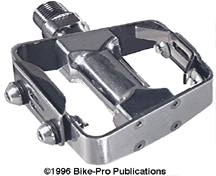
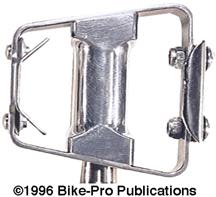
These are a downsized version of the Grafton Speedtrap pedals. The body is made using the same techniques but isn't as long, similarly the Titanium spindle and bearing stance is shorter. The cage is die-cut of sheet aluminum, like the Speedtrap but is much smaller without the teeth found on the mountain pedal cage. To give you a relative size between the two pedals, the rear cage width for the Speedlite is 2 11/16", while it is 3 3/8" on the Speedtrap. The pedal body and cage are highly polished on a polishing wheel. The Speedlite has just one cleat retention system mounted on the top, with the rear retainer and it's hardware made of steel. The Speedlite uses the same cleat as the Speedtrap. The Grafton pedal set comes with nylon grip inserts, so you can walk in the cleat. Also included is a small replacement parts kit and the tools necessary to work on the pedals. They are made in several anodized colors, the pair weighs just 262 grams, (without cleats). The included Silver cleat set with the mounting hardware weigh 62 grams. The cleats are compatible with shoes that have the standard two hole SPD Road compatible drilling. They were available with the body in Silver only, however the cages can be Blue, Black, Gun Metal Grey, 3DV (lavender), Red, or Silver. These were first manufactured when John and Cindy were still married before her meeting her future police officer boyfriend, during the "Sims period" when Benson Sims machine shop was used as the machining sub-contractor. No longer made, they sold for $227.99
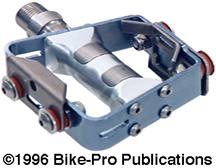
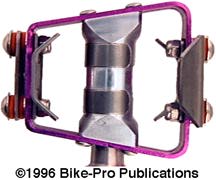
The Speedtrap Cross is the smaller Speedlite pedal with a cleat retention system mounted on the top, and the bottom. The Speedtrap Cross uses the same cleat system used in the Speedtrap and the Speedlite. The Speedtrap Cross pedals bring double sided entry to the light weight body, for use by Road, Cross, Hybrid, and mountain riders who want a smaller pedal surface, and don't need the toothed cage used on the Speedtrap pedals. The Cross pedal set comes with nylon grip inserts, so you can walk in the cleat. Also included is a small replacement parts kit and the tools necessary to work on the pedals. They are made in the several anodized colors, with a pair weight of just 319 1/2 grams, (without cleats). The included Silver cleat set with the mounting hardware weigh 62 grams. The cleats are compatible with shoes that have the standard two hole SPD compatible drilling. They were available with the body in Silver only, however the cages can be Blue, Black, 3DV (lavender), Red, or Silver. No longer made, they sold for $227.99