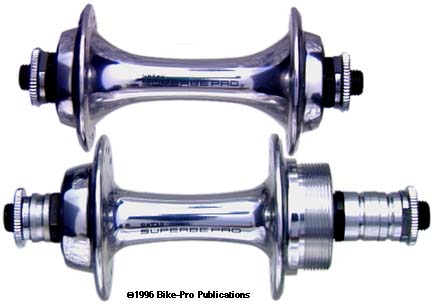
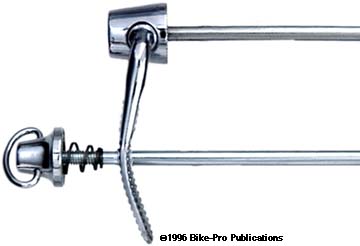
The Superbe Pro hubs are the longest mass produced pair of Road Racing hubs using precision sealed cartridge bearings. The hub shells are forged as a single piece of aluminum alloy, then polished to achieve a mirror like finish. The front hub is drilled through for the axle and bored from each side to recess for the bearing cartridge. The Japanese FWK 6001 RS bearings are used in both sides A thin Black steel dust cap covers and encloses the outer side of each cartridge bearing. A machined steel shoulder race threads down the hollow steel axle, butting squarely against the dust cap covering the bearing. A chrome plated lock nut cinches against both of the shoulder races. The rear hub is constructed uses the same principles. The alloy hub is drilled and bored for the axle and the two Japanese Nachi 6001NK sealed cartridge bearings. The threads for the freewheel are precisely cut after the polishing stage. The bearings are, again, shrouded by thin steel dust caps, held in place by machined steel shoulder races. The hollow Cro-moly axle is fitted with small steel and aluminum spacers to bring the axle set to it's full 130mm width. The final steel spacing nut on each axle are forged of steel, cut with precision to accept an adjusting cone wrench, polished and then chrome plated, so their serrated surfaces will have an enduring life. These hubs are simple, and elegant in their design, while being esthetically pleasing to the eye. Superbe Pro hubs come with quick release skewers made of forged and machined steel, which is then chrome-plated. Thoughtfully, the nut on the skewer has the classic revolving D-ring which provides positive finger grip and then swivels aerodynamically away. The volute spring for the nut is designed to be held, in a recessed lip, inside the nut, where it snaps in place and stays, making it difficult to drop or loose. The rear hub is threaded for English threaded 7 or 8 speed freewheels. There is also a freehub version of the rear hub available. It uses the Suntour 8 speed cassette cogs avaliable in our freewheel section. The pair that includes the freehub costs slightly more. The front hub has a 48mm hub flange diameter, with flanges spaced 65mm apart. The front spoke holes have a 38.5mm center circle diameter. The rear hub has a 53.5mm hub flange diameter, with flanges spaced 54mm apart. The rear spoke holes have a 45mm center circle diameter. With skewer, the front weighs 242 grams, (skewer is 81.5 grams, lighter because of the plastic cap). The Freewheel rear with skewer, and without cogs, weighs 299.5 grams, (skewer 86 grams). The Freehub cassette rear with skewer, and without cogs, weighs 465.5 grams, (skewer 86 grams). The front hub requires a thin 13mm cone wrench and a separate thin 14mm cone wrench to work on. You will need the same two 13mm cone wrenches to work on the rear hub. The hubs are available in 28, 32 or 36 hole drilling, matched the way you want. No longer made the freewheel version of the pair sold for $139.99 and the freehub style pair sold for $159.99
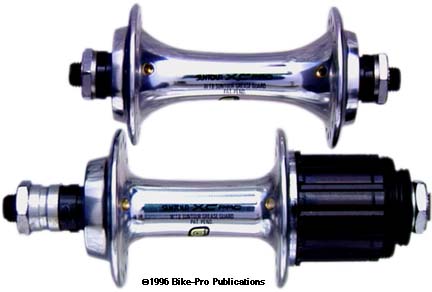
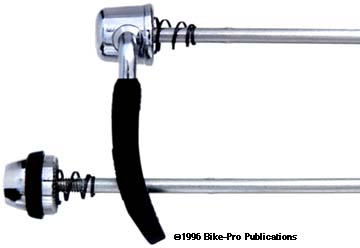
The XC PRO hubset employs the Wilderness Trail Bike's GreaseGuard bearing concept to provide trouble free, low maintenance use over a long life. XC PRO hubs begin with a one- piece, forged, aluminum hub shell. The front hub shell is drilled through for the axle, then bored from each side to recess the bearing cartridges. The hub shell is high polished, leaving a mirror-like finish. The bearings are the Japanese IKS 6001RS that have been modified, so that outer seals yield slightly near the axle which allows older grease to be pushed through in the area around the axle, to the outside where it can be conveniently wiped away, without wheel removal. A small "Zerk" type fitting inside each hub flange permits grease to be injected into the backside of the bearing. The rear seal has been modified to permit grease to pass through the back toward the front. This same feature exists to re-lubricate the drive side bearings of the freehub body itself. The hollow axles are made of Cro-moly steel, a machined shoulder positions the axle and which is locked in place by a nickel plated lock nut that has a serrated face. The freehub design of the rear uses a 135mm length axle, and is compatible with the 8 speed Suntour cassettes sold in the freewheel section of this book The hubset comes with quick release axle skewers, that are made of cast, and machined steel. The skewers use an internal cam that constricts to close and lock the wheel onto the bike. The skewer nut has a depression molded into it that a wide, flat, O-ring lays into, giving an easy finger grip for the adjusting nut. Additionally, the volute spring for the adjusting nut is made to snap into the nut, and be held by it, so it's less likely to be lost accidentally. The skewer lever has broad plastic sleeve fit over it, giving the user an easy grip. The front hub has a 48mm hub flange diameter, with 65mm spaced flanges. The front spoke holes have a 38.5mm center circle diameter. The rear hub has a 53.5mm hub flange diameter, with flanges spaced 54mm apart. The rear spoke holes have a 45mm center circle diameter. With skewer, the front weighs 243.5 grams, (skewer is 84.5 grams, lighter because of the plastic cap). The Freehub cassette rear with skewer, and without cogs, weighs 460 grams, (skewer 90 grams). The front hub requires a thin 13mm cone wrench and an adjustable wrench to work on. The rear hub requires the same tools. The hubs are available in 32 or 36 hole drilling, matched the way you want. No longer made the front sold for $49.99, the rear sold for $104.99 and there was a pair price of $144.99