Archival Review of Suntour Cranks
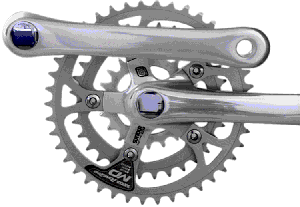
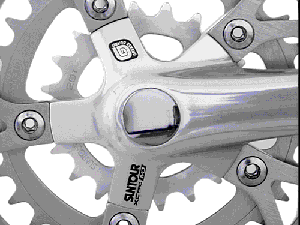
SUNTOUR XC PRO MICRO DRIVE CRANKSET
This is the crankset that started the compact crank/drive train revolution. The XC Pro MD arms are both cold forged for Suntour in the Sugino cold forging facility, (who you may remember makes the Ritchey and Specialized cranks sets as well as the Sugino brand name). SR/Suntour's forging facility is capable only of Impression die forging which they refer to as "Accurad." The arms are received from Sugino and are then hand polished and Silver (clear) anodized. The arms are 32.5mm wide at the pedal spindle, and remains at roughly a 25.4mm width through the length. The left arm is 37.25mm wide at the B/B spindle. The arms of the spider on the right arm are just 103mm across. The XC Pro MD cranks come with three round chainrings. The middle and outer made of "grey" anodized aluminum, while the inner 20 tooth chainring is made of stainless steel for long life. The aluminum rings are die cut from 3.5mm aluminum plate, and then turned on a lathe to taper the backside for easy chain engagement, and to taper the teeth precisely to fit current narrow chains. The outer chainring has an anti-jam pin driven into the perimeter at the crank arm. The mid/outer and inner fixing bolts are made of nickel plated steel with a 5mm hex head fitting for ease of removal. The XC Pro Micro Drive cranks come with chrome plated, snap-in plastic crank arm caps, which will be needed if you elect not to use the XC Pro Grease Guard B/B. These cranks will work with any 2 degree tapered spindle bottom bracket. We found the XC Pro MD cranks has a Bike-Pro Q measurement of 158mm. XC Pro Micro Drive cranks are made in 170mm, 175mm, or 177.5mm lengths with 20-32-42 tooth chainrings. XC Pro Micro Drive cranks come as right arm, left arm, three chainrings, all the required fixing bolts and the plastic crank arm caps. XC Pro Micro Drive 175mm cranks with 20- 32-42 chainrings, with all included parts, weigh 647 grams. When ordering specify length. These are no longer made. In 1994 we sold them for $159.99
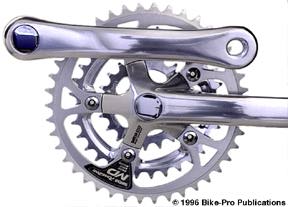
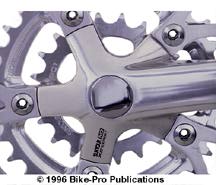
SUNTOUR XC EXPERT MICRO DRIVE CRANKSET
XC Expert MD and XC Pro Micro Drive are styled similarly and have the same properties of reduced weight from using a scaled down drive train. The technical explanation of how Micro Drive differs from a conventional drive train can be read in the overview. All compact drive principles apply to the XC Expert MD cranks. The difference between the two is XC Expert MD cranks are Accurad forged by SR/Suntour, then X-ray analyzed for defects, while the XC Pro MD arms are cold forged by Sugino. The XC Expert also has a steel middle chainring. The XC Expert arms are polished after forging and then Silver (clear) anodized. The XC Expert MD cranks come with three round chainrings. The same outer one used on the XC Pro model, however this is Silver anodized rather than the "hard anodized" grey color that are on the XC Pro. This aluminum ring is cut from 3.5mm aluminum plate and the turned on a lathe to taper the backside for easy chain engagement, and to precisely taper the teeth to fit current narrow chains. The outer chainring has an anti-jam pin driven into the perimeter, at the crank arm. The middle and inner chainrings are made of die cut stainless steel, for extended life. All of the fixing bolts are made of nickel plated steel and have a 5mm hex head fitting for easy removal. The XC Expert MD crankset comes with chrome plated, plastic snap-in crank arm caps. These cranks will work with any 2 degree tapered spindle bottom bracket. We found the XC Expert MD cranks had a Bike-Pro Q measurement of 159mm. XC Expert Micro Drive cranks are made in 170mm, or 175mm lengths with 20-32-42 tooth chainrings. XC Expert Micro Drive cranks come as right arm, left arm, three chainrings, the fixing bolts, and crank arm caps. XC Expert MD 170mm cranks with 20-32-42 chainrings, with all included parts, weigh 717.5 grams. When ordering specify length. These are no longer made, in 1994 we sold them for $129.99